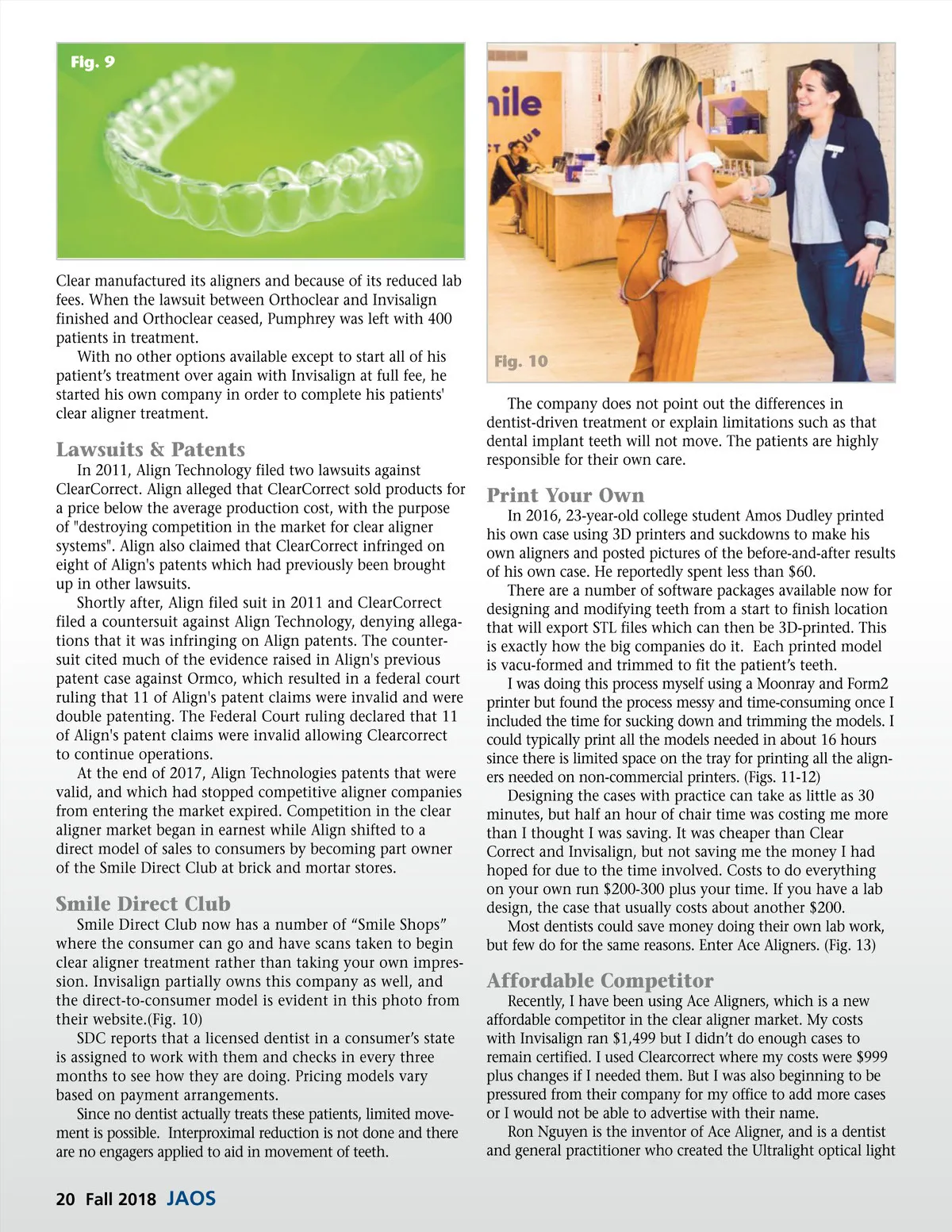
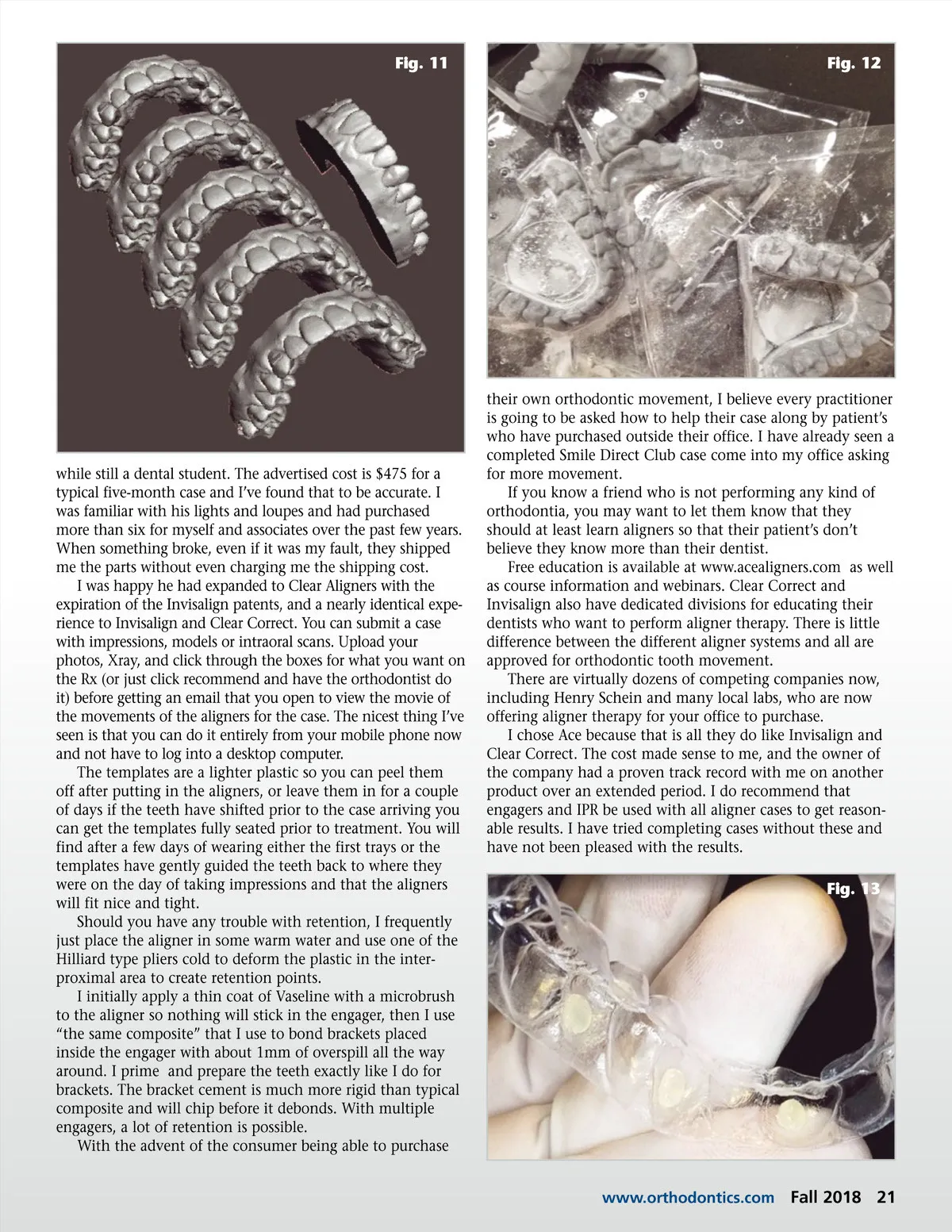
Fig. 9 Clear manufactured its aligners and because of its reduced lab fees. When the lawsuit between Orthoclear and Invisalign finished and Orthoclear ceased, Pumphrey was left with 400 patients in treatment. With no other options available except to start all of his patient’s treatment over again with Invisalign at full fee, he started his own company in order to complete his patients' clear aligner treatment. Fig. 10 The company does not point out the differences in dentist-driven treatment or explain limitations such as that dental implant teeth will not move. The patients are highly responsible for their own care. Lawsuits & Patents In 2011, Align Technology filed two lawsuits against ClearCorrect. Align alleged that ClearCorrect sold products for a price below the average production cost, with the purpose of "destroying competition in the market for clear aligner systems". Align also claimed that ClearCorrect infringed on eight of Align's patents which had previously been brought up in other lawsuits. Shortly after, Align filed suit in 2011 and ClearCorrect filed a countersuit against Align Technology, denying allega-tions that it was infringing on Align patents. The counter-suit cited much of the evidence raised in Align's previous patent case against Ormco, which resulted in a federal court ruling that 11 of Align's patent claims were invalid and were double patenting. The Federal Court ruling declared that 11 of Align's patent claims were invalid allowing Clearcorrect to continue operations. At the end of 2017, Align Technologies patents that were valid, and which had stopped competitive aligner companies from entering the market expired. Competition in the clear aligner market began in earnest while Align shifted to a direct model of sales to consumers by becoming part owner of the Smile Direct Club at brick and mortar stores. Print Your Own In 2016, 23-year-old college student Amos Dudley printed his own case using 3D printers and suckdowns to make his own aligners and posted pictures of the before-and-after results of his own case. He reportedly spent less than $60. There are a number of software packages available now for designing and modifying teeth from a start to finish location that will export STL files which can then be 3D-printed. This is exactly how the big companies do it. Each printed model is vacu-formed and trimmed to fit the patient’s teeth. I was doing this process myself using a Moonray and Form2 printer but found the process messy and time-consuming once I included the time for sucking down and trimming the models. I could typically print all the models needed in about 16 hours since there is limited space on the tray for printing all the align-ers needed on non-commercial printers. (Figs. 11-12) Designing the cases with practice can take as little as 30 minutes, but half an hour of chair time was costing me more than I thought I was saving. It was cheaper than Clear Correct and Invisalign, but not saving me the money I had hoped for due to the time involved. Costs to do everything on your own run $200-300 plus your time. If you have a lab design, the case that usually costs about another $200. Most dentists could save money doing their own lab work, but few do for the same reasons. Enter Ace Aligners. (Fig. 13) Smile Direct Club Smile Direct Club now has a number of “Smile Shops” where the consumer can go and have scans taken to begin clear aligner treatment rather than taking your own impres-sion. Invisalign partially owns this company as well, and the direct-to-consumer model is evident in this photo from their website.(Fig. 10) SDC reports that a licensed dentist in a consumer’s state is assigned to work with them and checks in every three months to see how they are doing. Pricing models vary based on payment arrangements. Since no dentist actually treats these patients, limited move-ment is possible. Interproximal reduction is not done and there are no engagers applied to aid in movement of teeth. Affordable Competitor Recently, I have been using Ace Aligners, which is a new affordable competitor in the clear aligner market. My costs with Invisalign ran $1,499 but I didn’t do enough cases to remain certified. I used Clearcorrect where my costs were $999 plus changes if I needed them. But I was also beginning to be pressured from their company for my office to add more cases or I would not be able to advertise with their name. Ron Nguyen is the inventor of Ace Aligner, and is a dentist and general practitioner who created the Ultralight optical light 20 Fall 2018 JAOS
Journal of the American Orthodontic Society Fall 2018: Page 20