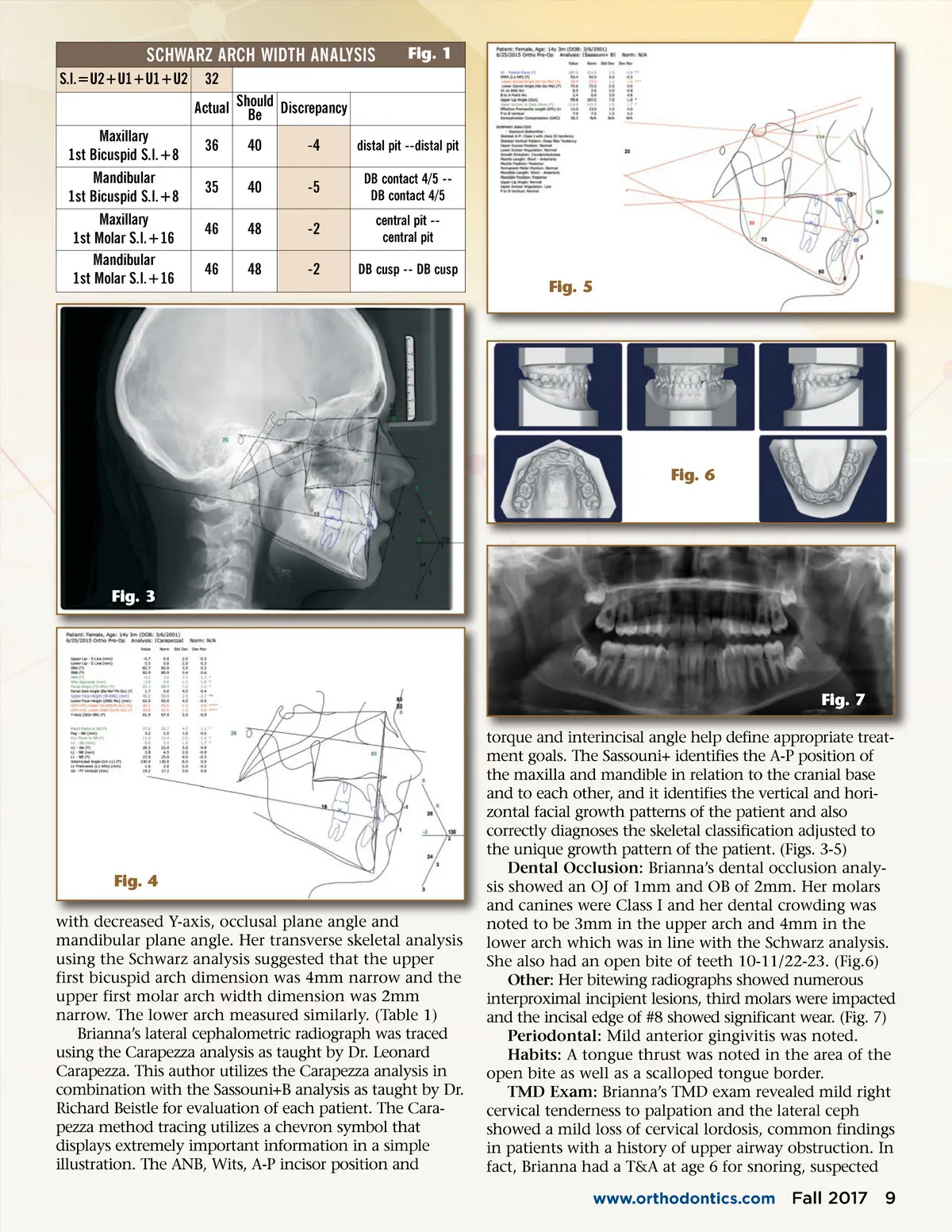
INNOVATIVE APPLIANCES: Arch Development with TransForce 2 Transverse By Jeff Dahm, DDS rthodontic diagnosis is a complex process in which many factors must be analyzed and interpreted for the development of a correct treatment plan. Skeletal analysis must be made in the sagittal, transverse and vertical dimensions with an understanding of the growth direction of the growing patient. Dental occlusion is then classified with overjet and overbite, while canine and molar clas-sifications are noted in addition to the amount of dental crowding in the upper and lower arches. Other dental factors such as attrition, caries risk, impactions and direction of eruption of unerupted permanent teeth are taken into account. Periodontal health and biotype are noted. Dysfunctional habits such as lip sucking, tongue thrusting and finger sucking, etc. are taken into consideration. A thorough TMD examina-tion should also be made that includes evaluation of the TMJs, muscles of mastication, cervical structures and any associated headaches, pain or dysfunction and range of motion of the mandible are noted. The upper airway structures should be evaluated as well for signs of upper airway obstruction (UAO) as this has an effect on facial growth and development as well as sleep and general health. A sleep history of the patient is impor-tant as many patients are at high risk for obstructive sleep apnea and orthodontic treatment options can be O chosen that will be a benefit rather than increase the risk for OSA. Finally, the age of the patient and stage of growth and development is important to assess. The Schwarz Analysis 1 is a simple analysis of the transverse dimension of the upper and lower dental arches in the first bicuspid and first molar areas. An arch width index measurement (SI index) is determined by taking the sum of the mesial to distal widths of the upper permanent incisors and extrapolating estimated arch width dimensions needed for uncrowding the dentition. Estimates can be made for unerupted upper permanent incisors during the mixed dentition or in cases of congenitally missing upper lateral incisors. The SI index can also be adjusted for the brachycephalic and dolichocephalic patient. (Figs.1 & 2) One must also consider an arch width index as an approximation rather than a specific goal as numerous arti-cles suggest that different ethnic populations have tooth size variation making an exact index difficult to apply to all patients. 2 However, it is a useful tool in treatment plan-ning and helping the clinician decide how much arch width development may be necessary for a patient with dental arch constriction and a crowded dentition. Skeletal Analysis: Brianna presented for orthodontic evaluation of her dental crowding at age 14.3. Her CVS classification at examination was stage 4, indicating that the peak in mandibular growth had occurred within 1 to 2 years before this stage. 3 Her skeletal anal-ysis in the sagittal dimension showed a Class III tendency with an ANB of 0 and Wits of -5.6mm, with SNA and SNB at 83 respectively. Her vertical skeletal analysis showed a counterclockwise growth pattern Fig. 1 Fig. 2 8 Fall 2017 JAOS
Journal of the American Orthodontic Society Fall 2017: Page 8