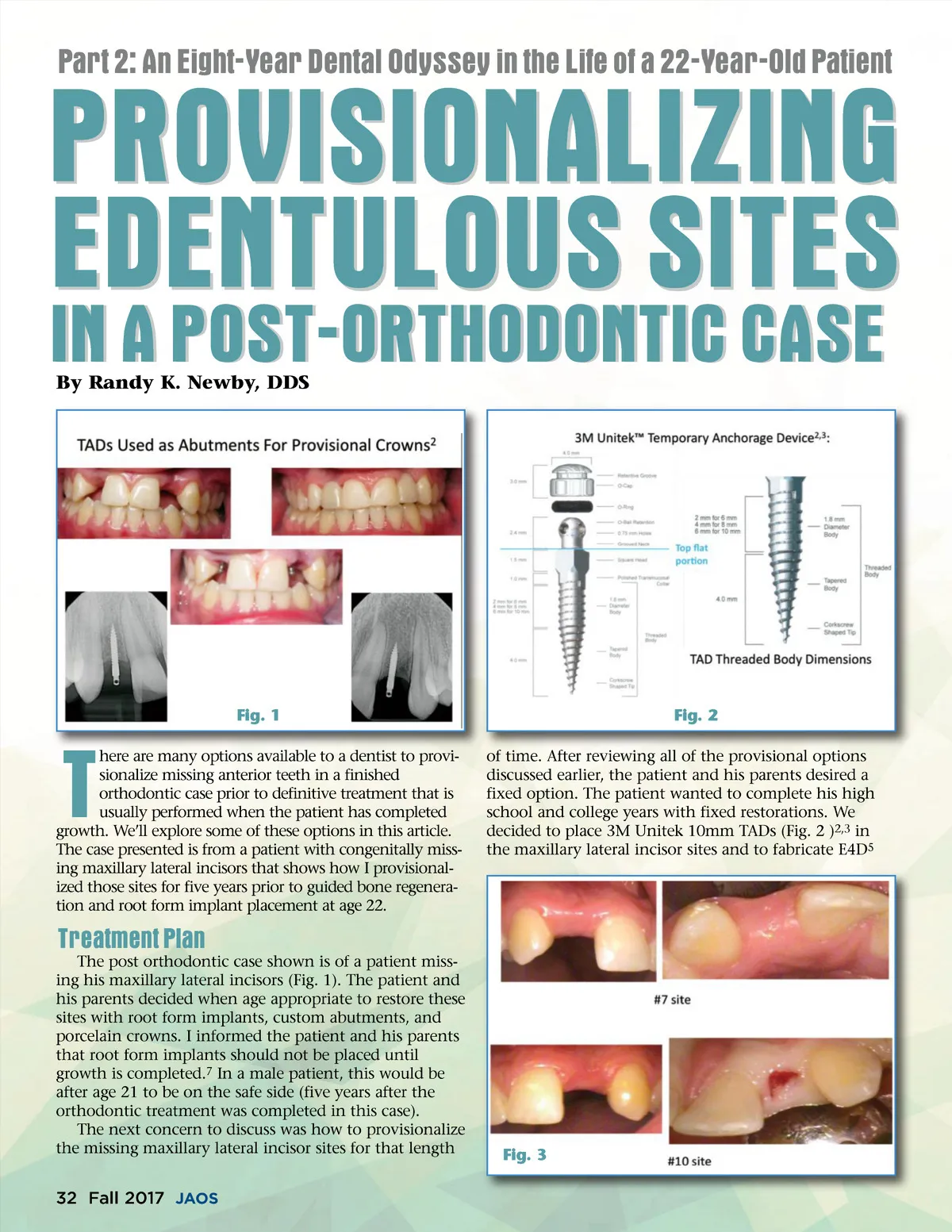
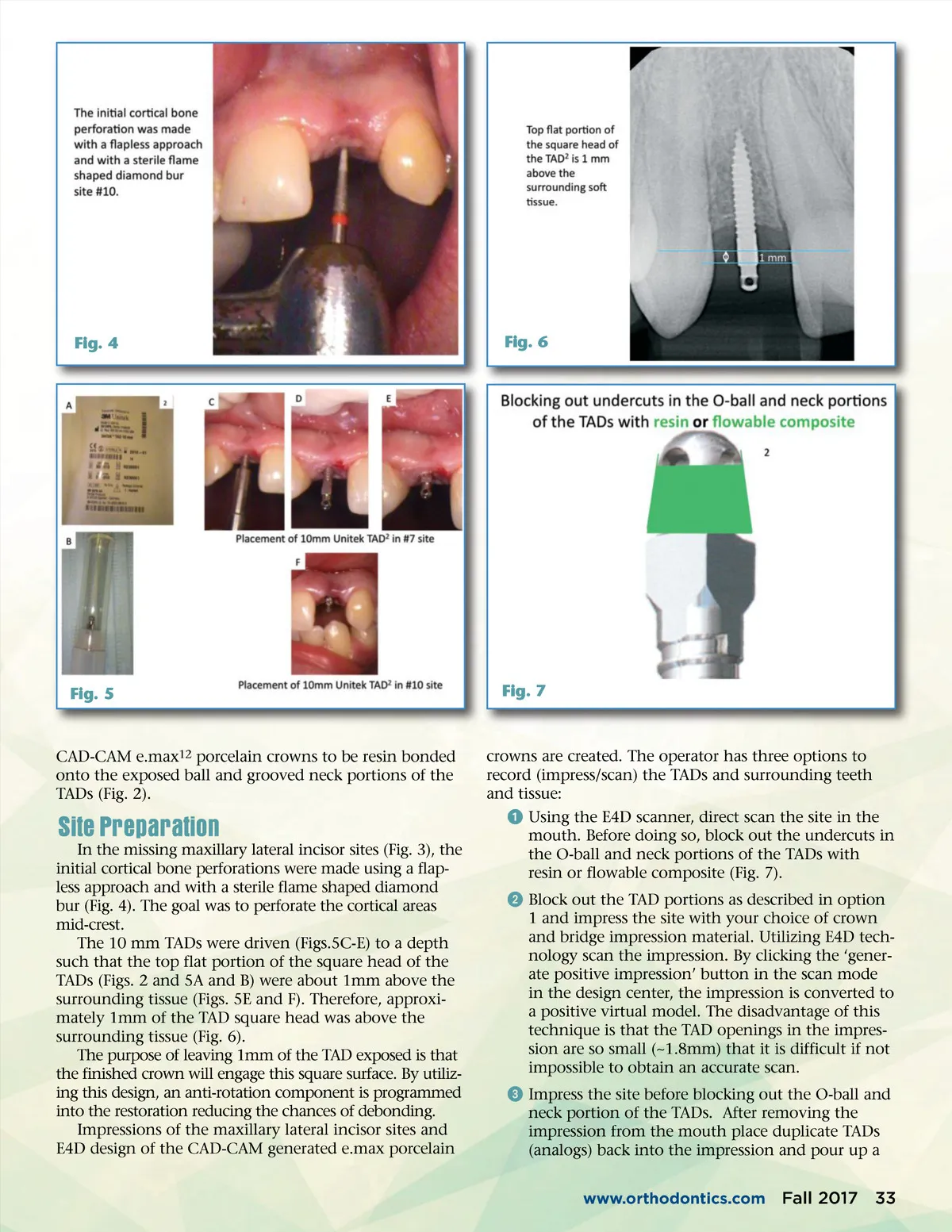
Fig. 4 Fig. 6 Fig. 5 Fig. 7 CAD-CAM e.max 12 porcelain crowns to be resin bonded onto the exposed ball and grooved neck portions of the TADs (Fig. 2). Site Preparation In the missing maxillary lateral incisor sites (Fig. 3), the initial cortical bone perforations were made using a flap-less approach and with a sterile flame shaped diamond bur (Fig. 4). The goal was to perforate the cortical areas mid-crest. The 10 mm TADs were driven (Figs.5C-E) to a depth such that the top flat portion of the square head of the TADs (Figs. 2 and 5A and B) were about 1mm above the surrounding tissue (Figs. 5E and F). Therefore, approxi-mately 1mm of the TAD square head was above the surrounding tissue (Fig. 6). The purpose of leaving 1mm of the TAD exposed is that the finished crown will engage this square surface. By utiliz-ing this design, an anti-rotation component is programmed into the restoration reducing the chances of debonding. Impressions of the maxillary lateral incisor sites and E4D design of the CAD-CAM generated e.max porcelain crowns are created. The operator has three options to record (impress/scan) the TADs and surrounding teeth and tissue: ᕡ Using the E4D scanner, direct scan the site in the mouth. Before doing so, block out the undercuts in the O-ball and neck portions of the TADs with resin or flowable composite (Fig. 7). ᕢ Block out the TAD portions as described in option 1 and impress the site with your choice of crown and bridge impression material. Utilizing E4D tech-nology scan the impression. By clicking the ‘gener-ate positive impression’ button in the scan mode in the design center, the impression is converted to a positive virtual model. The disadvantage of this technique is that the TAD openings in the impres-sion are so small (~1.8mm) that it is difficult if not impossible to obtain an accurate scan. ᕣ Impress the site before blocking out the O-ball and neck portion of the TADs. After removing the impression from the mouth place duplicate TADs (analogs) back into the impression and pour up a www.orthodontics.com Fall 2017 33
Journal of the American Orthodontic Society Fall 2017: Page 33