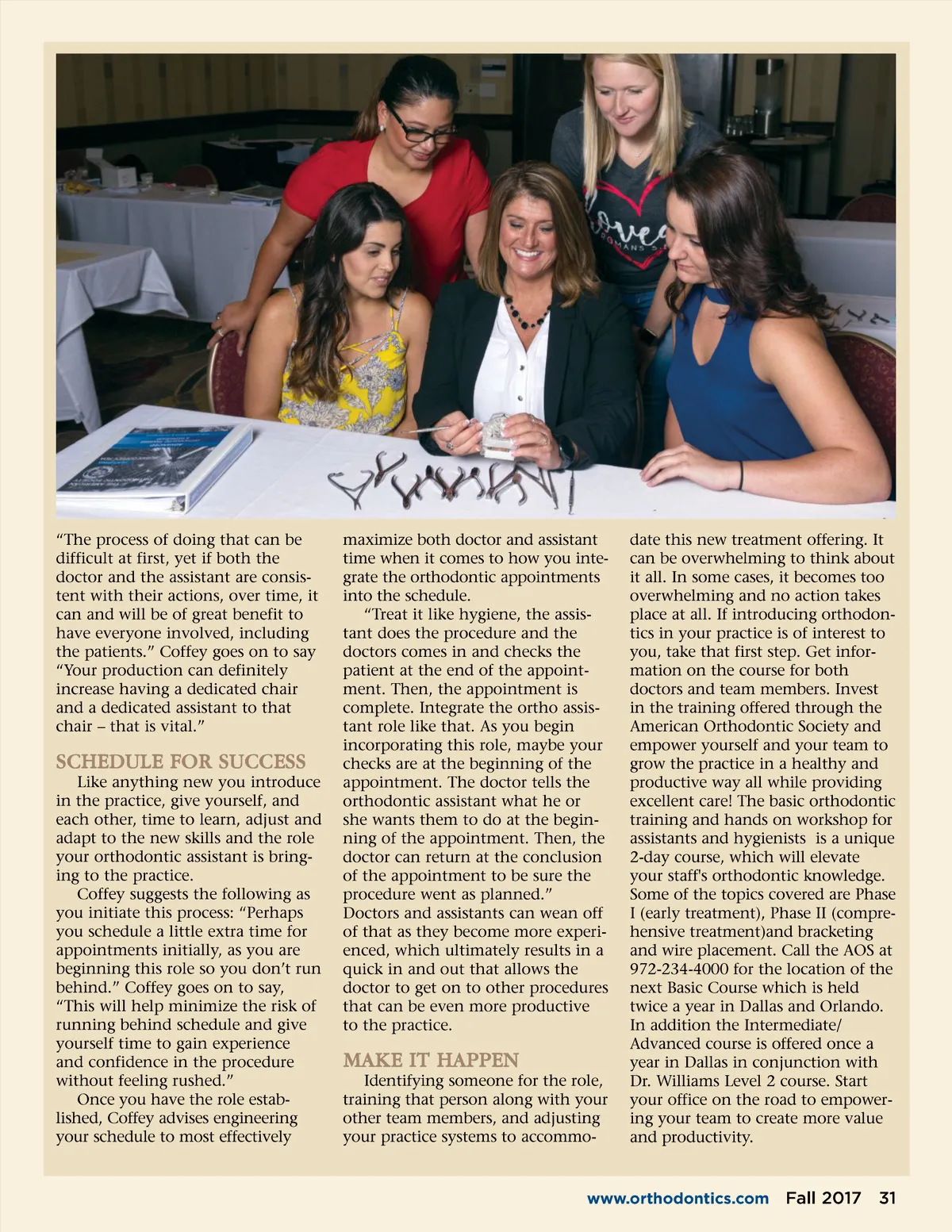
“The process of doing that can be difficult at first, yet if both the doctor and the assistant are consis-tent with their actions, over time, it can and will be of great benefit to have everyone involved, including the patients.” Coffey goes on to say “Your production can definitely increase having a dedicated chair and a dedicated assistant to that chair – that is vital.” SCHEDULE FOR SUCCESS Like anything new you introduce in the practice, give yourself, and each other, time to learn, adjust and adapt to the new skills and the role your orthodontic assistant is bring-ing to the practice. Coffey suggests the following as you initiate this process: “Perhaps you schedule a little extra time for appointments initially, as you are beginning this role so you don’t run behind.” Coffey goes on to say, “This will help minimize the risk of running behind schedule and give yourself time to gain experience and confidence in the procedure without feeling rushed.” Once you have the role estab-lished, Coffey advises engineering your schedule to most effectively maximize both doctor and assistant time when it comes to how you inte-grate the orthodontic appointments into the schedule. “Treat it like hygiene, the assis-tant does the procedure and the doctors comes in and checks the patient at the end of the appoint-ment. Then, the appointment is complete. Integrate the ortho assis-tant role like that. As you begin incorporating this role, maybe your checks are at the beginning of the appointment. The doctor tells the orthodontic assistant what he or she wants them to do at the begin-ning of the appointment. Then, the doctor can return at the conclusion of the appointment to be sure the procedure went as planned.” Doctors and assistants can wean off of that as they become more experi-enced, which ultimately results in a quick in and out that allows the doctor to get on to other procedures that can be even more productive to the practice. MAKE IT HAPPEN Identifying someone for the role, training that person along with your other team members, and adjusting your practice systems to accommo-date this new treatment offering. It can be overwhelming to think about it all. In some cases, it becomes too overwhelming and no action takes place at all. If introducing orthodon-tics in your practice is of interest to you, take that first step. Get infor-mation on the course for both doctors and team members. Invest in the training offered through the American Orthodontic Society and empower yourself and your team to grow the practice in a healthy and productive way all while providing excellent care! The basic orthodontic training and hands on workshop for assistants and hygienists is a unique 2-day course, which will elevate your staff's orthodontic knowledge. Some of the topics covered are Phase I (early treatment), Phase II (compre-hensive treatment)and bracketing and wire placement. Call the AOS at 972-234-4000 for the location of the next Basic Course which is held twice a year in Dallas and Orlando. In addition the Intermediate/ Advanced course is offered once a year in Dallas in conjunction with Dr. Williams Level 2 course. Start your office on the road to empower-ing your team to create more value and productivity. www.orthodontics.com Fall 2017 31
Journal of the American Orthodontic Society Fall 2017: Page 31