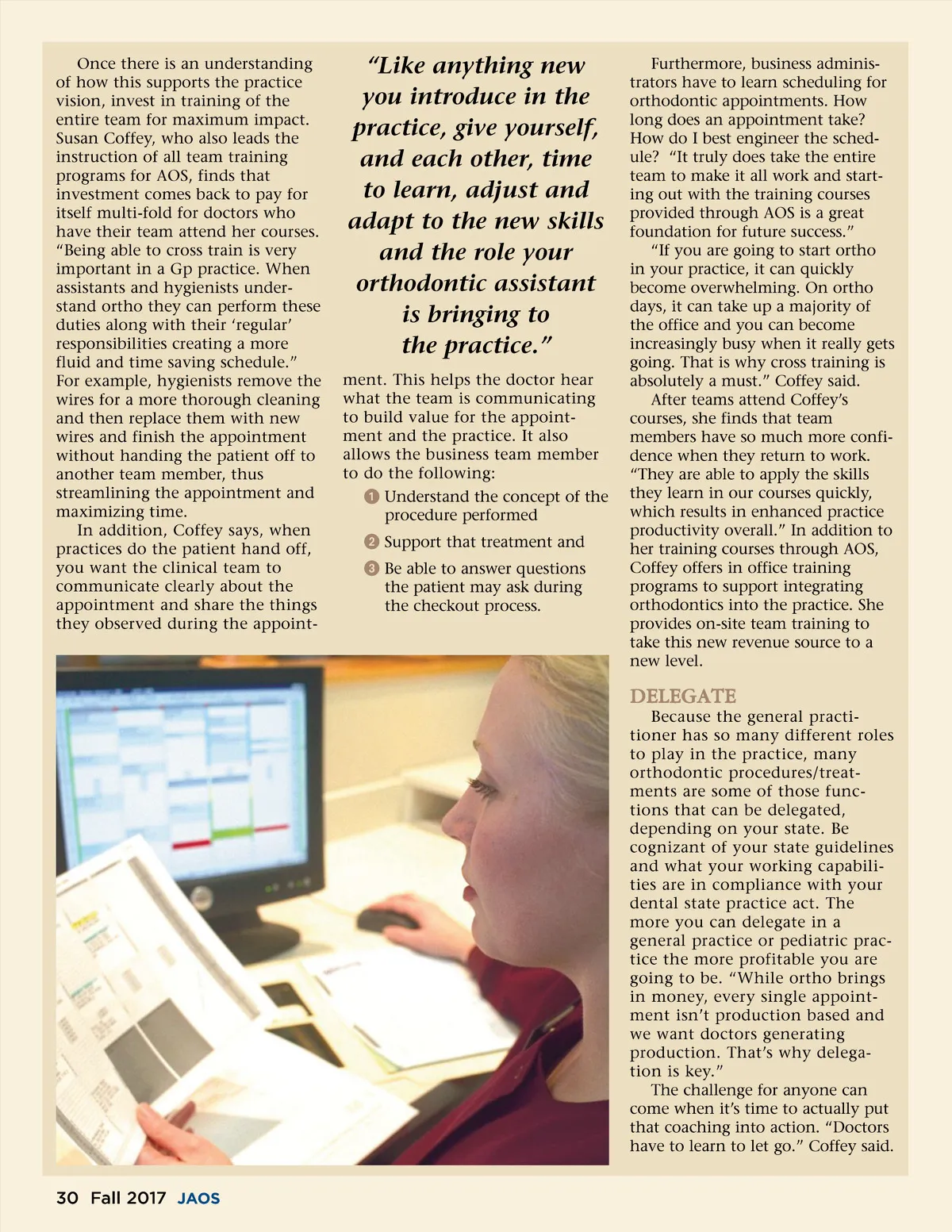
Once there is an understanding of how this supports the practice vision, invest in training of the entire team for maximum impact. Susan Coffey, who also leads the instruction of all team training programs for AOS, finds that investment comes back to pay for itself multi-fold for doctors who have their team attend her courses. “Being able to cross train is very important in a Gp practice. When assistants and hygienists under-stand ortho they can perform these duties along with their ‘regular’ responsibilities creating a more fluid and time saving schedule.” For example, hygienists remove the wires for a more thorough cleaning and then replace them with new wires and finish the appointment without handing the patient off to another team member, thus streamlining the appointment and maximizing time. In addition, Coffey says, when practices do the patient hand off, you want the clinical team to communicate clearly about the appointment and share the things they observed during the appoint-“Like anything new you introduce in the practice, give yourself, and each other, time to learn, adjust and adapt to the new skills and the role your orthodontic assistant is bringing to the practice.” ment. This helps the doctor hear what the team is communicating to build value for the appoint-ment and the practice. It also allows the business team member to do the following: ᕡ Understand the concept of the procedure performed ᕢ Support that treatment and ᕣ Be able to answer questions the patient may ask during the checkout process. Furthermore, business adminis-trators have to learn scheduling for orthodontic appointments. How long does an appointment take? How do I best engineer the sched-ule? “It truly does take the entire team to make it all work and start-ing out with the training courses provided through AOS is a great foundation for future success.” “If you are going to start ortho in your practice, it can quickly become overwhelming. On ortho days, it can take up a majority of the office and you can become increasingly busy when it really gets going. That is why cross training is absolutely a must.” Coffey said. After teams attend Coffey’s courses, she finds that team members have so much more confi-dence when they return to work. “They are able to apply the skills they learn in our courses quickly, which results in enhanced practice productivity overall.” In addition to her training courses through AOS, Coffey offers in office training programs to support integrating orthodontics into the practice. She provides on-site team training to take this new revenue source to a new level. DELEGATE Because the general practi-tioner has so many different roles to play in the practice, many orthodontic procedures/treat-ments are some of those func-tions that can be delegated, depending on your state. Be cognizant of your state guidelines and what your working capabili-ties are in compliance with your dental state practice act. The more you can delegate in a general practice or pediatric prac-tice the more profitable you are going to be. “While ortho brings in money, every single appoint-ment isn’t production based and we want doctors generating production. That’s why delega-tion is key.” The challenge for anyone can come when it’s time to actually put that coaching into action. “Doctors have to learn to let go.” Coffey said. 30 Fall 2017 JAOS
Journal of the American Orthodontic Society Fall 2017: Page 30