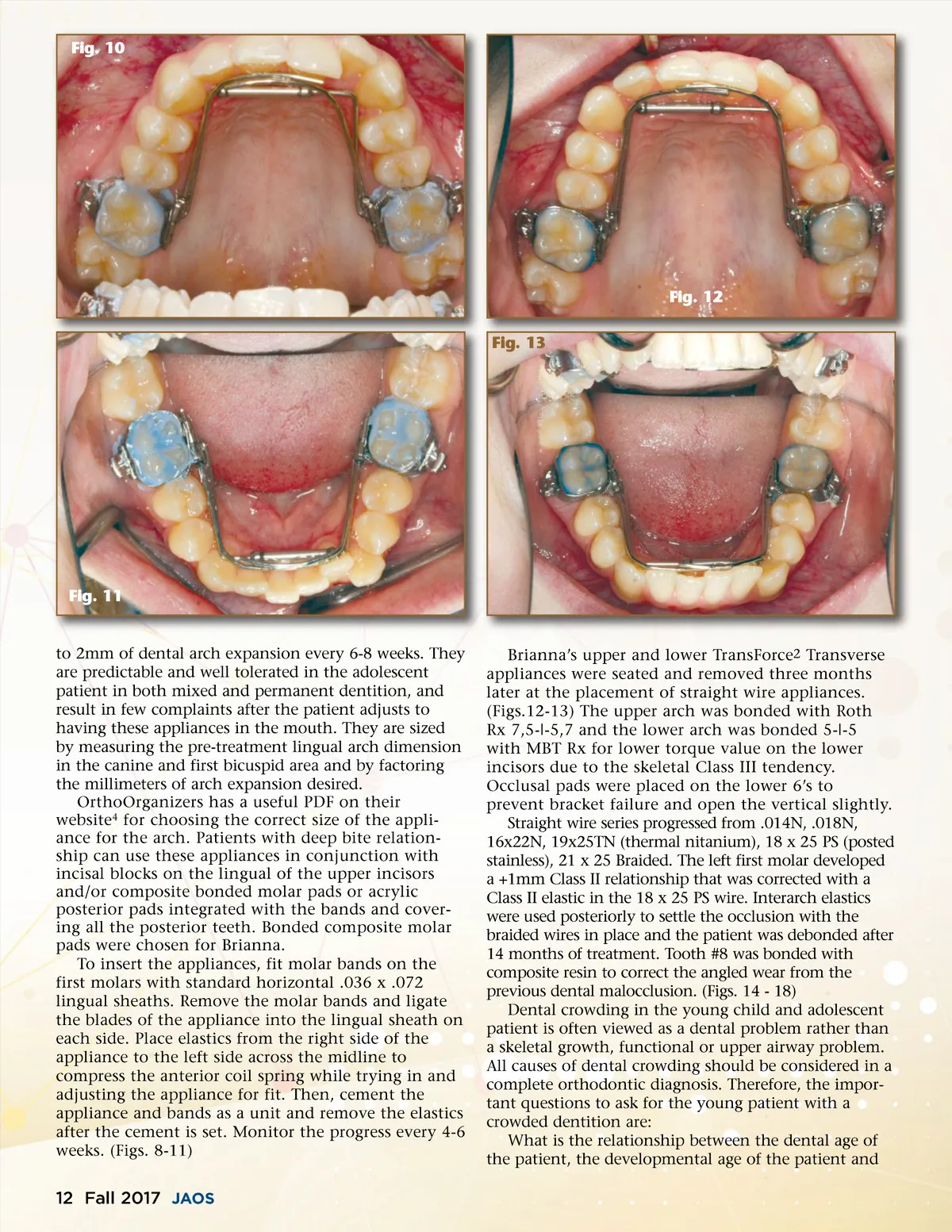
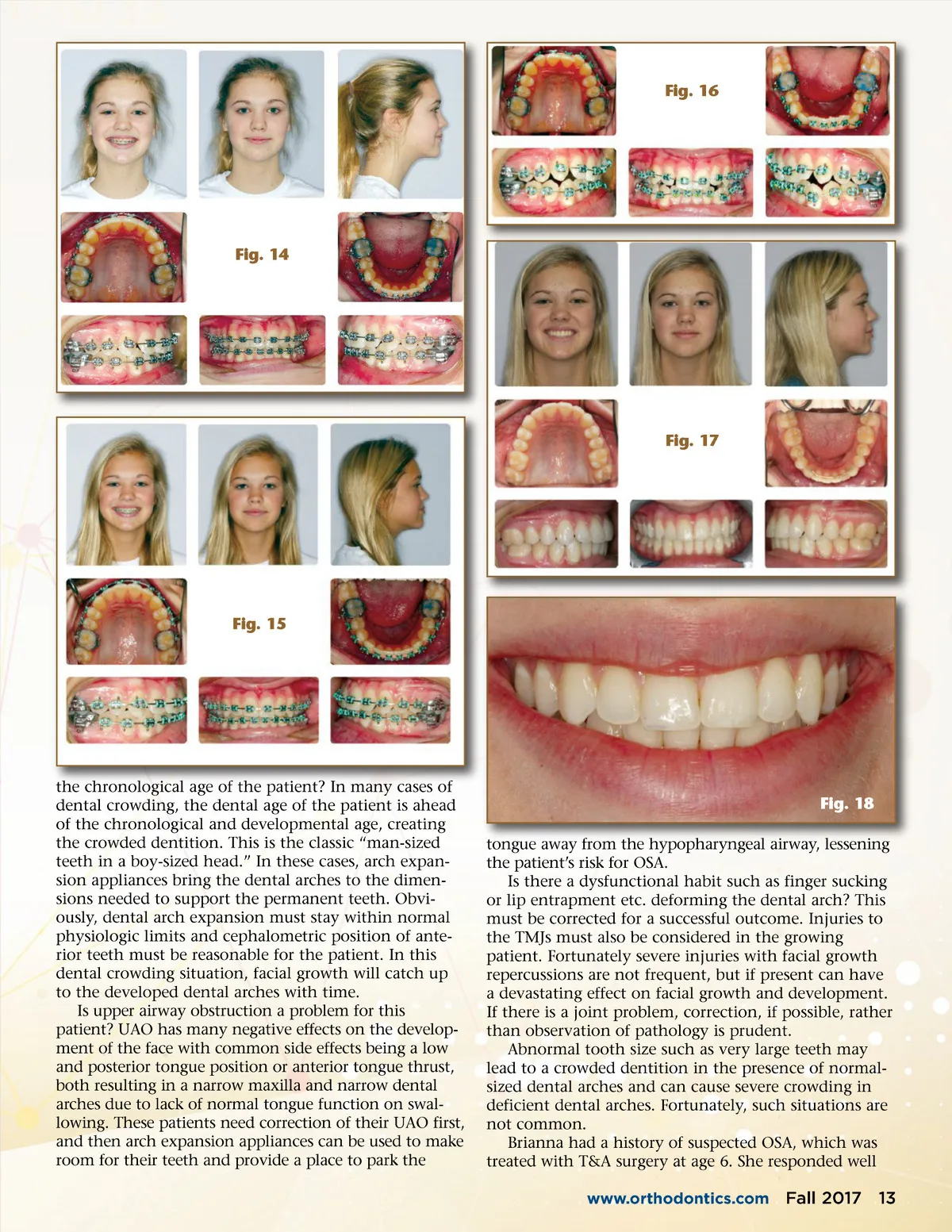
Fig. 16 Fig. 14 Fig. 17 Fig. 15 the chronological age of the patient? In many cases of dental crowding, the dental age of the patient is ahead of the chronological and developmental age, creating the crowded dentition. This is the classic “man-sized teeth in a boy-sized head.” In these cases, arch expan-sion appliances bring the dental arches to the dimen-sions needed to support the permanent teeth. Obvi-ously, dental arch expansion must stay within normal physiologic limits and cephalometric position of ante-rior teeth must be reasonable for the patient. In this dental crowding situation, facial growth will catch up to the developed dental arches with time. Is upper airway obstruction a problem for this patient? UAO has many negative effects on the develop-ment of the face with common side effects being a low and posterior tongue position or anterior tongue thrust, both resulting in a narrow maxilla and narrow dental arches due to lack of normal tongue function on swal-lowing. These patients need correction of their UAO first, and then arch expansion appliances can be used to make room for their teeth and provide a place to park the Fig. 18 tongue away from the hypopharyngeal airway, lessening the patient’s risk for OSA. Is there a dysfunctional habit such as finger sucking or lip entrapment etc. deforming the dental arch? This must be corrected for a successful outcome. Injuries to the TMJs must also be considered in the growing patient. Fortunately severe injuries with facial growth repercussions are not frequent, but if present can have a devastating effect on facial growth and development. If there is a joint problem, correction, if possible, rather than observation of pathology is prudent. Abnormal tooth size such as very large teeth may lead to a crowded dentition in the presence of normal-sized dental arches and can cause severe crowding in deficient dental arches. Fortunately, such situations are not common. Brianna had a history of suspected OSA, which was treated with T&A surgery at age 6. She responded well www.orthodontics.com Fall 2017 13
Journal of the American Orthodontic Society Fall 2017: Page 13