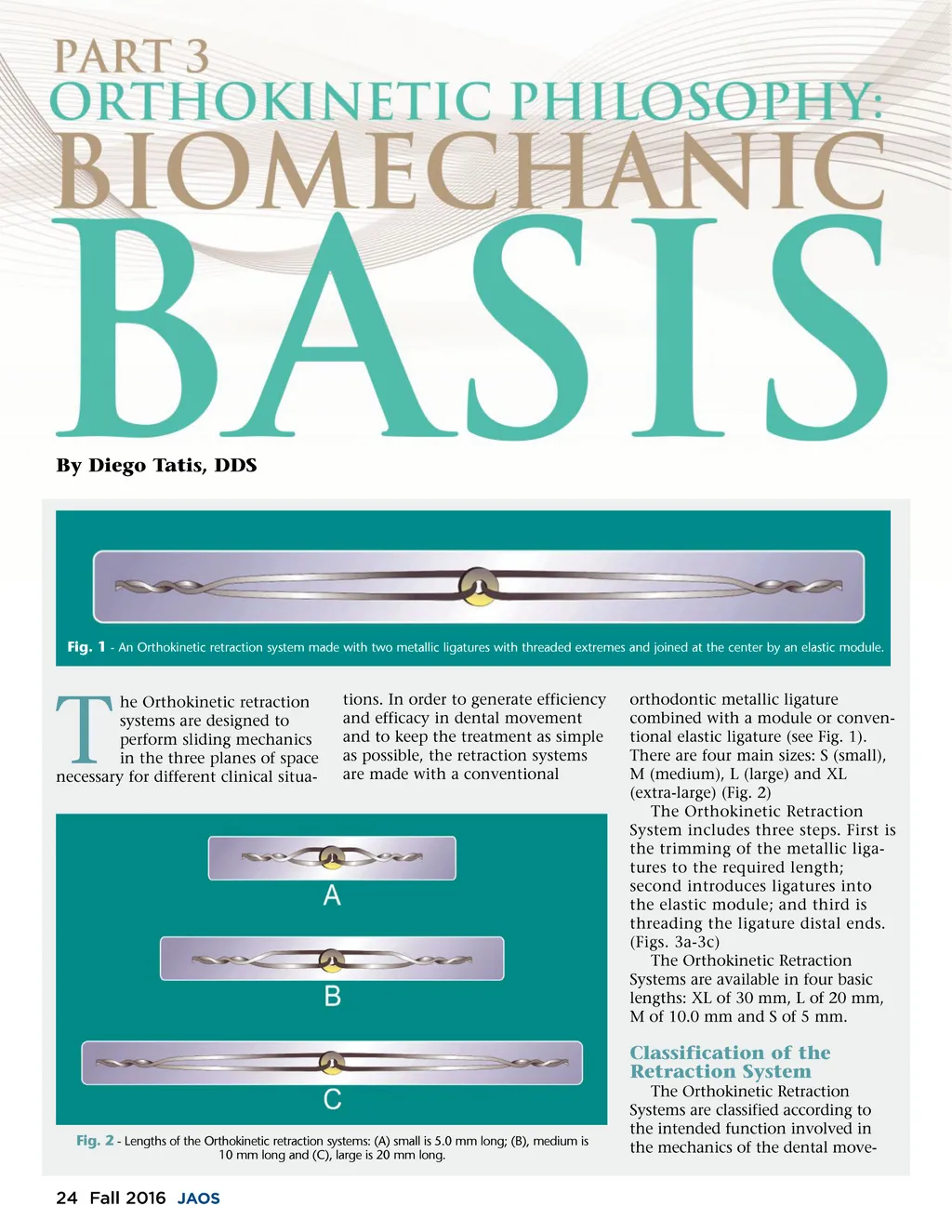
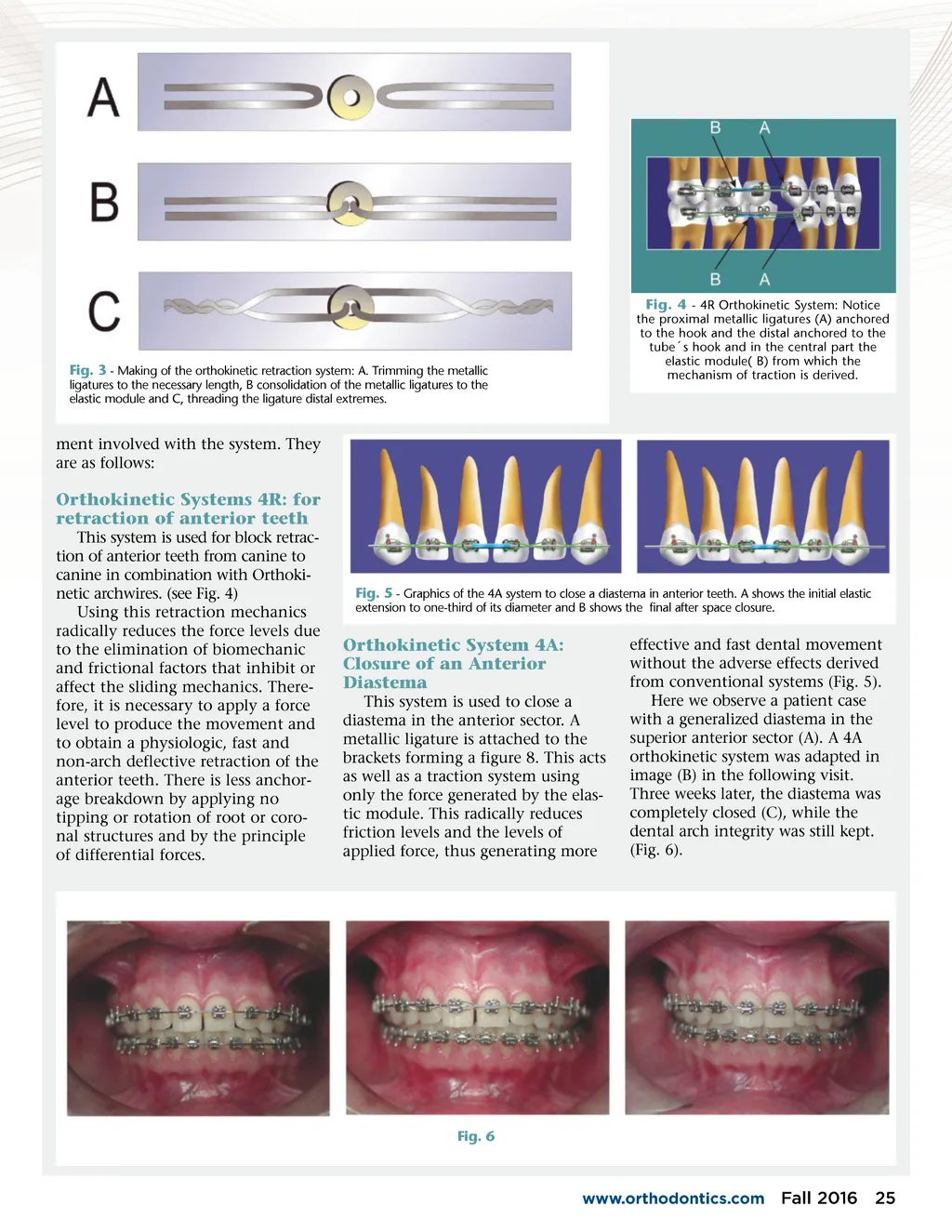
By Diego Tatis, DDS Fig. 1 -An Orthokinetic retraction system made with two metallic ligatures with threaded extremes and joined at the center by an elastic module. T he Orthokinetic retraction systems are designed to perform sliding mechanics in the three planes of space necessary for different clinical situa-tions. In order to generate efficiency and efficacy in dental movement and to keep the treatment as simple as possible, the retraction systems are made with a conventional orthodontic metallic ligature combined with a module or conven-tional elastic ligature (see Fig. 1). There are four main sizes: S (small), M (medium), L (large) and XL (extra-large) (Fig. 2) The Orthokinetic Retraction System includes three steps. First is the trimming of the metallic liga-tures to the required length; second introduces ligatures into the elastic module; and third is threading the ligature distal ends. (Figs. 3a-3c) The Orthokinetic Retraction Systems are available in four basic lengths: XL of 30 mm, L of 20 mm, M of 10.0 mm and S of 5 mm. Classification of the Retraction System The Orthokinetic Retraction Systems are classified according to the intended function involved in the mechanics of the dental move-Fig. 2 -Lengths of the Orthokinetic retraction systems: (A) small is 5.0 mm long; (B), medium is 10 mm long and (C), large is 20 mm long. 24 Fall 2016 JAOS
Journal of the American Orthodontic Society Fall 2016: Page 24