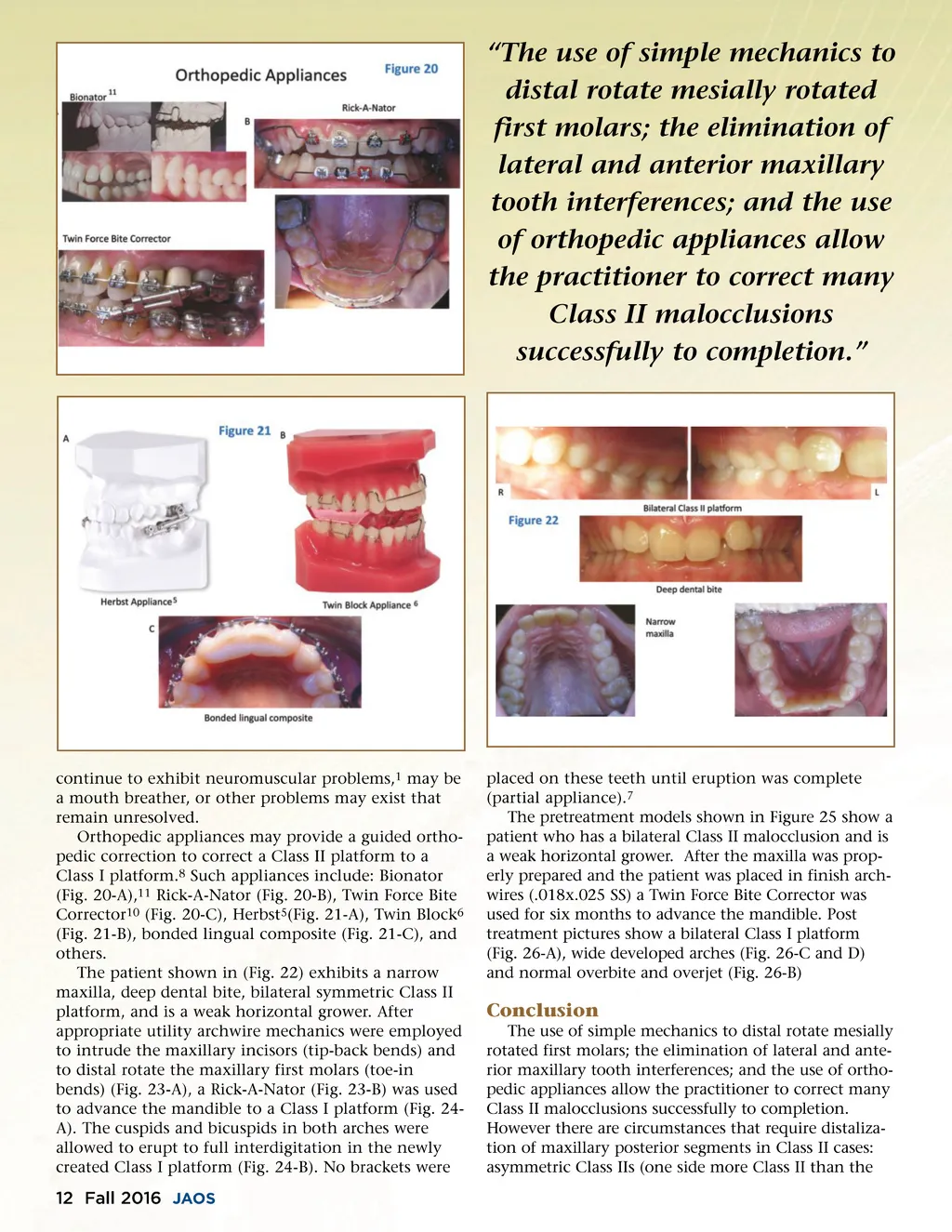
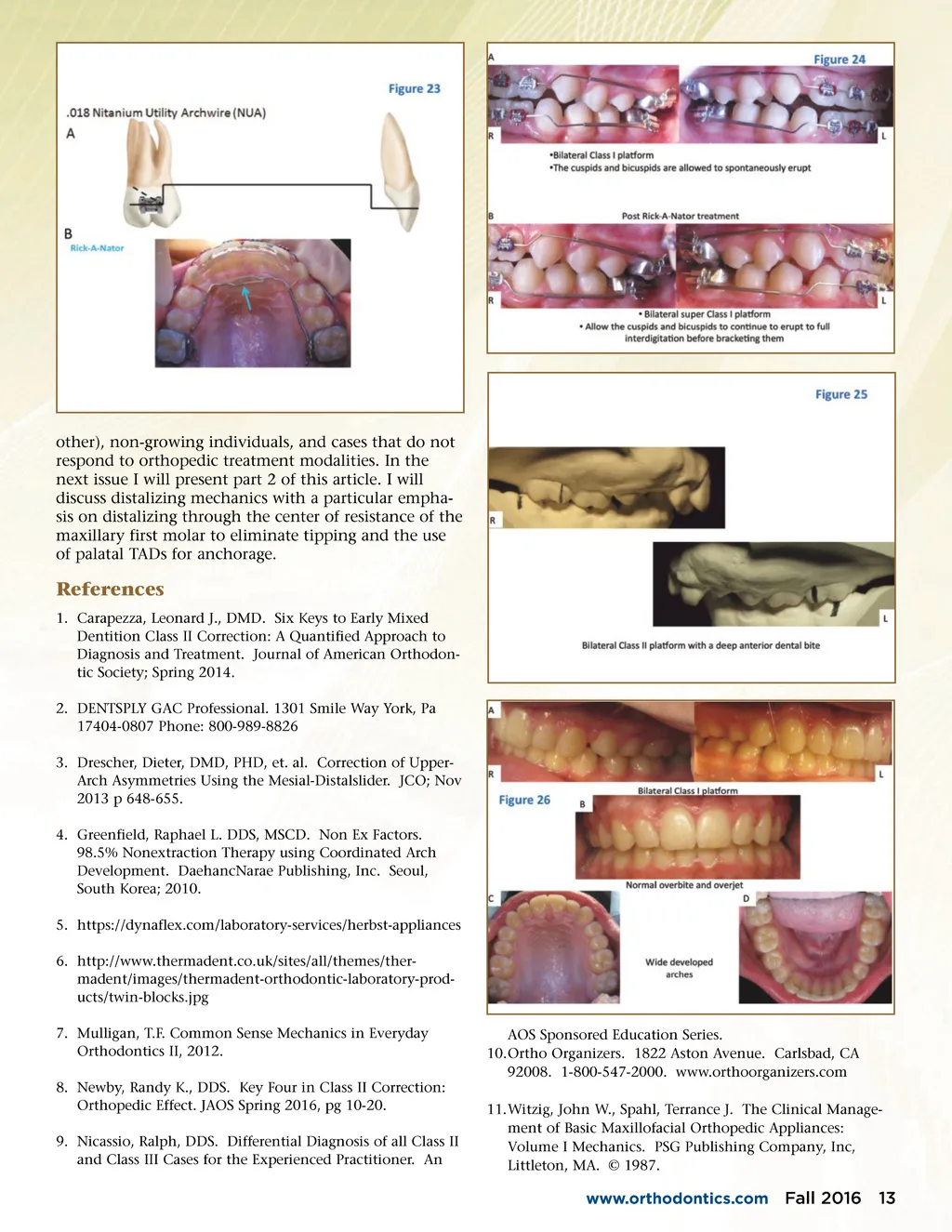
“The use of simple mechanics to distal rotate mesially rotated first molars; the elimination of lateral and anterior maxillary tooth interferences; and the use of orthopedic appliances allow the practitioner to correct many Class II malocclusions successfully to completion.” continue to exhibit neuromuscular problems, 1 may be a mouth breather, or other problems may exist that remain unresolved. Orthopedic appliances may provide a guided ortho-pedic correction to correct a Class II platform to a Class I platform. 8 Such appliances include: Bionator (Fig. 20-A), 11 Rick-A-Nator (Fig. 20-B), Twin Force Bite Corrector 10 (Fig. 20-C), Herbst 5 (Fig. 21-A), Twin Block 6 (Fig. 21-B), bonded lingual composite (Fig. 21-C), and others. The patient shown in (Fig. 22) exhibits a narrow maxilla, deep dental bite, bilateral symmetric Class II platform, and is a weak horizontal grower. After appropriate utility archwire mechanics were employed to intrude the maxillary incisors (tip-back bends) and to distal rotate the maxillary first molars (toe-in bends) (Fig. 23-A), a Rick-A-Nator (Fig. 23-B) was used to advance the mandible to a Class I platform (Fig. 24-A). The cuspids and bicuspids in both arches were allowed to erupt to full interdigitation in the newly created Class I platform (Fig. 24-B). No brackets were placed on these teeth until eruption was complete (partial appliance). 7 The pretreatment models shown in Figure 25 show a patient who has a bilateral Class II malocclusion and is a weak horizontal grower. After the maxilla was prop-erly prepared and the patient was placed in finish arch-wires (.018x.025 SS) a Twin Force Bite Corrector was used for six months to advance the mandible. Post treatment pictures show a bilateral Class I platform (Fig. 26-A), wide developed arches (Fig. 26-C and D) and normal overbite and overjet (Fig. 26-B) Conclusion The use of simple mechanics to distal rotate mesially rotated first molars; the elimination of lateral and ante-rior maxillary tooth interferences; and the use of ortho-pedic appliances allow the practitioner to correct many Class II malocclusions successfully to completion. However there are circumstances that require distaliza-tion of maxillary posterior segments in Class II cases: asymmetric Class IIs (one side more Class II than the 12 Fall 2016 JAOS
Journal of the American Orthodontic Society Fall 2016: Page 12