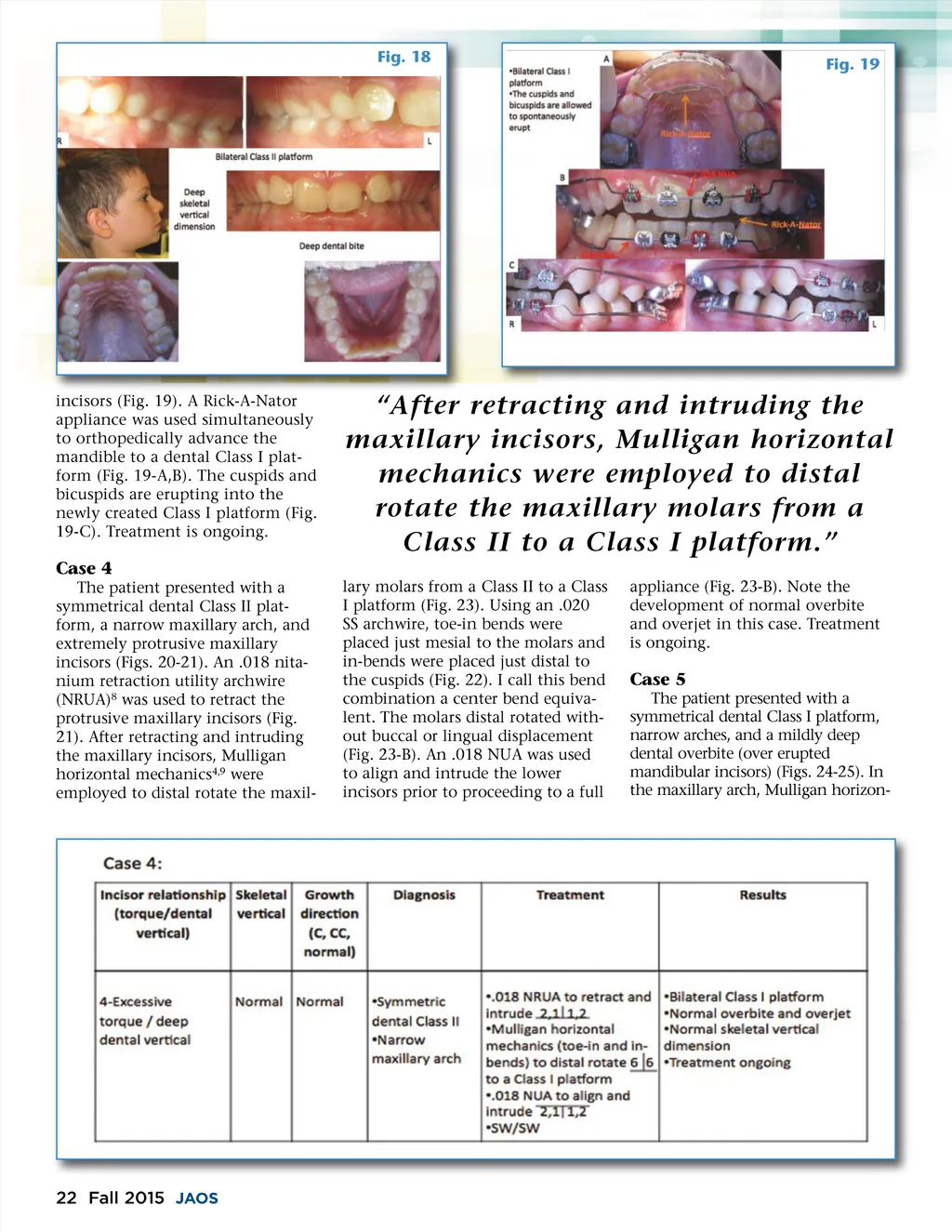
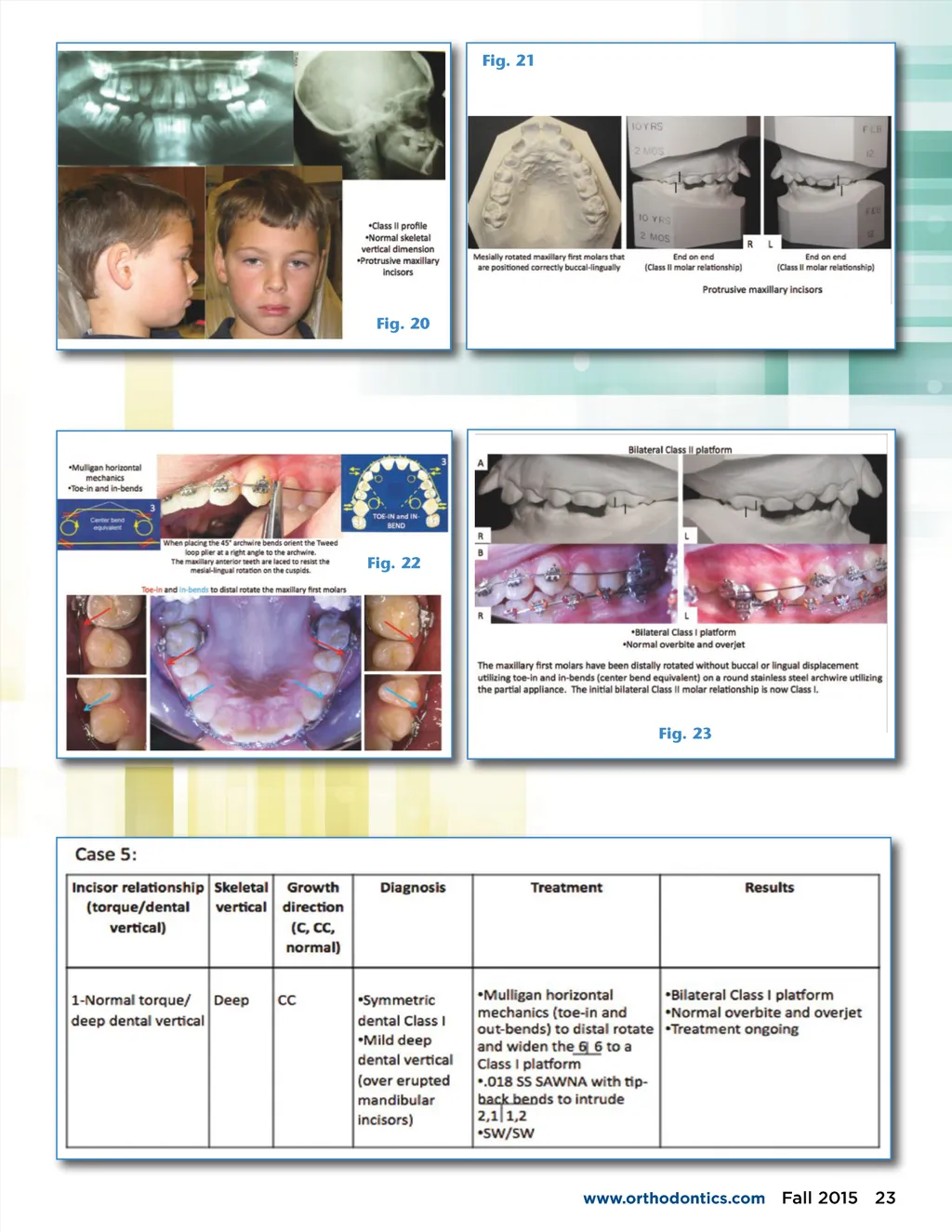
Fig. 18 Fig. 19 incisors (Fig. 19). A Rick-A-Nator appliance was used simultaneously to orthopedically advance the mandible to a dental Class I plat-form (Fig. 19-A,B). The cuspids and bicuspids are erupting into the newly created Class I platform (Fig. 19-C). Treatment is ongoing. “After retracting and intruding the maxillary incisors, Mulligan horizontal mechanics were employed to distal rotate the maxillary molars from a Class II to a Class I platform.” lary molars from a Class II to a Class I platform (Fig. 23). Using an .020 SS archwire, toe-in bends were placed just mesial to the molars and in-bends were placed just distal to the cuspids (Fig. 22). I call this bend combination a center bend equiva-lent. The molars distal rotated with-out buccal or lingual displacement (Fig. 23-B). An .018 NUA was used to align and intrude the lower incisors prior to proceeding to a full appliance (Fig. 23-B). Note the development of normal overbite and overjet in this case. Treatment is ongoing. Case 4 The patient presented with a symmetrical dental Class II plat-form, a narrow maxillary arch, and extremely protrusive maxillary incisors (Figs. 20-21). An .018 nita-nium retraction utility archwire (NRUA) 8 was used to retract the protrusive maxillary incisors (Fig. 21). After retracting and intruding the maxillary incisors, Mulligan horizontal mechanics 4,9 were employed to distal rotate the maxil-Case 5 The patient presented with a symmetrical dental Class I platform, narrow arches, and a mildly deep dental overbite (over erupted mandibular incisors) (Figs. 24-25). In the maxillary arch, Mulligan horizon-22 Fall 2015 JAOS
Journal of the American Orthodontic Society Fall 2015: Page 22