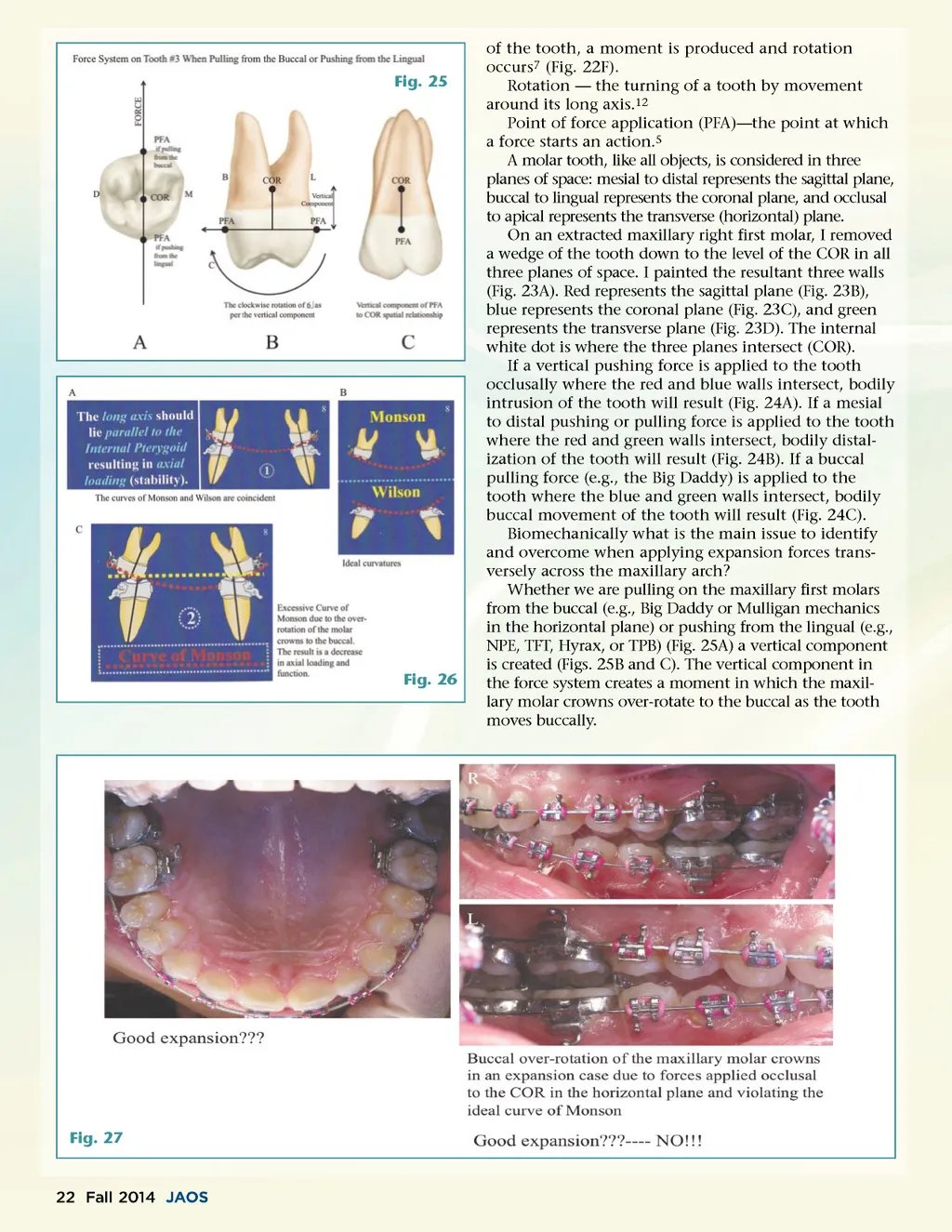
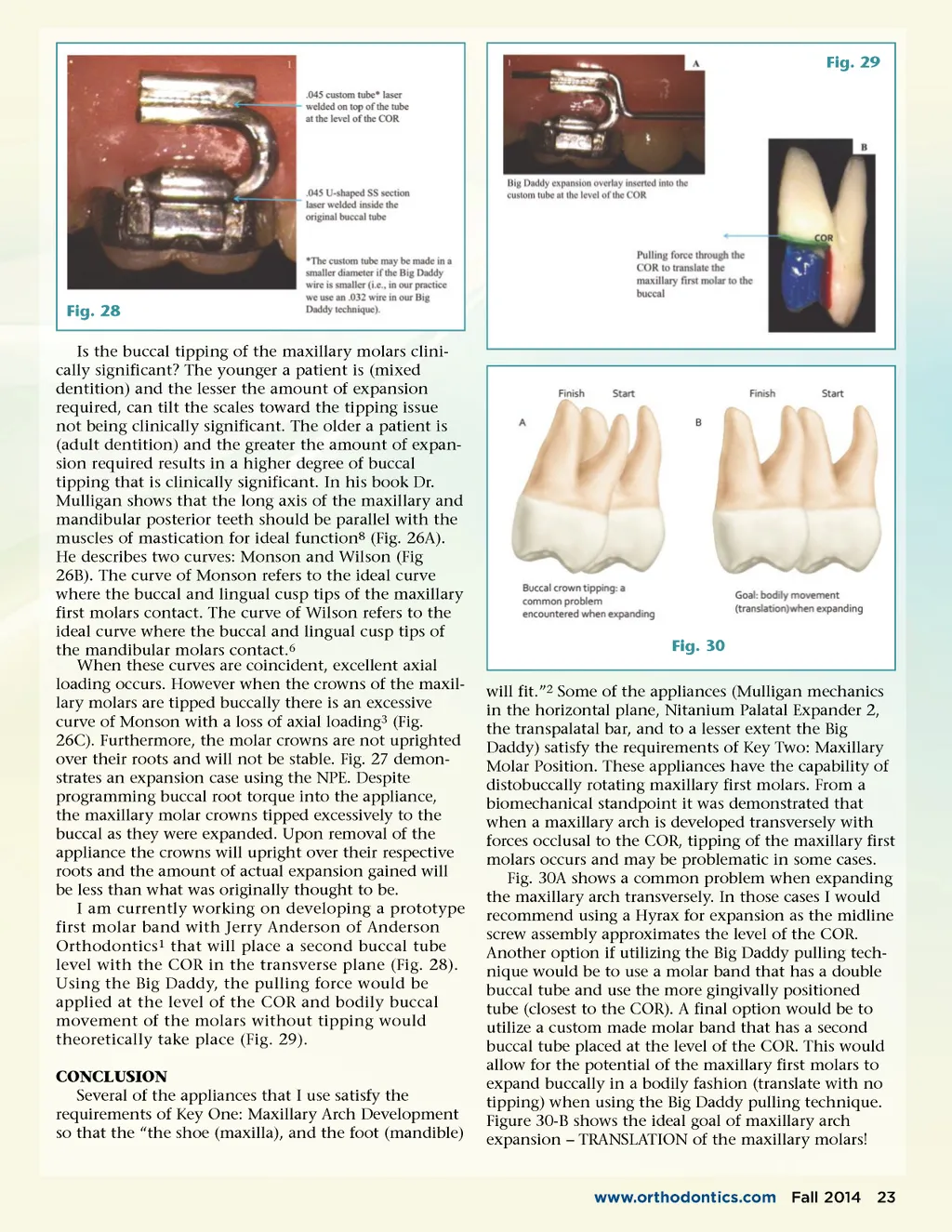
Fig. 29 Fig. 28 Is the buccal tipping of the maxillary molars clini-cally significant? The younger a patient is (mixed dentition) and the lesser the amount of expansion required, can tilt the scales toward the tipping issue not being clinically significant. The older a patient is (adult dentition) and the greater the amount of expan-sion required results in a higher degree of buccal tipping that is clinically significant. In his book Dr. Mulligan shows that the long axis of the maxillary and mandibular posterior teeth should be parallel with the muscles of mastication for ideal function 8 (Fig. 26A). He describes two curves: Monson and Wilson (Fig 26B). The curve of Monson refers to the ideal curve where the buccal and lingual cusp tips of the maxillary first molars contact. The curve of Wilson refers to the ideal curve where the buccal and lingual cusp tips of the mandibular molars contact. 6 When these curves are coincident, excellent axial loading occurs. However when the crowns of the maxil-lary molars are tipped buccally there is an excessive curve of Monson with a loss of axial loading 3 (Fig. 26C). Furthermore, the molar crowns are not uprighted over their roots and will not be stable. Fig. 27 demon-strates an expansion case using the NPE. Despite programming buccal root torque into the appliance, the maxillary molar crowns tipped excessively to the buccal as they were expanded. Upon removal of the appliance the crowns will upright over their respective roots and the amount of actual expansion gained will be less than what was originally thought to be. I am currently working on developing a prototype first molar band with Jerry Anderson of Anderson Orthodontics 1 that will place a second buccal tube level with the COR in the transverse plane (Fig. 28). Using the Big Daddy, the pulling force would be applied at the level of the COR and bodily buccal movement of the molars without tipping would theoretically take place (Fig. 29). CONCLUSION Several of the appliances that I use satisfy the requirements of Key One: Maxillary Arch Development so that the “the shoe (maxilla), and the foot (mandible) Fig. 30 will fit.” 2 Some of the appliances (Mulligan mechanics in the horizontal plane, Nitanium Palatal Expander 2, the transpalatal bar, and to a lesser extent the Big Daddy) satisfy the requirements of Key Two: Maxillary Molar Position. These appliances have the capability of distobuccally rotating maxillary first molars. From a biomechanical standpoint it was demonstrated that when a maxillary arch is developed transversely with forces occlusal to the COR, tipping of the maxillary first molars occurs and may be problematic in some cases. Fig. 30A shows a common problem when expanding the maxillary arch transversely. In those cases I would recommend using a Hyrax for expansion as the midline screw assembly approximates the level of the COR. Another option if utilizing the Big Daddy pulling tech-nique would be to use a molar band that has a double buccal tube and use the more gingivally positioned tube (closest to the COR). A final option would be to utilize a custom made molar band that has a second buccal tube placed at the level of the COR. This would allow for the potential of the maxillary first molars to expand buccally in a bodily fashion (translate with no tipping) when using the Big Daddy pulling technique. Figure 30-B shows the ideal goal of maxillary arch expansion – TRANSLATION of the maxillary molars! www.orthodontics.com Fall 2014 23
Journal of the American Orthodontic Society Fall 2014: Page 23