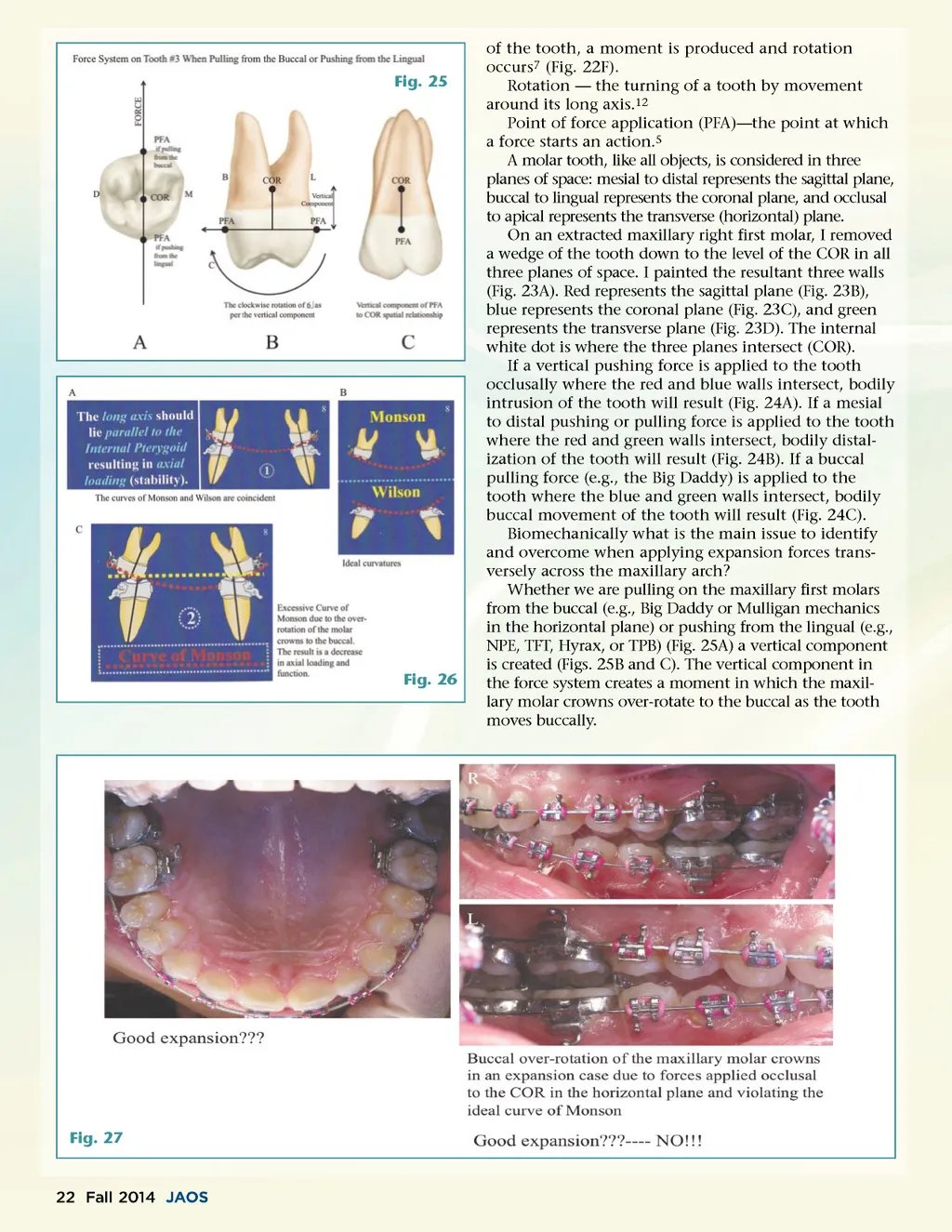
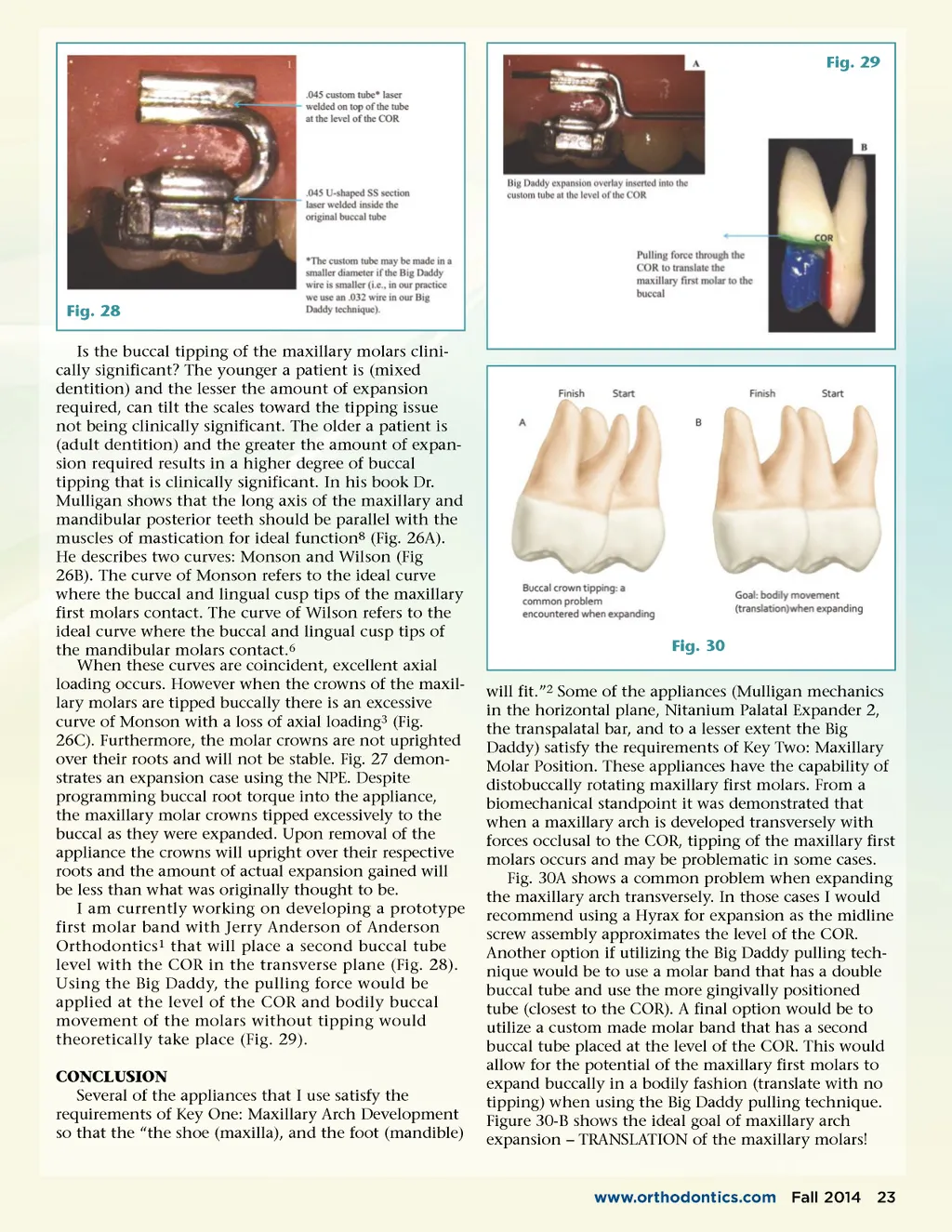
Fig. 25 Fig. 26 of the tooth, a moment is produced and rotation occurs 7 (Fig. 22F). Rotation — the turning of a tooth by movement around its long axis. 12 Point of force application (PFA)—the point at which a force starts an action. 5 A molar tooth, like all objects, is considered in three planes of space: mesial to distal represents the sagittal plane, buccal to lingual represents the coronal plane, and occlusal to apical represents the transverse (horizontal) plane. On an extracted maxillary right first molar, I removed a wedge of the tooth down to the level of the COR in all three planes of space. I painted the resultant three walls (Fig. 23A). Red represents the sagittal plane (Fig. 23B), blue represents the coronal plane (Fig. 23C), and green represents the transverse plane (Fig. 23D). The internal white dot is where the three planes intersect (COR). If a vertical pushing force is applied to the tooth occlusally where the red and blue walls intersect, bodily intrusion of the tooth will result (Fig. 24A). If a mesial to distal pushing or pulling force is applied to the tooth where the red and green walls intersect, bodily distal-ization of the tooth will result (Fig. 24B). If a buccal pulling force (e.g., the Big Daddy) is applied to the tooth where the blue and green walls intersect, bodily buccal movement of the tooth will result (Fig. 24C). Biomechanically what is the main issue to identify and overcome when applying expansion forces trans-versely across the maxillary arch? Whether we are pulling on the maxillary first molars from the buccal (e.g., Big Daddy or Mulligan mechanics in the horizontal plane) or pushing from the lingual (e.g., NPE, TFT, Hyrax, or TPB) (Fig. 25A) a vertical component is created (Figs. 25B and C). The vertical component in the force system creates a moment in which the maxil-lary molar crowns over-rotate to the buccal as the tooth moves buccally. Fig. 27 22 Fall 2014 JAOS
Journal of the American Orthodontic Society Fall 2014: Page 22