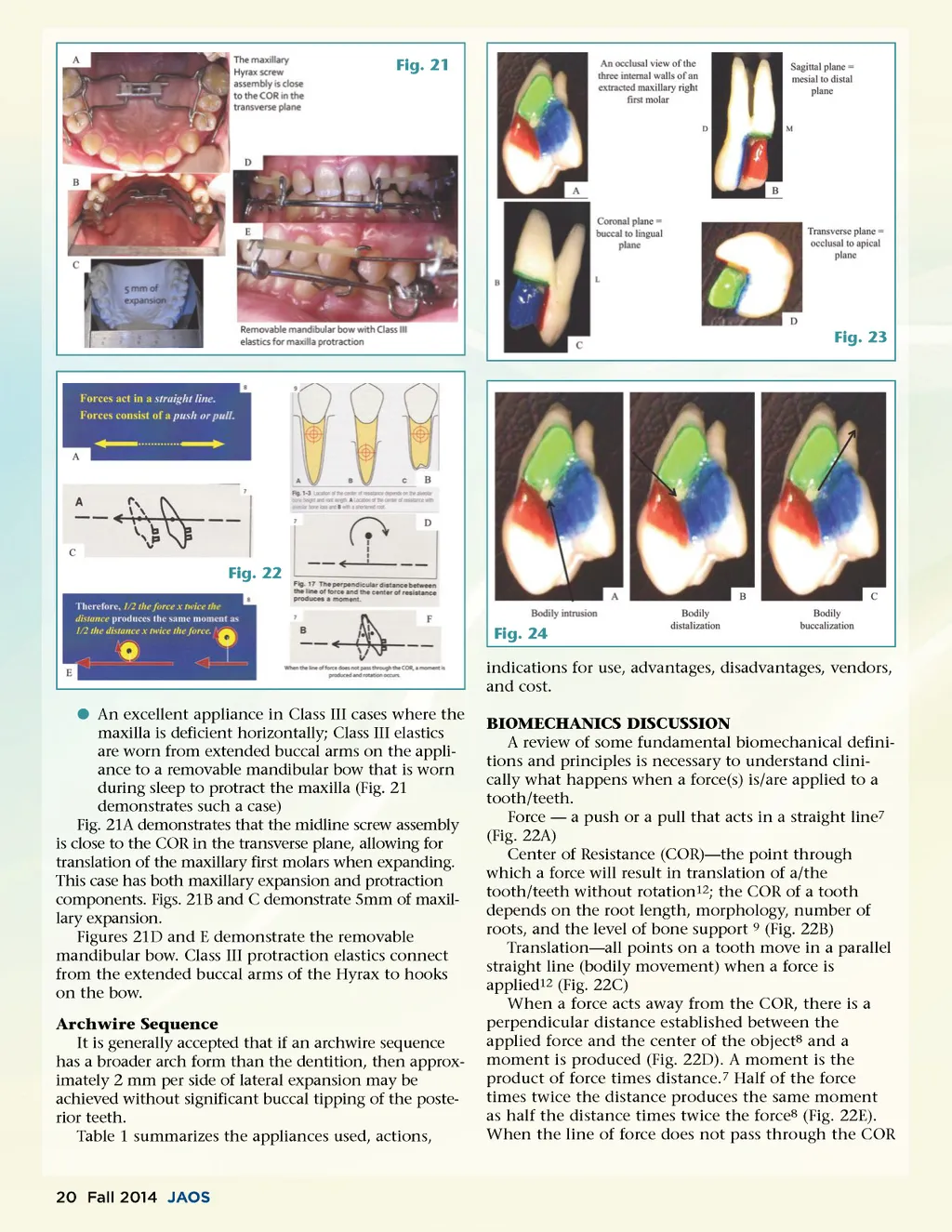
Fig. 21 Fig. 23 Fig. 22 Fig. 24 indications for use, advantages, disadvantages, vendors, and cost. b An excellent appliance in Class III cases where the maxilla is deficient horizontally; Class III elastics are worn from extended buccal arms on the appli-ance to a removable mandibular bow that is worn during sleep to protract the maxilla (Fig. 21 demonstrates such a case) Fig. 21A demonstrates that the midline screw assembly is close to the COR in the transverse plane, allowing for translation of the maxillary first molars when expanding. This case has both maxillary expansion and protraction components. Figs. 21B and C demonstrate 5mm of maxil-lary expansion. Figures 21D and E demonstrate the removable mandibular bow. Class III protraction elastics connect from the extended buccal arms of the Hyrax to hooks on the bow. Archwire Sequence It is generally accepted that if an archwire sequence has a broader arch form than the dentition, then approx-imately 2 mm per side of lateral expansion may be achieved without significant buccal tipping of the poste-rior teeth. Table 1 summarizes the appliances used, actions, BIOMECHANICS DISCUSSION A review of some fundamental biomechanical defini-tions and principles is necessary to understand clini-cally what happens when a force(s) is/are applied to a tooth/teeth. Force — a push or a pull that acts in a straight line 7 (Fig. 22A) Center of Resistance (COR)—the point through which a force will result in translation of a/the tooth/teeth without rotation 12 ; the COR of a tooth depends on the root length, morphology, number of roots, and the level of bone support 9 (Fig. 22B) Translation—all points on a tooth move in a parallel straight line (bodily movement) when a force is applied 12 (Fig. 22C) When a force acts away from the COR, there is a perpendicular distance established between the applied force and the center of the object 8 and a moment is produced (Fig. 22D). A moment is the product of force times distance. 7 Half of the force times twice the distance produces the same moment as half the distance times twice the force 8 (Fig. 22E). When the line of force does not pass through the COR 20 Fall 2014 JAOS
Journal of the American Orthodontic Society Fall 2014: Page 20