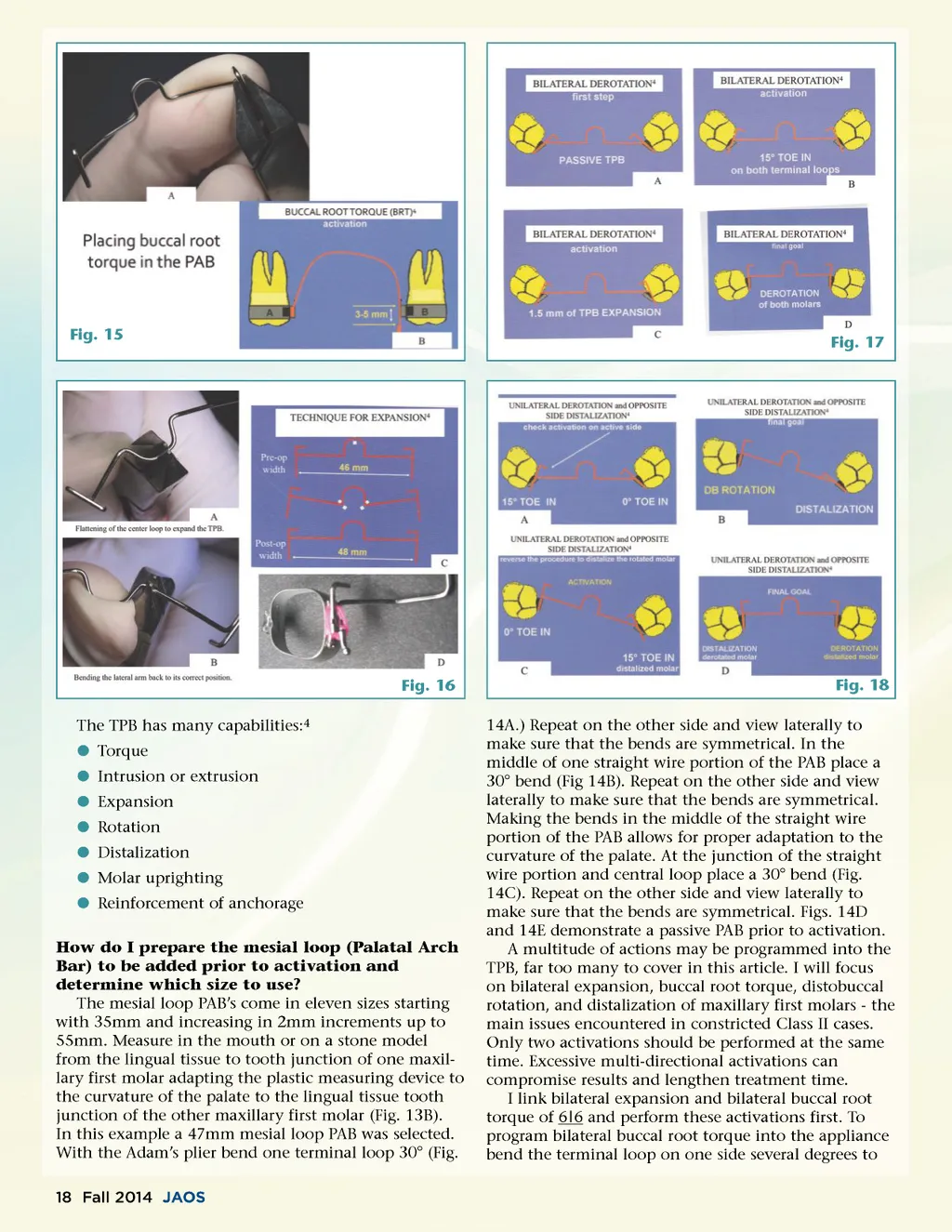
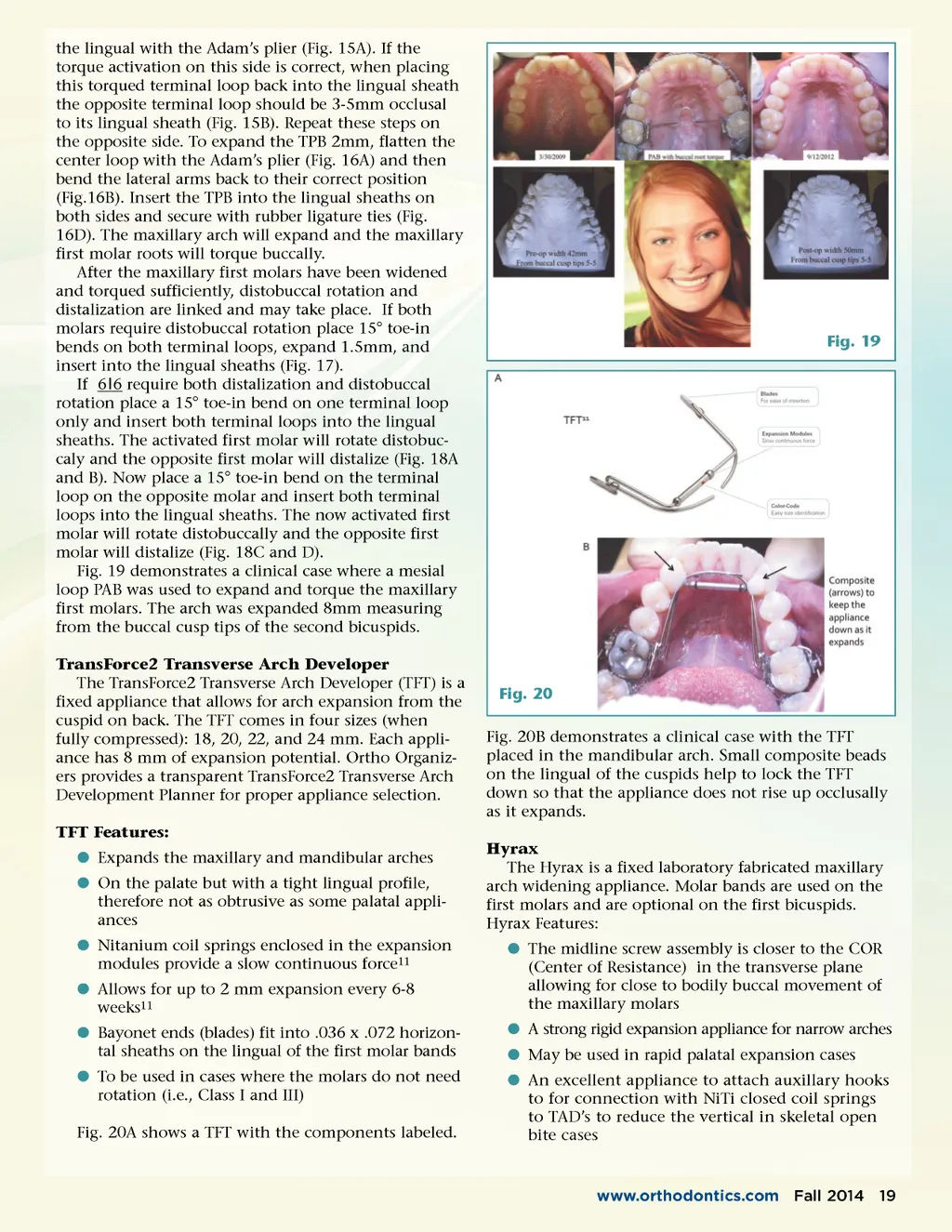
the lingual with the Adam’s plier (Fig. 15A). If the torque activation on this side is correct, when placing this torqued terminal loop back into the lingual sheath the opposite terminal loop should be 3-5mm occlusal to its lingual sheath (Fig. 15B). Repeat these steps on the opposite side. To expand the TPB 2mm, flatten the center loop with the Adam’s plier (Fig. 16A) and then bend the lateral arms back to their correct position (Fig.16B). Insert the TPB into the lingual sheaths on both sides and secure with rubber ligature ties (Fig. 16D). The maxillary arch will expand and the maxillary first molar roots will torque buccally. After the maxillary first molars have been widened and torqued sufficiently, distobuccal rotation and distalization are linked and may take place. If both molars require distobuccal rotation place 15° toe-in bends on both terminal loops, expand 1.5mm, and insert into the lingual sheaths (Fig. 17). If 6 | 6 require both distalization and distobuccal rotation place a 15° toe-in bend on one terminal loop only and insert both terminal loops into the lingual sheaths. The activated first molar will rotate distobuc-caly and the opposite first molar will distalize (Fig. 18A and B). Now place a 15° toe-in bend on the terminal loop on the opposite molar and insert both terminal loops into the lingual sheaths. The now activated first molar will rotate distobuccally and the opposite first molar will distalize (Fig. 18C and D). Fig. 19 demonstrates a clinical case where a mesial loop PAB was used to expand and torque the maxillary first molars. The arch was expanded 8mm measuring from the buccal cusp tips of the second bicuspids. TransForce2 Transverse Arch Developer The TransForce2 Transverse Arch Developer (TFT) is a fixed appliance that allows for arch expansion from the cuspid on back. The TFT comes in four sizes (when fully compressed): 18, 20, 22, and 24 mm. Each appli-ance has 8 mm of expansion potential. Ortho Organiz-ers provides a transparent TransForce2 Transverse Arch Development Planner for proper appliance selection. TFT Features: b Expands the maxillary and mandibular arches b On the palate but with a tight lingual profile, therefore not as obtrusive as some palatal appli-ances b Nitanium coil springs enclosed in the expansion modules provide a slow continuous force 11 b Allows for up to 2 mm expansion every 6-8 weeks 11 b Bayonet ends (blades) fit into .036 x .072 horizon-tal sheaths on the lingual of the first molar bands b To be used in cases where the molars do not need rotation (i.e., Class I and III) Fig. 20A shows a TFT with the components labeled. Fig. 19 Fig. 20 Fig. 20B demonstrates a clinical case with the TFT placed in the mandibular arch. Small composite beads on the lingual of the cuspids help to lock the TFT down so that the appliance does not rise up occlusally as it expands. Hyrax The Hyrax is a fixed laboratory fabricated maxillary arch widening appliance. Molar bands are used on the first molars and are optional on the first bicuspids. Hyrax Features: b The midline screw assembly is closer to the COR (Center of Resistance) in the transverse plane allowing for close to bodily buccal movement of the maxillary molars b A strong rigid expansion appliance for narrow arches b May be used in rapid palatal expansion cases b An excellent appliance to attach auxillary hooks to for connection with NiTi closed coil springs to TAD’s to reduce the vertical in skeletal open bite cases www.orthodontics.com Fall 2014 19
Journal of the American Orthodontic Society Fall 2014: Page 19