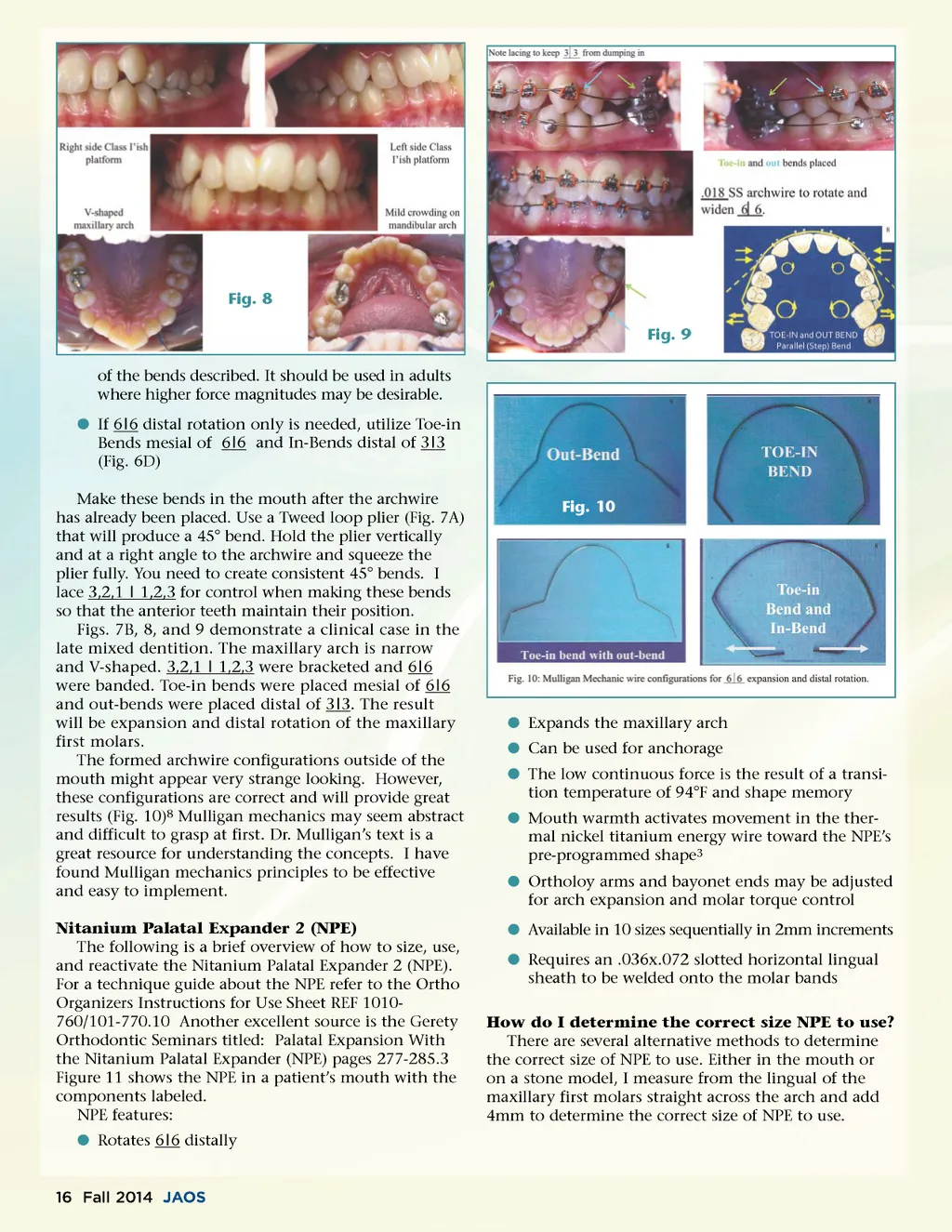
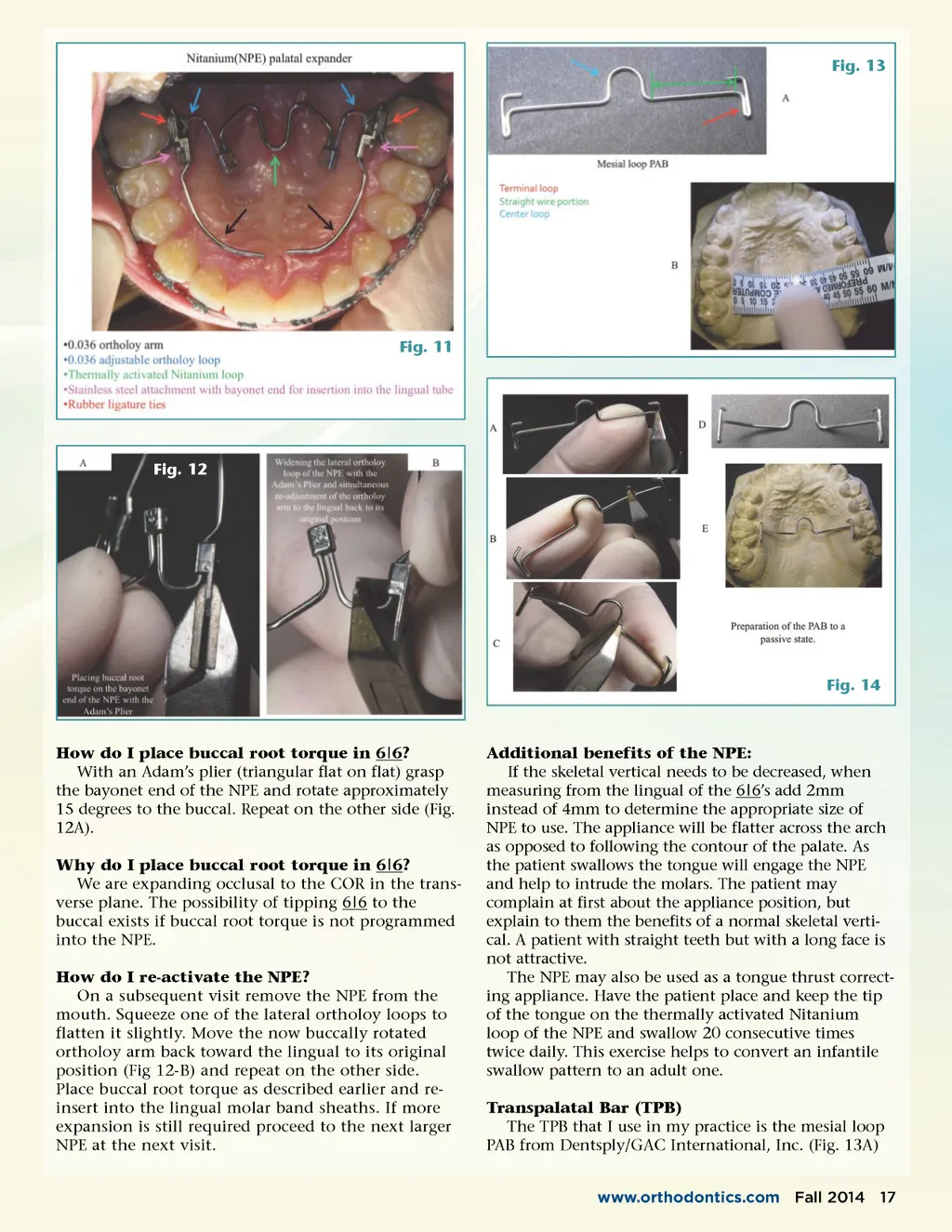
Fig. 8 Fig. 9 of the bends described. It should be used in adults where higher force magnitudes may be desirable. b If 6 | 6 distal rotation only is needed, utilize Toe-in Bends mesial of 6 | 6 and In-Bends distal of 3 | 3 (Fig. 6D) Make these bends in the mouth after the archwire has already been placed. Use a Tweed loop plier (Fig. 7A) that will produce a 45° bend. Hold the plier vertically and at a right angle to the archwire and squeeze the plier fully. You need to create consistent 45° bends. I lace 3,2,1 | 1,2,3 for control when making these bends so that the anterior teeth maintain their position. Figs. 7B, 8, and 9 demonstrate a clinical case in the late mixed dentition. The maxillary arch is narrow and V-shaped. 3,2,1 | 1,2,3 were bracketed and 6 | 6 were banded. Toe-in bends were placed mesial of 6 | 6 and out-bends were placed distal of 3 | 3. The result will be expansion and distal rotation of the maxillary first molars. The formed archwire configurations outside of the mouth might appear very strange looking. However, these configurations are correct and will provide great results (Fig. 10) 8 Mulligan mechanics may seem abstract and difficult to grasp at first. Dr. Mulligan’s text is a great resource for understanding the concepts. I have found Mulligan mechanics principles to be effective and easy to implement. Nitanium Palatal Expander 2 (NPE) The following is a brief overview of how to size, use, and reactivate the Nitanium Palatal Expander 2 (NPE). For a technique guide about the NPE refer to the Ortho Organizers Instructions for Use Sheet REF 1010-760/101-770.10 Another excellent source is the Gerety Orthodontic Seminars titled: Palatal Expansion With the Nitanium Palatal Expander (NPE) pages 277-285.3 Figure 11 shows the NPE in a patient’s mouth with the components labeled. NPE features: b Rotates 6 | 6 distally 16 Fall 2014 JAOS Fig. 10 b Expands the maxillary arch b Can be used for anchorage b The low continuous force is the result of a transi-tion temperature of 94°F and shape memory b Mouth warmth activates movement in the ther-mal nickel titanium energy wire toward the NPE’s pre-programmed shape 3 b Ortholoy arms and bayonet ends may be adjusted for arch expansion and molar torque control b Available in 10 sizes sequentially in 2mm increments b Requires an .036x.072 slotted horizontal lingual sheath to be welded onto the molar bands How do I determine the correct size NPE to use? There are several alternative methods to determine the correct size of NPE to use. Either in the mouth or on a stone model, I measure from the lingual of the maxillary first molars straight across the arch and add 4mm to determine the correct size of NPE to use.
Journal of the American Orthodontic Society Fall 2014: Page 16