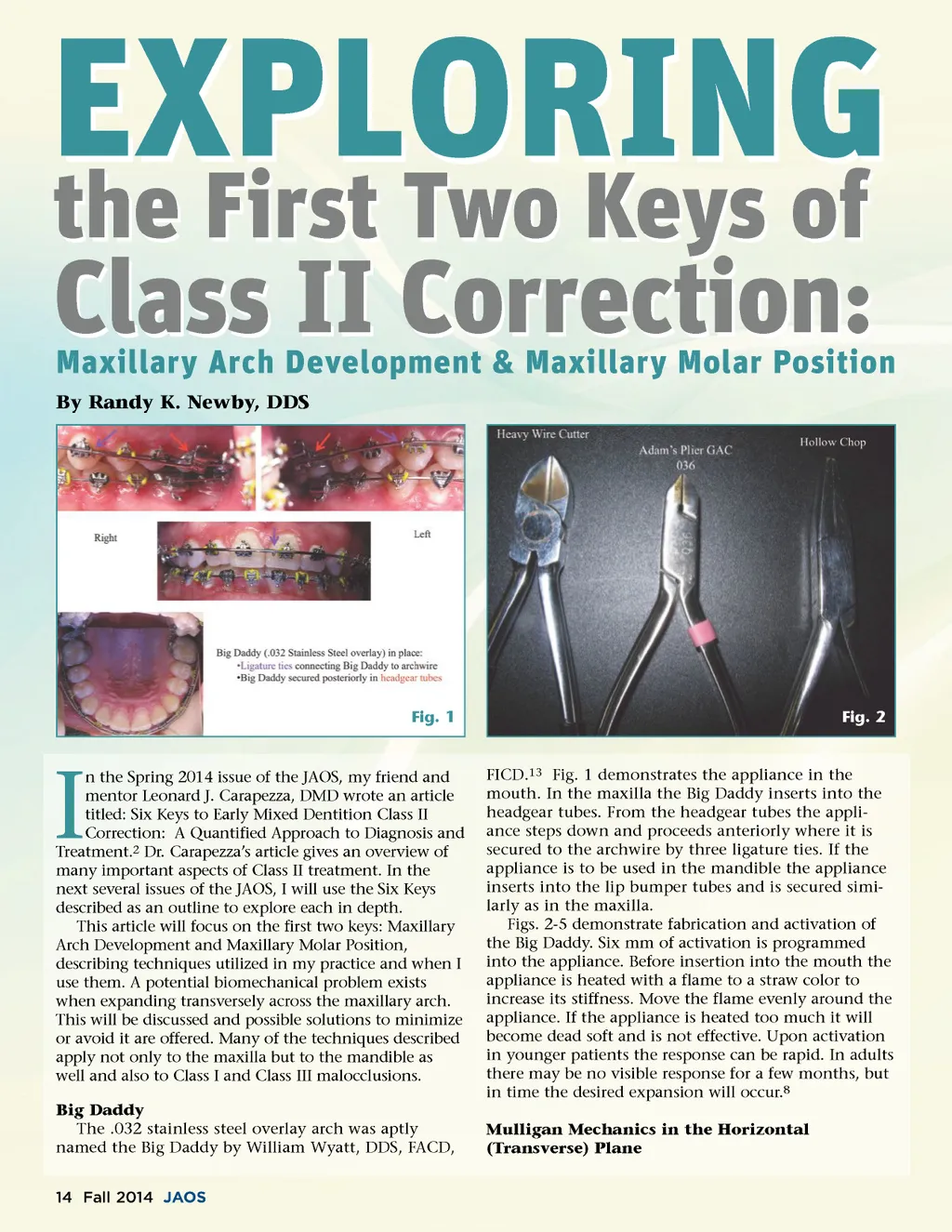
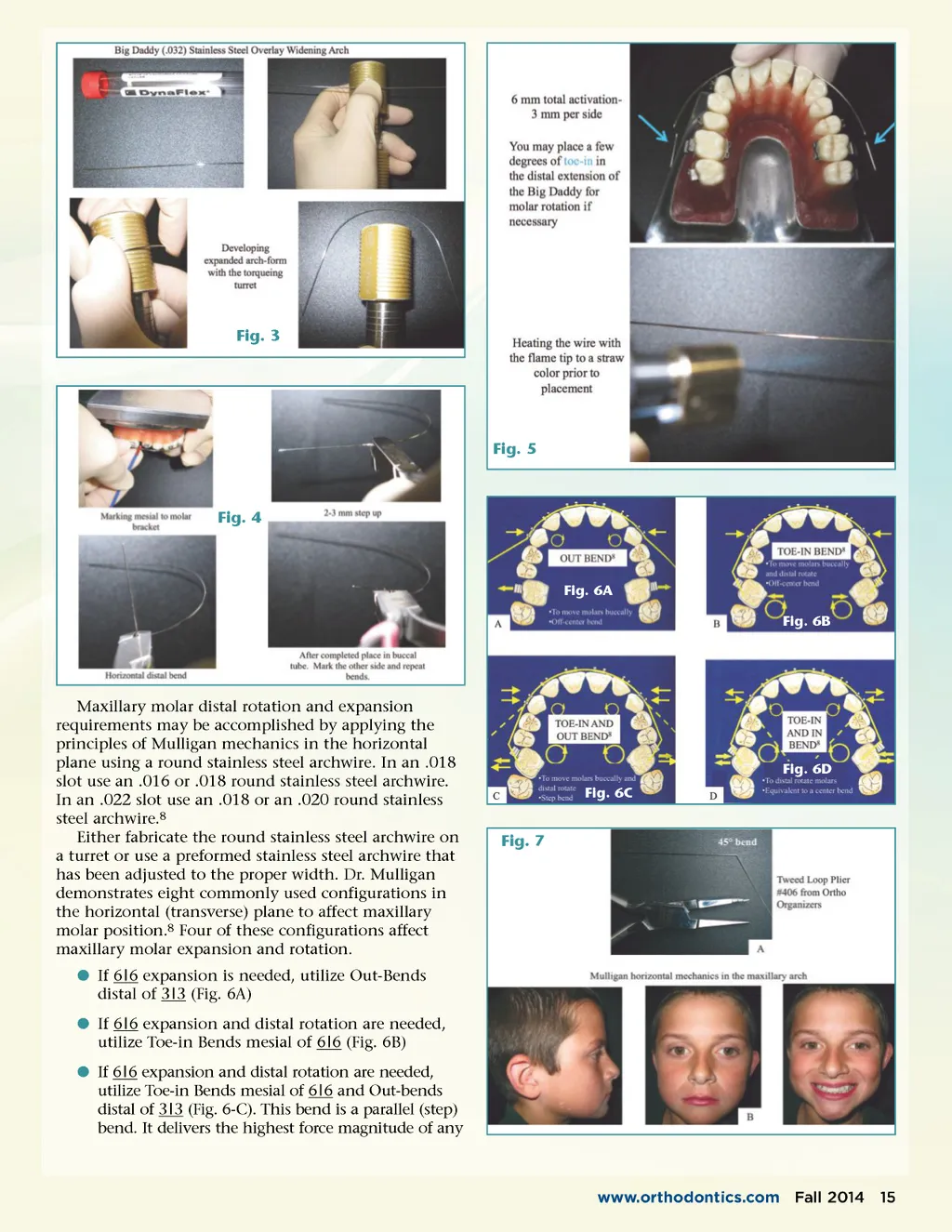
Fig. 3 Fig. 5 Fig. 4 Fig. 6A Fig. 6B Maxillary molar distal rotation and expansion requirements may be accomplished by applying the principles of Mulligan mechanics in the horizontal plane using a round stainless steel archwire. In an .018 slot use an .016 or .018 round stainless steel archwire. In an .022 slot use an .018 or an .020 round stainless steel archwire. 8 Either fabricate the round stainless steel archwire on a turret or use a preformed stainless steel archwire that has been adjusted to the proper width. Dr. Mulligan demonstrates eight commonly used configurations in the horizontal (transverse) plane to affect maxillary molar position. 8 Four of these configurations affect maxillary molar expansion and rotation. b If 6 | 6 expansion is needed, utilize Out-Bends distal of 3 | 3 (Fig. 6A) b If 6 | 6 expansion and distal rotation are needed, utilize Toe-in Bends mesial of 6 | 6 (Fig. 6B) b If 6 | 6 expansion and distal rotation are needed, utilize Toe-in Bends mesial of 6 | 6 and Out-bends distal of 3 | 3 (Fig. 6-C). This bend is a parallel (step) bend. It delivers the highest force magnitude of any Fig. 6D Fig. 6C Fig. 7 www.orthodontics.com Fall 2014 15
Journal of the American Orthodontic Society Fall 2014: Page 15