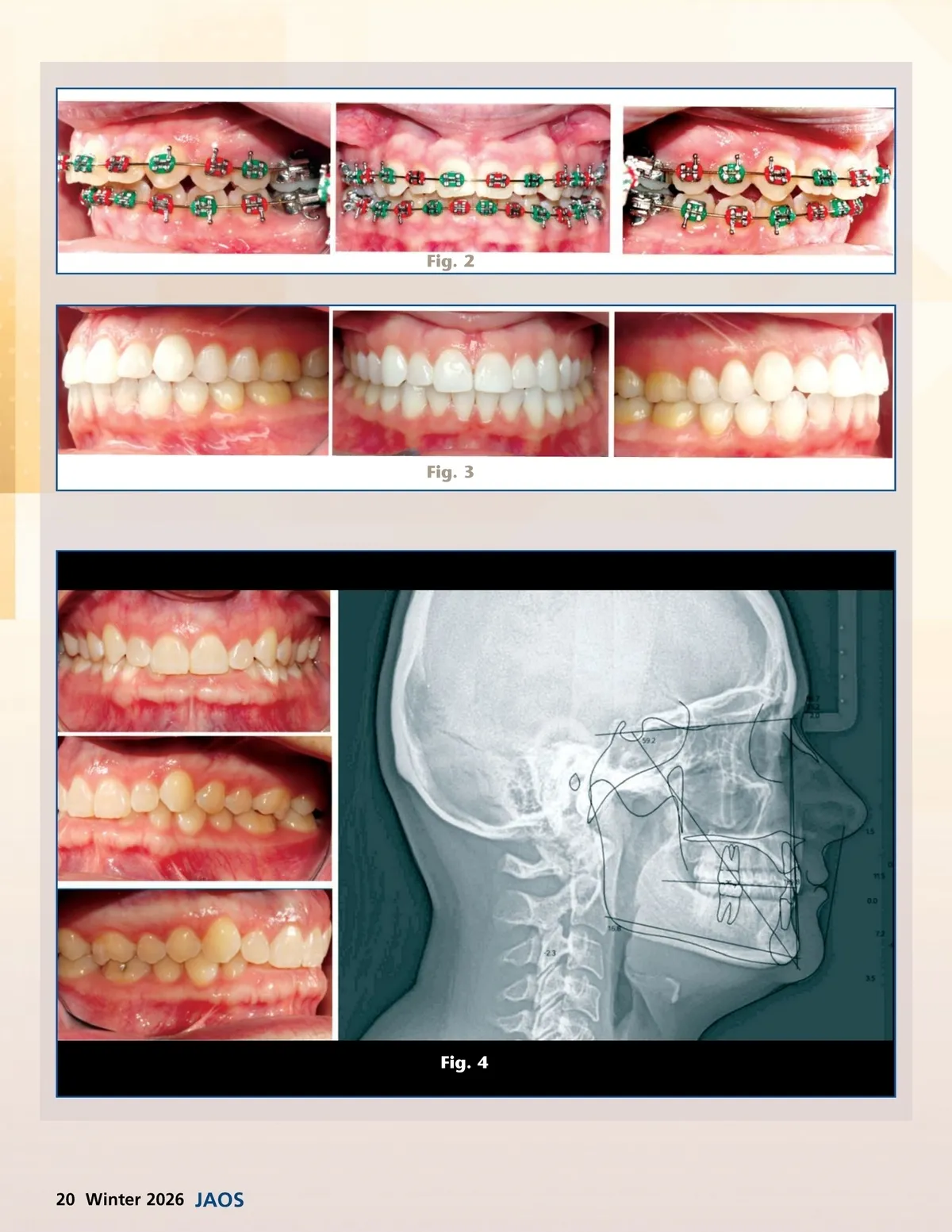
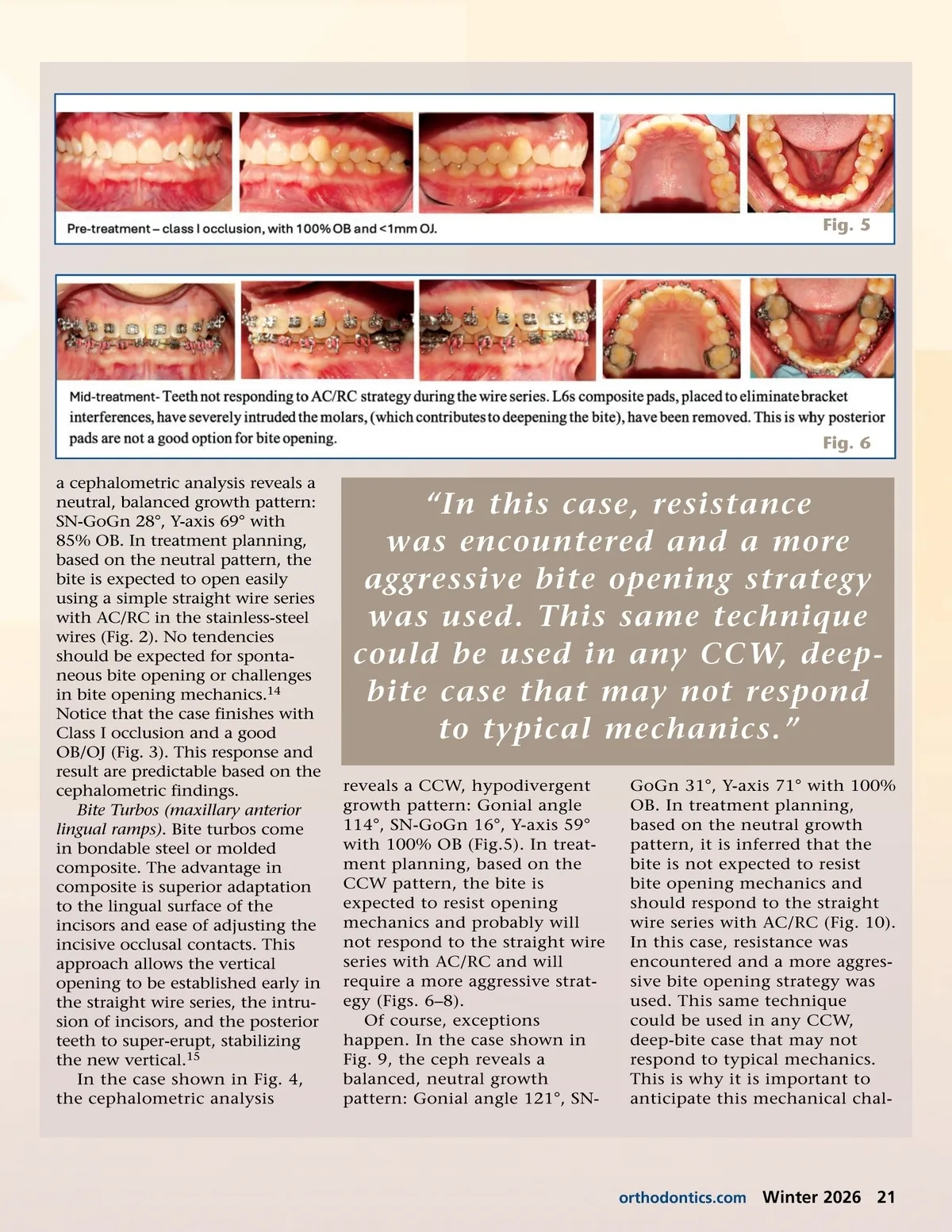
Fig. 5 Fig. 6 a cephalometric analysis reveals a neutral, balanced growth pattern: SN-GoGn 28°, Y-axis 69° with 85% OB. In treatment planning, based on the neutral pattern, the bite is expected to open easily using a simple straight wire series with AC/RC in the stainless-steel wires (Fig. 2). No tendencies should be expected for sponta-neous bite opening or challenges in bite opening mechanics. 14 Notice that the case finishes with Class I occlusion and a good OB/OJ (Fig. 3). This response and result are predictable based on the cephalometric findings. Bite Turbos (maxillary anterior lingual ramps) . Bite turbos come in bondable steel or molded composite. The advantage in composite is superior adaptation to the lingual surface of the incisors and ease of adjusting the incisive occlusal contacts. This approach allows the vertical opening to be established early in the straight wire series, the intru-sion of incisors, and the posterior teeth to super-erupt, stabilizing the new vertical. 15 In the case shown in Fig. 4, the cephalometric analysis “In this case, resistance was encountered and a more aggressive bite opening strategy was used. This same technique could be used in any CCW, deep-bite case that may not respond to typical mechanics.” reveals a CCW, hypodivergent growth pattern: Gonial angle 114°, SN-GoGn 16°, Y-axis 59° with 100% OB (Fig.5). In treat-ment planning, based on the CCW pattern, the bite is expected to resist opening mechanics and probably will not respond to the straight wire series with AC/RC and will require a more aggressive strat-egy (Figs. 6–8). Of course, exceptions happen. In the case shown in Fig. 9, the ceph reveals a balanced, neutral growth pattern: Gonial angle 121°, SN-GoGn 31°, Y-axis 71° with 100% OB. In treatment planning, based on the neutral growth pattern, it is inferred that the bite is not expected to resist bite opening mechanics and should respond to the straight wire series with AC/RC (Fig. 10). In this case, resistance was encountered and a more aggres-sive bite opening strategy was used. This same technique could be used in any CCW, deep-bite case that may not respond to typical mechanics. This is why it is important to anticipate this mechanical chal-orthodontics.com Winter 2026 21
Journal of the American Orthodontic Society Winter 2026: Page 21