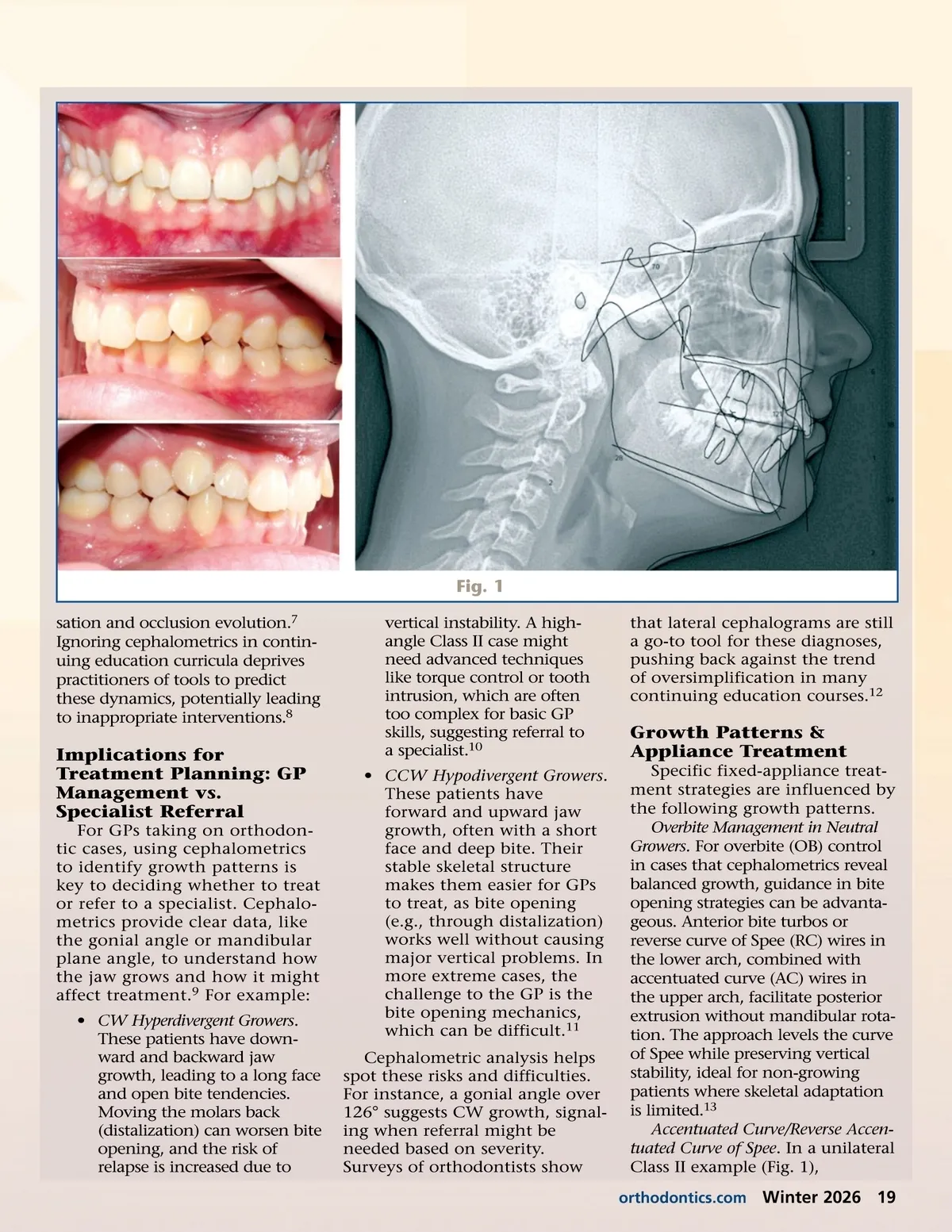
Fig. 1 sation and occlusion evolution. 7 Ignoring cephalometrics in contin-uing education curricula deprives practitioners of tools to predict these dynamics, potentially leading to inappropriate interventions. 8 vertical instability. A high-angle Class II case might need advanced techniques like torque control or tooth intrusion, which are often too complex for basic GP skills, suggesting referral to a specialist. 10 • CCW Hypodivergent Growers. These patients have forward and upward jaw growth, often with a short face and deep bite. Their stable skeletal structure makes them easier for GPs to treat, as bite opening (e.g., through distalization) works well without causing major vertical problems. In more extreme cases, the challenge to the GP is the bite opening mechanics, which can be difficult. 11 Cephalometric analysis helps spot these risks and difficulties. For instance, a gonial angle over 126° suggests CW growth, signal-ing when referral might be needed based on severity. Surveys of orthodontists show that lateral cephalograms are still a go-to tool for these diagnoses, pushing back against the trend of oversimplification in many continuing education courses. 12 Implications for Treatment Planning: GP Management vs. Specialist Referral For GPs taking on orthodon-tic cases, using cephalometrics to identify growth patterns is key to deciding whether to treat or refer to a specialist. Cephalo-metrics provide clear data, like the gonial angle or mandibular plane angle, to understand how the jaw grows and how it might affect treatment. 9 For example: • CW Hyperdivergent Growers . These patients have down-ward and backward jaw growth, leading to a long face and open bite tendencies. Moving the molars back (distalization) can worsen bite opening, and the risk of relapse is increased due to Growth Patterns & Appliance Treatment Specific fixed-appliance treat-ment strategies are influenced by the following growth patterns. Overbite Management in Neutral Growers. For overbite (OB) control in cases that cephalometrics reveal balanced growth, guidance in bite opening strategies can be advanta-geous. Anterior bite turbos or reverse curve of Spee (RC) wires in the lower arch, combined with accentuated curve (AC) wires in the upper arch, facilitate posterior extrusion without mandibular rota-tion. The approach levels the curve of Spee while preserving vertical stability, ideal for non-growing patients where skeletal adaptation is limited. 13 Accentuated Curve/Reverse Accen-tuated Curve of Spee . In a unilateral Class II example (Fig. 1), orthodontics.com Winter 2026 19
Journal of the American Orthodontic Society Winter 2026: Page 19