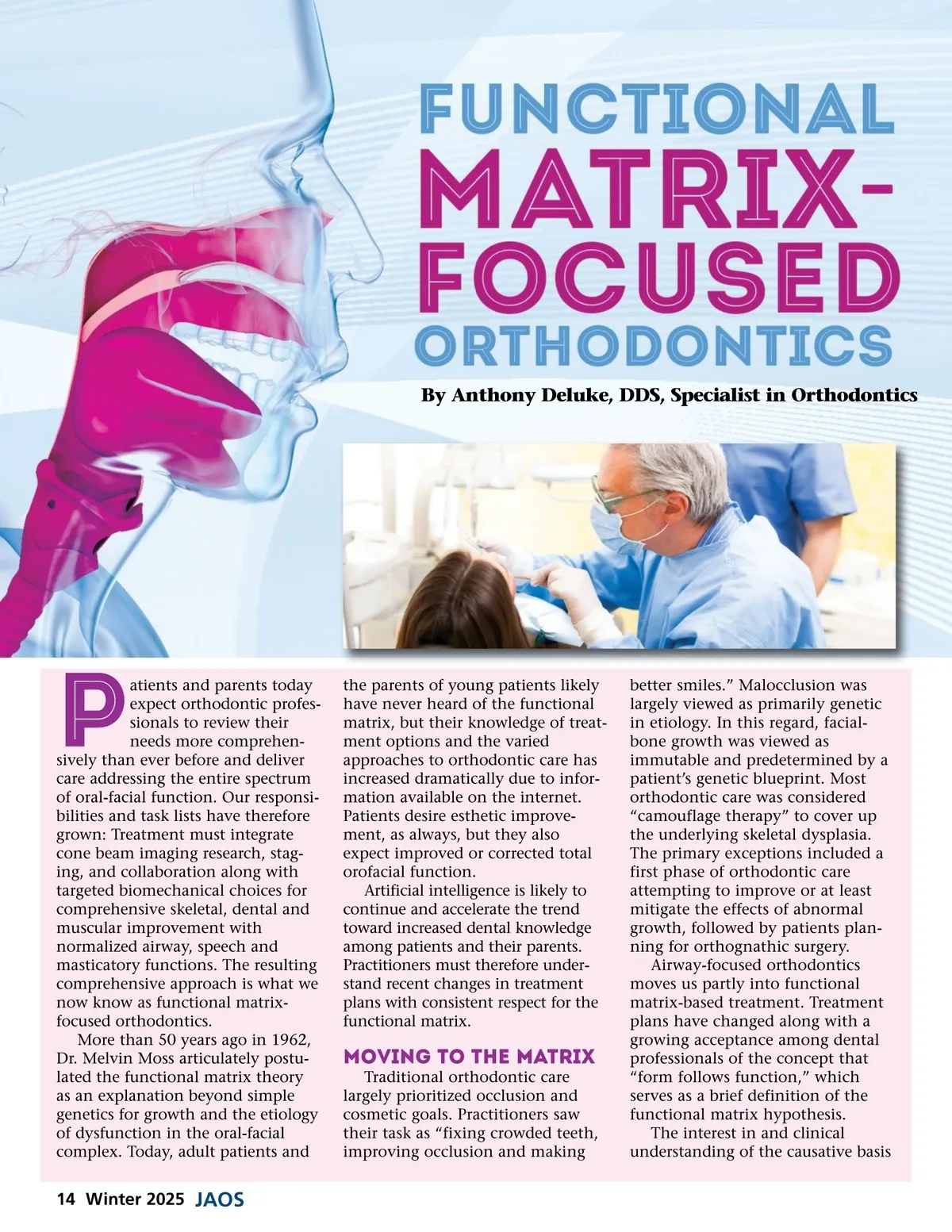
By Anthony Deluke, DDS, Specialist in Orthodontics P atients and parents today expect orthodontic profes-sionals to review their needs more comprehen-sively than ever before and deliver care addressing the entire spectrum of oral-facial function. Our responsi-bilities and task lists have therefore grown: Treatment must integrate cone beam imaging research, stag-ing, and collaboration along with targeted biomechanical choices for comprehensive skeletal, dental and muscular improvement with normalized airway, speech and masticatory functions. The resulting comprehensive approach is what we now know as functional matrix-focused orthodontics. More than 50 years ago in 1962, Dr. Melvin Moss articulately postu-lated the functional matrix theory as an explanation beyond simple genetics for growth and the etiology of dysfunction in the oral-facial complex. Today, adult patients and the parents of young patients likely have never heard of the functional matrix, but their knowledge of treat-ment options and the varied approaches to orthodontic care has increased dramatically due to infor-mation available on the internet. Patients desire esthetic improve-ment, as always, but they also expect improved or corrected total orofacial function. Artificial intelligence is likely to continue and accelerate the trend toward increased dental knowledge among patients and their parents. Practitioners must therefore under-stand recent changes in treatment plans with consistent respect for the functional matrix. Moving to the Matrix Traditional orthodontic care largely prioritized occlusion and cosmetic goals. Practitioners saw their task as “fixing crowded teeth, improving occlusion and making better smiles.” Malocclusion was largely viewed as primarily genetic in etiology. In this regard, facial-bone growth was viewed as immutable and predetermined by a patient’s genetic blueprint. Most orthodontic care was considered “camouflage therapy” to cover up the underlying skeletal dysplasia. The primary exceptions included a first phase of orthodontic care attempting to improve or at least mitigate the effects of abnormal growth, followed by patients plan-ning for orthognathic surgery. Airway-focused orthodontics moves us partly into functional matrix-based treatment. Treatment plans have changed along with a growing acceptance among dental professionals of the concept that “form follows function,” which serves as a brief definition of the functional matrix hypothesis. The interest in and clinical understanding of the causative basis 14 Winter 2025 JAOS
Journal of the American Orthodontic Society Winter 2025: Page 14