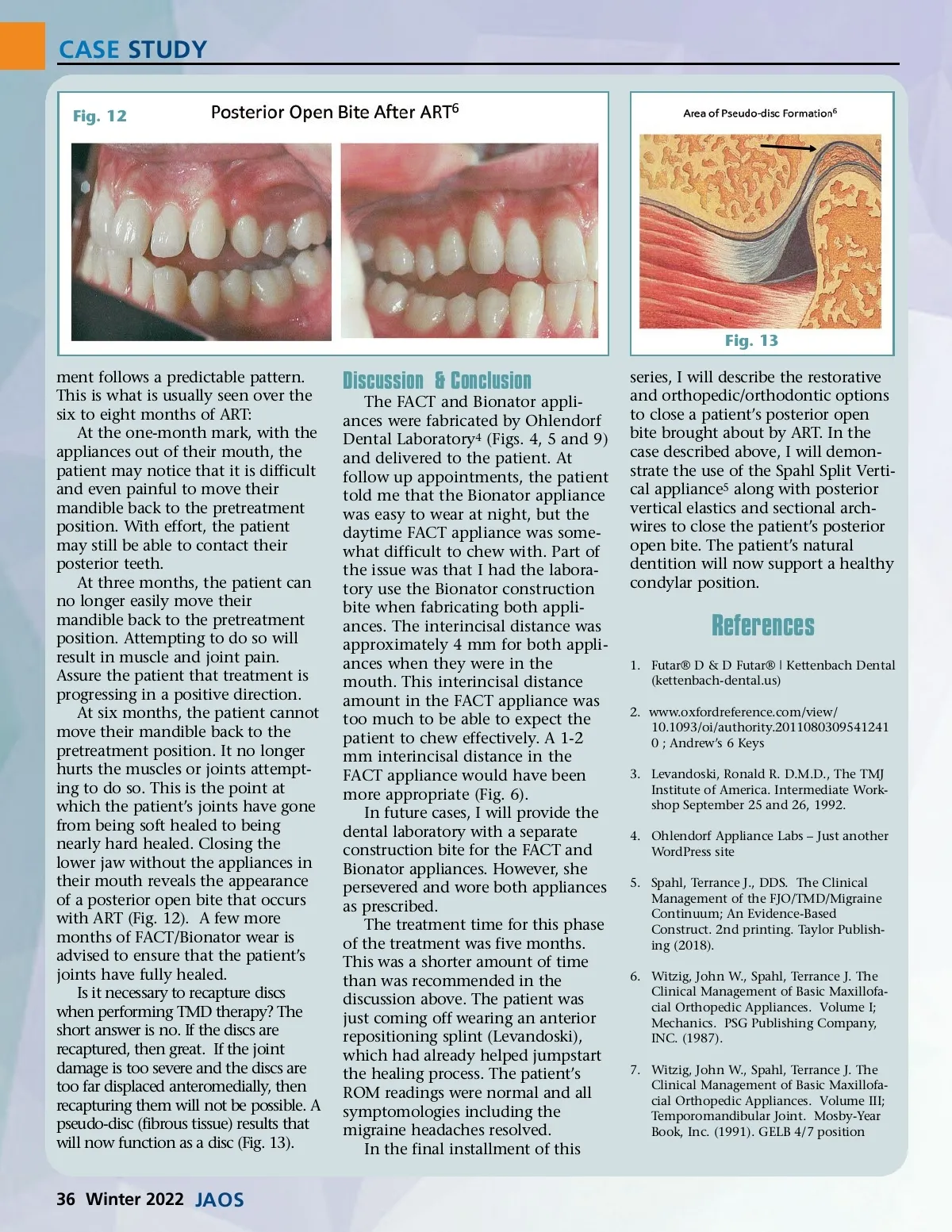
CASE STUDY Fig. 12 Fig. 13 ment follows a predictable pattern. This is what is usually seen over the six to eight months of ART: At the one-month mark, with the appliances out of their mouth, the patient may notice that it is difficult and even painful to move their mandible back to the pretreatment position. With effort, the patient may still be able to contact their posterior teeth. At three months, the patient can no longer easily move their mandible back to the pretreatment position. Attempting to do so will result in muscle and joint pain. Assure the patient that treatment is progressing in a positive direction. At six months, the patient cannot move their mandible back to the pretreatment position. It no longer hurts the muscles or joints attempt-ing to do so. This is the point at which the patient’s joints have gone from being soft healed to being nearly hard healed. Closing the lower jaw without the appliances in their mouth reveals the appearance of a posterior open bite that occurs with ART (Fig. 12). A few more months of FACT/Bionator wear is advised to ensure that the patient’s joints have fully healed. Is it necessary to recapture discs when performing TMD therapy? The short answer is no. If the discs are recaptured, then great. If the joint damage is too severe and the discs are too far displaced anteromedially, then recapturing them will not be possible. A pseudo-disc (fibrous tissue) results that will now function as a disc (Fig. 13). Discussion & Conclusion The FACT and Bionator appli-ances were fabricated by Ohlendorf Dental Laboratory 4 (Figs. 4, 5 and 9) and delivered to the patient. At follow up appointments, the patient told me that the Bionator appliance was easy to wear at night, but the daytime FACT appliance was some-what difficult to chew with. Part of the issue was that I had the labora-tory use the Bionator construction bite when fabricating both appli-ances. The interincisal distance was approximately 4 mm for both appli-ances when they were in the mouth. This interincisal distance amount in the FACT appliance was too much to be able to expect the patient to chew effectively. A 1-2 mm interincisal distance in the FACT appliance would have been more appropriate (Fig. 6). In future cases, I will provide the dental laboratory with a separate construction bite for the FACT and Bionator appliances. However, she persevered and wore both appliances as prescribed. The treatment time for this phase of the treatment was five months. This was a shorter amount of time than was recommended in the discussion above. The patient was just coming off wearing an anterior repositioning splint (Levandoski), which had already helped jumpstart the healing process. The patient’s ROM readings were normal and all symptomologies including the migraine headaches resolved. In the final installment of this series, I will describe the restorative and orthopedic/orthodontic options to close a patient’s posterior open bite brought about by ART. In the case described above, I will demon-strate the use of the Spahl Split Verti-cal appliance 5 along with posterior vertical elastics and sectional arch-wires to close the patient’s posterior open bite. The patient’s natural dentition will now support a healthy condylar position. References 1. Futar® D & D Futar® | Kettenbach Dental (kettenbach-dental.us) 2. www.oxfordreference.com/view/ 10.1093/oi/authority.2011080309541241 0 ; Andrew’s 6 Keys 3. Levandoski, Ronald R. D.M.D., The TMJ Institute of America. Intermediate Work-shop September 25 and 26, 1992. 4. Ohlendorf Appliance Labs – Just another WordPress site 5. Spahl, Terrance J., DDS. The Clinical Management of the FJO/TMD/Migraine Continuum; An Evidence-Based Construct. 2nd printing. Taylor Publish-ing (2018). 6. Witzig, John W., Spahl, Terrance J. The Clinical Management of Basic Maxillofa-cial Orthopedic Appliances. Volume I; Mechanics. PSG Publishing Company, INC. (1987). 7. Witzig, John W., Spahl, Terrance J. The Clinical Management of Basic Maxillofa-cial Orthopedic Appliances. Volume III; Temporomandibular Joint. Mosby-Year Book, Inc. (1991). GELB 4/7 position 36 Winter 2022 JAOS
Journal of the American Orthodontic Society Winter 2022: Page 36