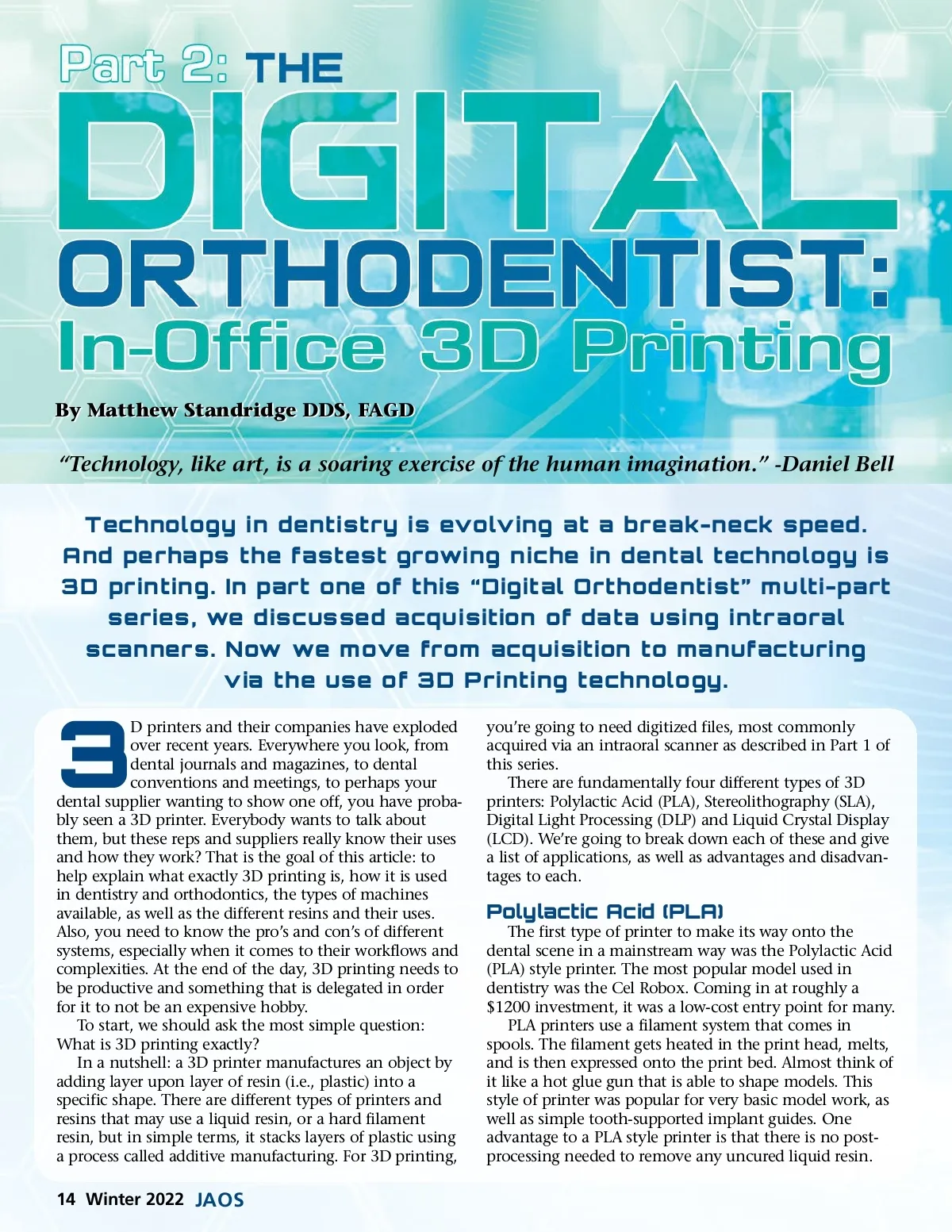
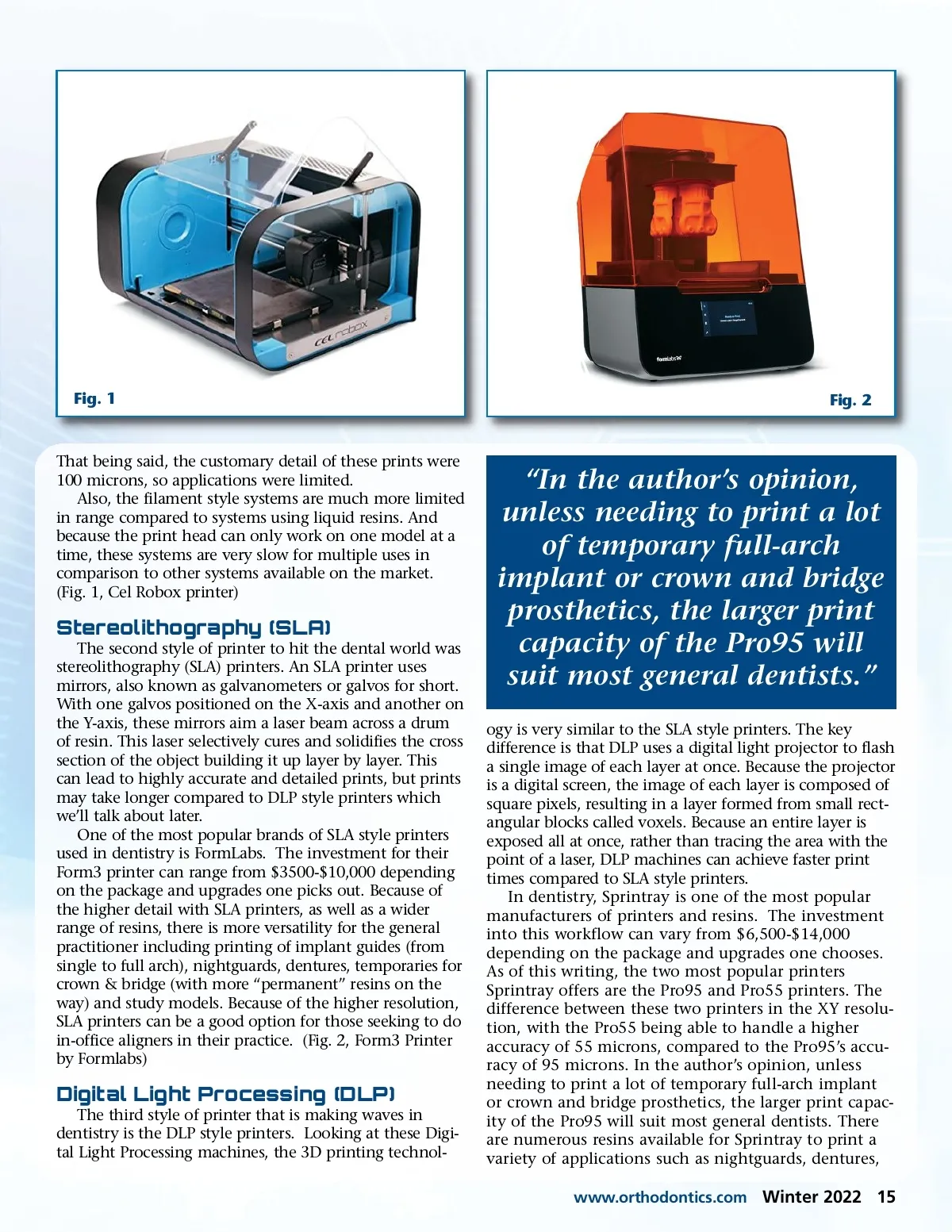
Fig. 1 Fig. 2 That being said, the customary detail of these prints were 100 microns, so applications were limited. Also, the filament style systems are much more limited in range compared to systems using liquid resins. And because the print head can only work on one model at a time, these systems are very slow for multiple uses in comparison to other systems available on the market. (Fig. 1, Cel Robox printer) Stereolithography (SLA) The second style of printer to hit the dental world was stereolithography (SLA) printers. An SLA printer uses mirrors, also known as galvanometers or galvos for short. With one galvos positioned on the X-axis and another on the Y-axis, these mirrors aim a laser beam across a drum of resin. This laser selectively cures and solidifies the cross section of the object building it up layer by layer. This can lead to highly accurate and detailed prints, but prints may take longer compared to DLP style printers which we’ll talk about later. One of the most popular brands of SLA style printers used in dentistry is FormLabs. The investment for their Form3 printer can range from $3500-$10,000 depending on the package and upgrades one picks out. Because of the higher detail with SLA printers, as well as a wider range of resins, there is more versatility for the general practitioner including printing of implant guides (from single to full arch), nightguards, dentures, temporaries for crown & bridge (with more “permanent” resins on the way) and study models. Because of the higher resolution, SLA printers can be a good option for those seeking to do in-office aligners in their practice. (Fig. 2, Form3 Printer by Formlabs) “In the author’s opinion, unless needing to print a lot of temporary full-arch implant or crown and bridge prosthetics, the larger print capacity of the Pro95 will suit most general dentists.” ogy is very similar to the SLA style printers. The key difference is that DLP uses a digital light projector to flash a single image of each layer at once. Because the projector is a digital screen, the image of each layer is composed of square pixels, resulting in a layer formed from small rect-angular blocks called voxels. Because an entire layer is exposed all at once, rather than tracing the area with the point of a laser, DLP machines can achieve faster print times compared to SLA style printers. In dentistry, Sprintray is one of the most popular manufacturers of printers and resins. The investment into this workflow can vary from $6,500-$14,000 depending on the package and upgrades one chooses. As of this writing, the two most popular printers Sprintray offers are the Pro95 and Pro55 printers. The difference between these two printers in the XY resolu-tion, with the Pro55 being able to handle a higher accuracy of 55 microns, compared to the Pro95’s accu-racy of 95 microns. In the author’s opinion, unless needing to print a lot of temporary full-arch implant or crown and bridge prosthetics, the larger print capac-ity of the Pro95 will suit most general dentists. There are numerous resins available for Sprintray to print a variety of applications such as nightguards, dentures, www.orthodontics.com Digital Light Processing (DLP) The third style of printer that is making waves in dentistry is the DLP style printers. Looking at these Digi-tal Light Processing machines, the 3D printing technol-Winter 2022 15
Journal of the American Orthodontic Society Winter 2022: Page 15