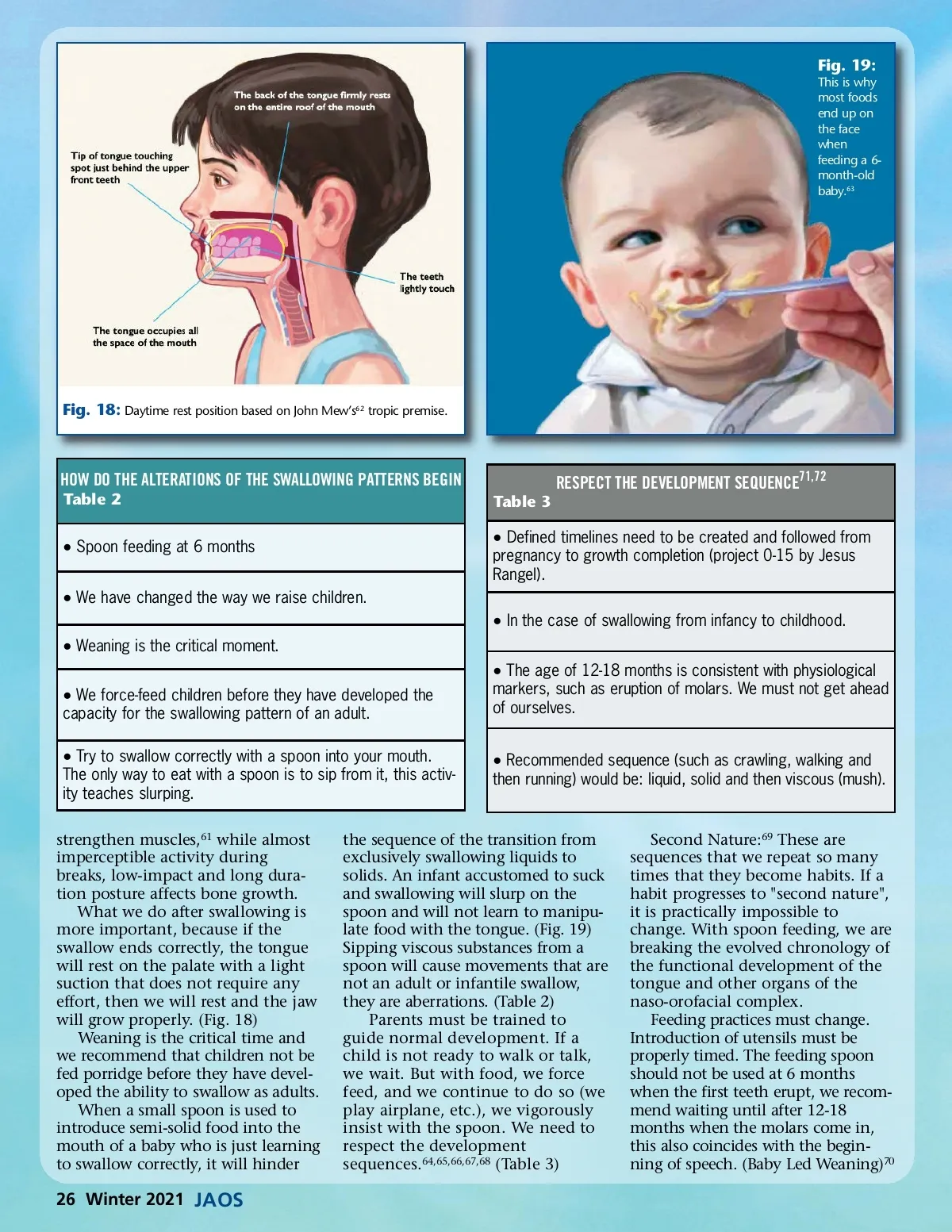
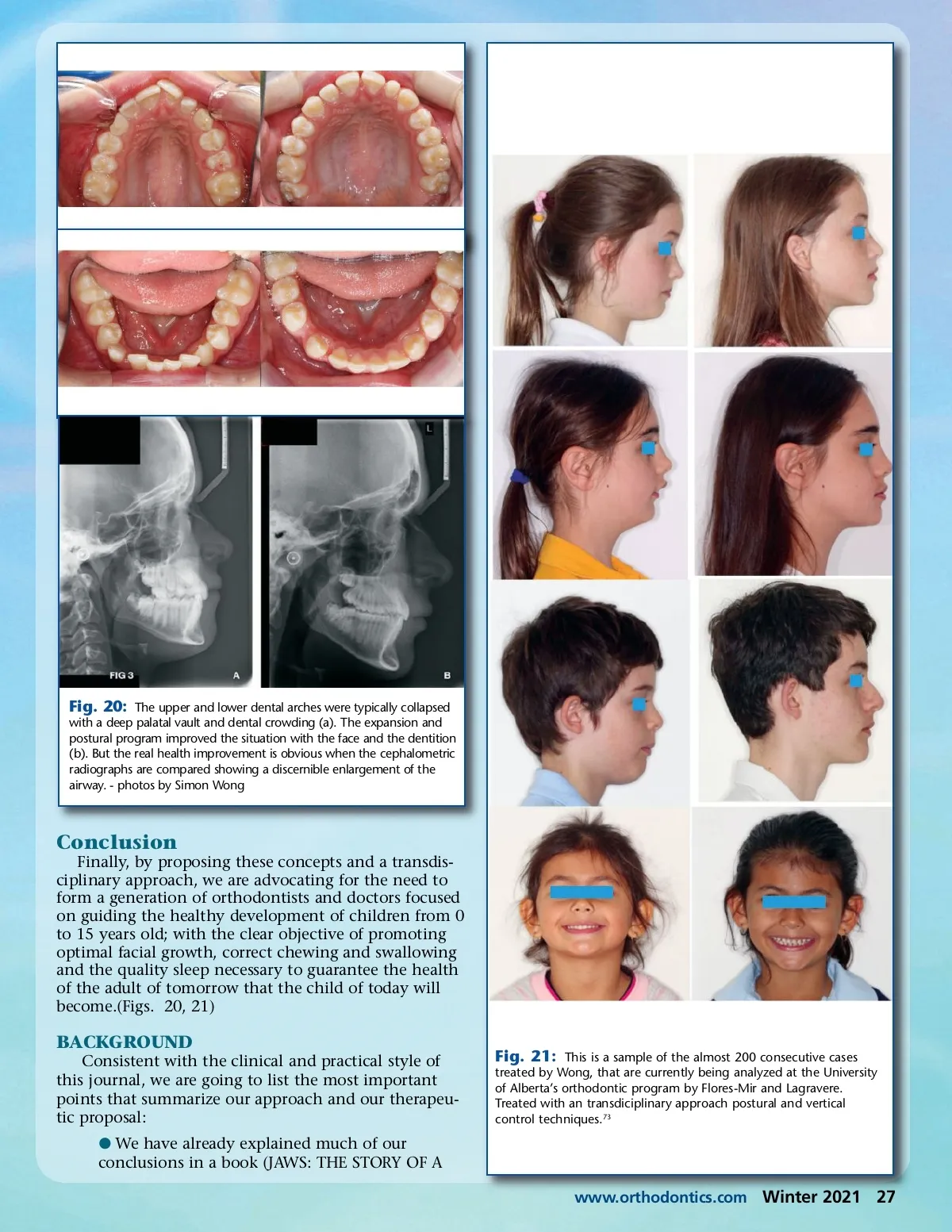
Fig. 19: This is why most foods end up on the face when feeding a 6-month-old baby. 63 Fig. 18: Daytime rest position based on John Mew’s 62 tropic premise. HOW DO THE ALTERATIONS OF THE SWALLOWING PATTERNS BEGIN Table 2 ● Spoon feeding at 6 months Table 3 RESPECT THE DEVELOPMENT SEQUENCE 71,72 ● Defined timelines need to be created and followed from pregnancy to growth completion (project 0-15 by Jesus Rangel). ● In the case of swallowing from infancy to childhood. ● We have changed the way we raise children. ● Weaning is the critical moment. ● We force-feed children before they have developed the capacity for the swallowing pattern of an adult. ● Try to swallow correctly with a spoon into your mouth. The only way to eat with a spoon is to sip from it, this activ-ity teaches slurping. strengthen muscles, 61 while almost imperceptible activity during breaks, low-impact and long dura-tion posture affects bone growth. What we do after swallowing is more important, because if the swallow ends correctly, the tongue will rest on the palate with a light suction that does not require any effort, then we will rest and the jaw will grow properly. (Fig. 18) Weaning is the critical time and we recommend that children not be fed porridge before they have devel-oped the ability to swallow as adults. When a small spoon is used to introduce semi-solid food into the mouth of a baby who is just learning to swallow correctly, it will hinder ● The age of 12-18 months is consistent with physiological markers, such as eruption of molars. We must not get ahead of ourselves. ● Recommended sequence (such as crawling, walking and then running) would be: liquid, solid and then viscous (mush). the sequence of the transition from exclusively swallowing liquids to solids. An infant accustomed to suck and swallowing will slurp on the spoon and will not learn to manipu-late food with the tongue. (Fig. 19) Sipping viscous substances from a spoon will cause movements that are not an adult or infantile swallow, they are aberrations. (Table 2) Parents must be trained to guide normal development. If a child is not ready to walk or talk, we wait. But with food, we force feed, and we continue to do so (we play airplane, etc.), we vigorously insist with the spoon. We need to respect the development sequences. 64,65,66,67,68 (Table 3) Second Nature: 69 These are sequences that we repeat so many times that they become habits. If a habit progresses to "second nature", it is practically impossible to change. With spoon feeding, we are breaking the evolved chronology of the functional development of the tongue and other organs of the naso-orofacial complex. Feeding practices must change. Introduction of utensils must be properly timed. The feeding spoon should not be used at 6 months when the first teeth erupt, we recom-mend waiting until after 12-18 months when the molars come in, this also coincides with the begin-ning of speech. (Baby Led Weaning) 70 26 Winter 2021 JAOS
Journal of the American Orthodontic Society Winter 2021: Page 26