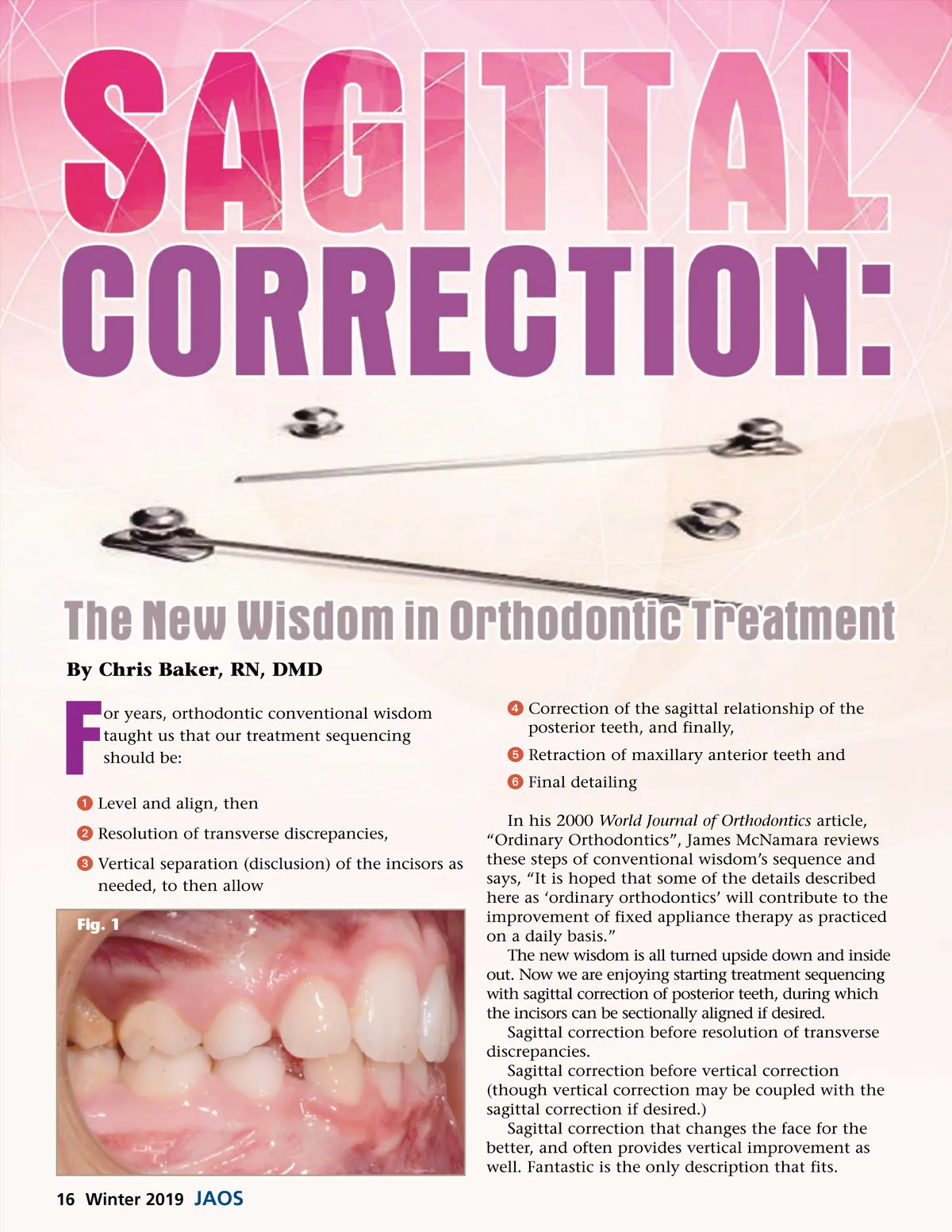
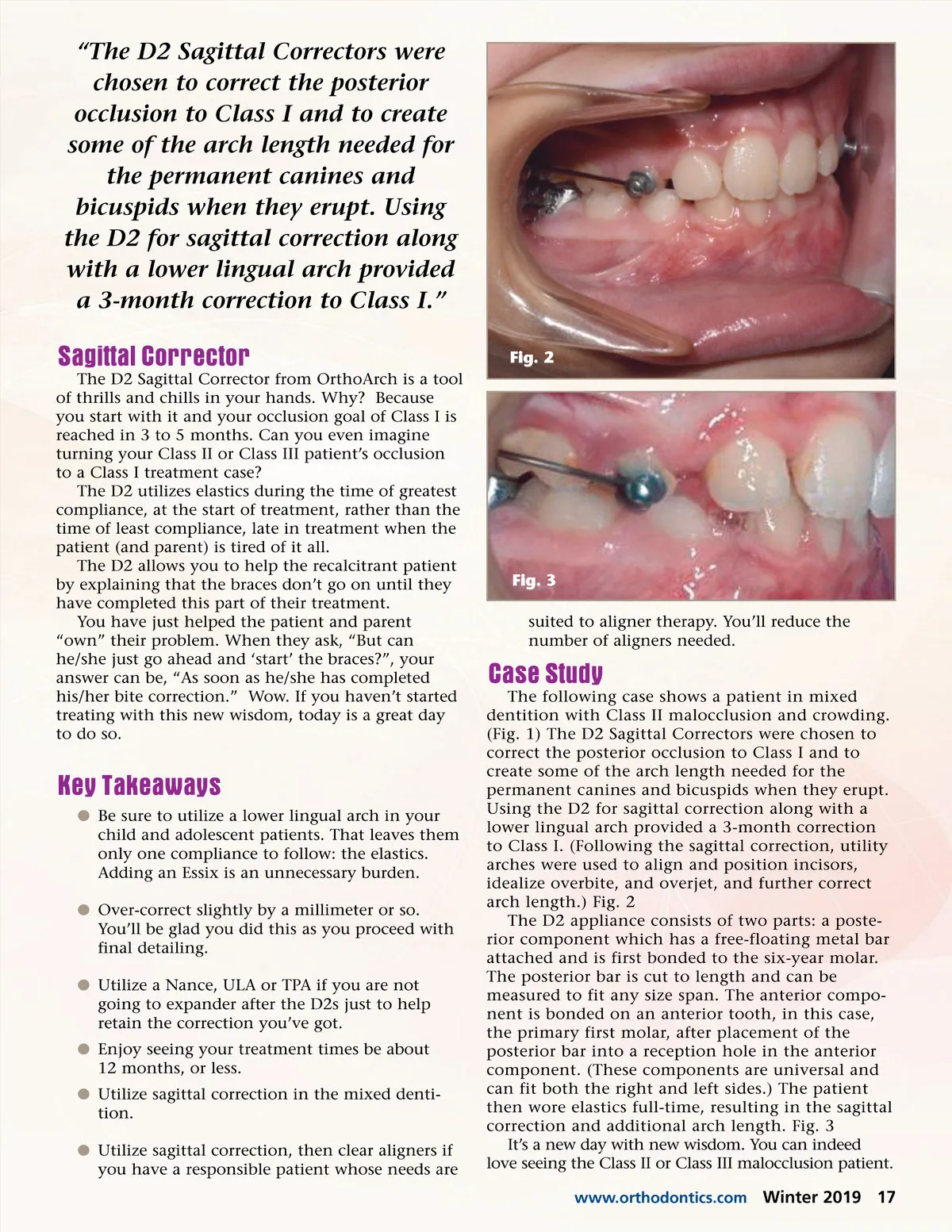
“The D2 Sagittal Correctors were chosen to correct the posterior occlusion to Class I and to create some of the arch length needed for the permanent canines and bicuspids when they erupt. Using the D2 for sagittal correction along with a lower lingual arch provided a 3-month correction to Class I.” Sagittal Corrector The D2 Sagittal Corrector from OrthoArch is a tool of thrills and chills in your hands. Why? Because you start with it and your occlusion goal of Class I is reached in 3 to 5 months. Can you even imagine turning your Class II or Class III patient’s occlusion to a Class I treatment case? The D2 utilizes elastics during the time of greatest compliance, at the start of treatment, rather than the time of least compliance, late in treatment when the patient (and parent) is tired of it all. The D2 allows you to help the recalcitrant patient by explaining that the braces don’t go on until they have completed this part of their treatment. You have just helped the patient and parent “own” their problem. When they ask, “But can he/she just go ahead and ‘start’ the braces?”, your answer can be, “As soon as he/she has completed his/her bite correction.” Wow. If you haven’t started treating with this new wisdom, today is a great day to do so. Fig. 2 Fig. 3 suited to aligner therapy. You’ll reduce the number of aligners needed. Case Study The following case shows a patient in mixed dentition with Class II malocclusion and crowding. (Fig. 1) The D2 Sagittal Correctors were chosen to correct the posterior occlusion to Class I and to create some of the arch length needed for the permanent canines and bicuspids when they erupt. Using the D2 for sagittal correction along with a lower lingual arch provided a 3-month correction to Class I. (Following the sagittal correction, utility arches were used to align and position incisors, idealize overbite, and overjet, and further correct arch length.) Fig. 2 The D2 appliance consists of two parts: a poste-rior component which has a free-floating metal bar attached and is first bonded to the six-year molar. The posterior bar is cut to length and can be measured to fit any size span. The anterior compo-nent is bonded on an anterior tooth, in this case, the primary first molar, after placement of the posterior bar into a reception hole in the anterior component. (These components are universal and can fit both the right and left sides.) The patient then wore elastics full-time, resulting in the sagittal correction and additional arch length. Fig. 3 It’s a new day with new wisdom. You can indeed love seeing the Class II or Class III malocclusion patient. www.orthodontics.com Key Takeaways b Be sure to utilize a lower lingual arch in your child and adolescent patients. That leaves them only one compliance to follow: the elastics. Adding an Essix is an unnecessary burden. b Over-correct slightly by a millimeter or so. You’ll be glad you did this as you proceed with final detailing. b Utilize a Nance, ULA or TPA if you are not going to expander after the D2s just to help retain the correction you’ve got. b Enjoy seeing your treatment times be about 12 months, or less. b Utilize sagittal correction in the mixed denti-tion. b Utilize sagittal correction, then clear aligners if you have a responsible patient whose needs are Winter 2019 17
Journal of the American Orthodontic Society Winter 2019: Page 17