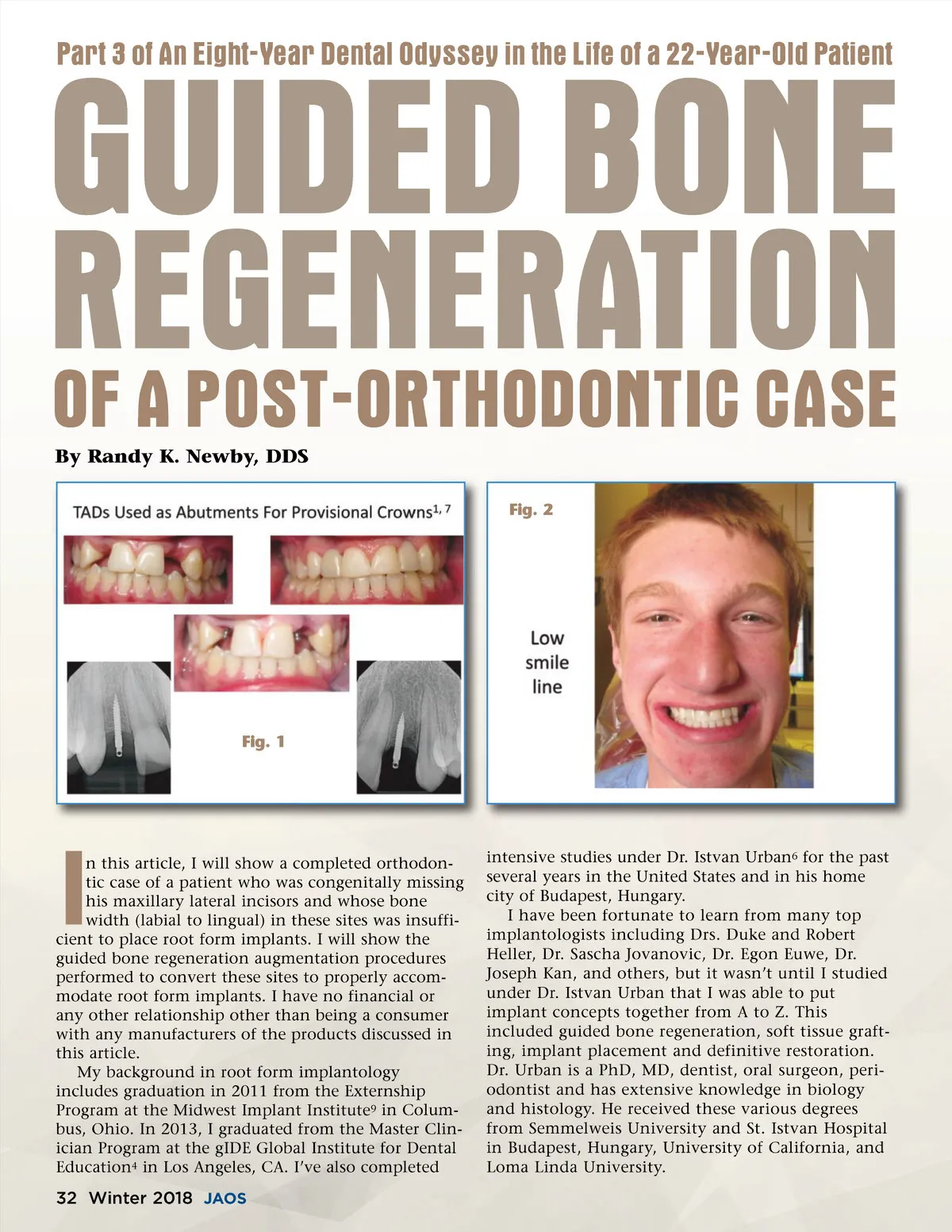
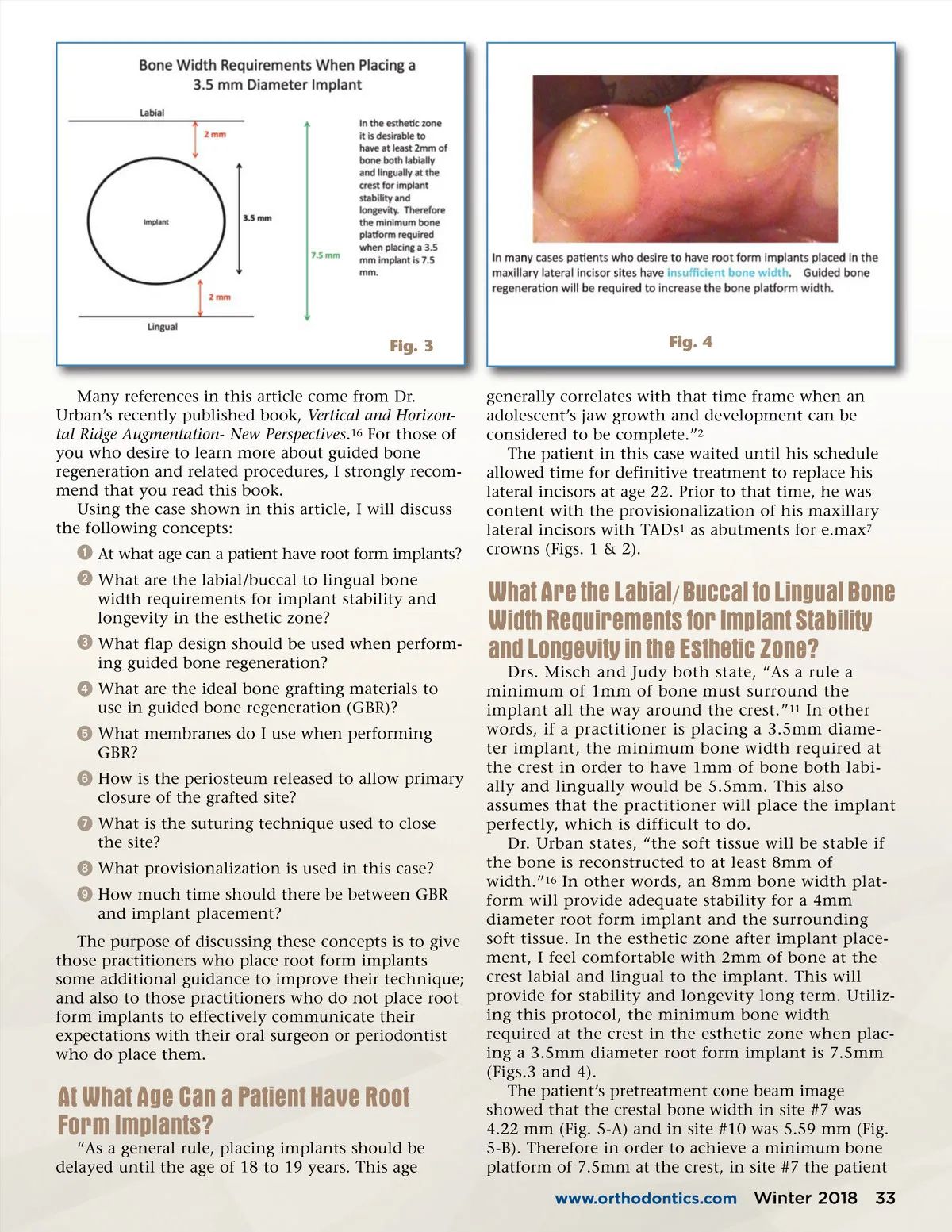
Fig. 3 Many references in this article come from Dr. Urban’s recently published book, Vertical and Horizon-tal Ridge Augmentation-New Perspectives . 16 For those of you who desire to learn more about guided bone regeneration and related procedures, I strongly recom-mend that you read this book. Using the case shown in this article, I will discuss the following concepts: ᕡ At what age can a patient have root form implants? ᕢ What are the labial/buccal to lingual bone width requirements for implant stability and longevity in the esthetic zone? ᕣ What flap design should be used when perform-ing guided bone regeneration? ᕤ What are the ideal bone grafting materials to use in guided bone regeneration (GBR)? ᕥ What membranes do I use when performing GBR? ᕦ How is the periosteum released to allow primary closure of the grafted site? ᕧ What is the suturing technique used to close the site? ᕨ What provisionalization is used in this case? ᕩ How much time should there be between GBR and implant placement? The purpose of discussing these concepts is to give those practitioners who place root form implants some additional guidance to improve their technique; and also to those practitioners who do not place root form implants to effectively communicate their expectations with their oral surgeon or periodontist who do place them. Fig. 4 generally correlates with that time frame when an adolescent’s jaw growth and development can be considered to be complete.” 2 The patient in this case waited until his schedule allowed time for definitive treatment to replace his lateral incisors at age 22. Prior to that time, he was content with the provisionalization of his maxillary lateral incisors with TADs 1 as abutments for e.max 7 crowns (Figs. 1 & 2). What Are the Labial / Buccal to Lingual Bone Width Requirements for Implant Stability and Longevity in the Esthetic Zone? At What Age Can a Patient Have Root Form Implants? “As a general rule, placing implants should be delayed until the age of 18 to 19 years. This age Drs. Misch and Judy both state, “As a rule a minimum of 1mm of bone must surround the implant all the way around the crest.” 11 In other words, if a practitioner is placing a 3.5mm diame-ter implant, the minimum bone width required at the crest in order to have 1mm of bone both labi-ally and lingually would be 5.5mm. This also assumes that the practitioner will place the implant perfectly, which is difficult to do. Dr. Urban states, “the soft tissue will be stable if the bone is reconstructed to at least 8mm of width.” 16 In other words, an 8mm bone width plat-form will provide adequate stability for a 4mm diameter root form implant and the surrounding soft tissue. In the esthetic zone after implant place-ment, I feel comfortable with 2mm of bone at the crest labial and lingual to the implant. This will provide for stability and longevity long term. Utiliz-ing this protocol, the minimum bone width required at the crest in the esthetic zone when plac-ing a 3.5mm diameter root form implant is 7.5mm (Figs.3 and 4). The patient’s pretreatment cone beam image showed that the crestal bone width in site #7 was 4.22 mm (Fig. 5-A) and in site #10 was 5.59 mm (Fig. 5-B). Therefore in order to achieve a minimum bone platform of 7.5mm at the crest, in site #7 the patient www.orthodontics.com Winter 2018 33
Journal of the American Orthodontic Society Winter 2018: Page 33