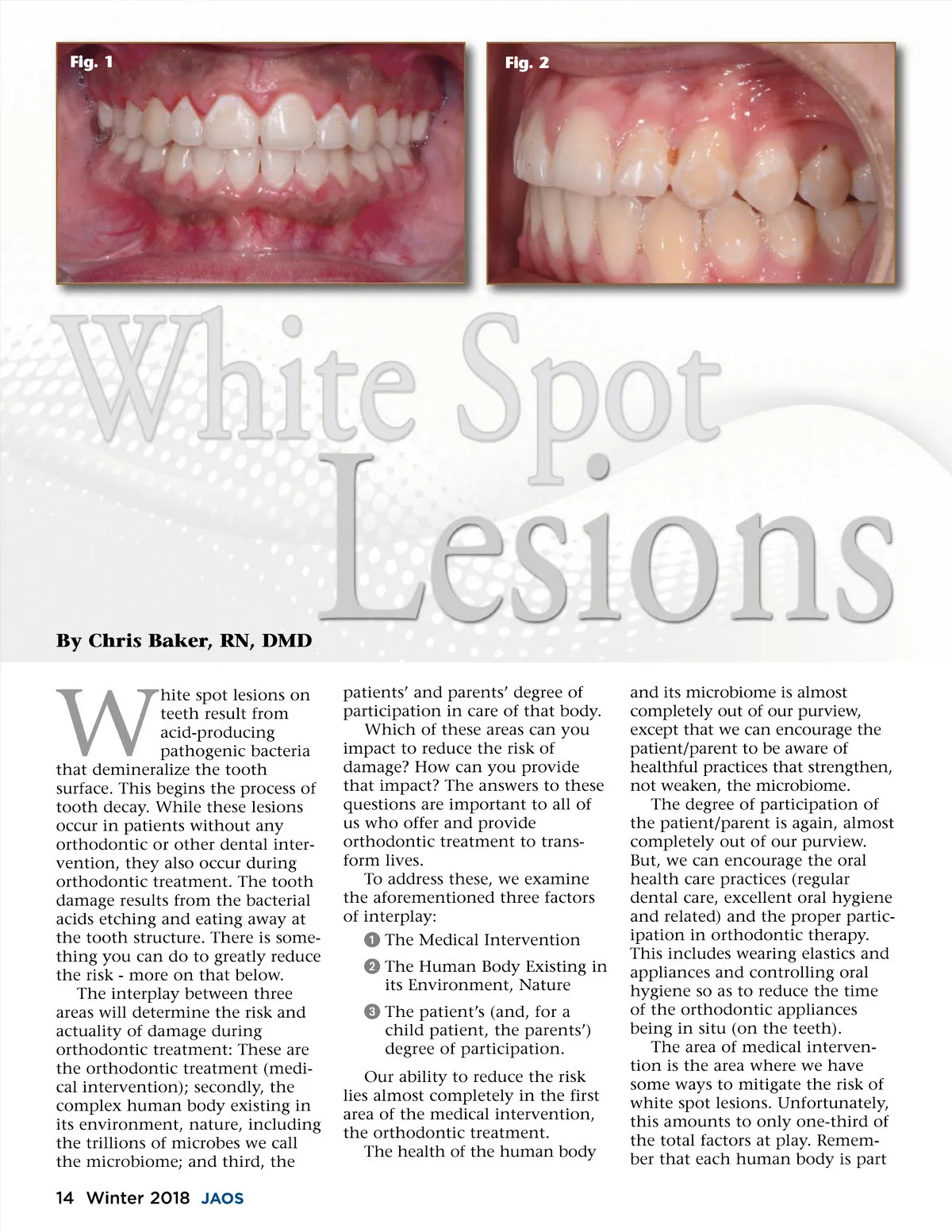
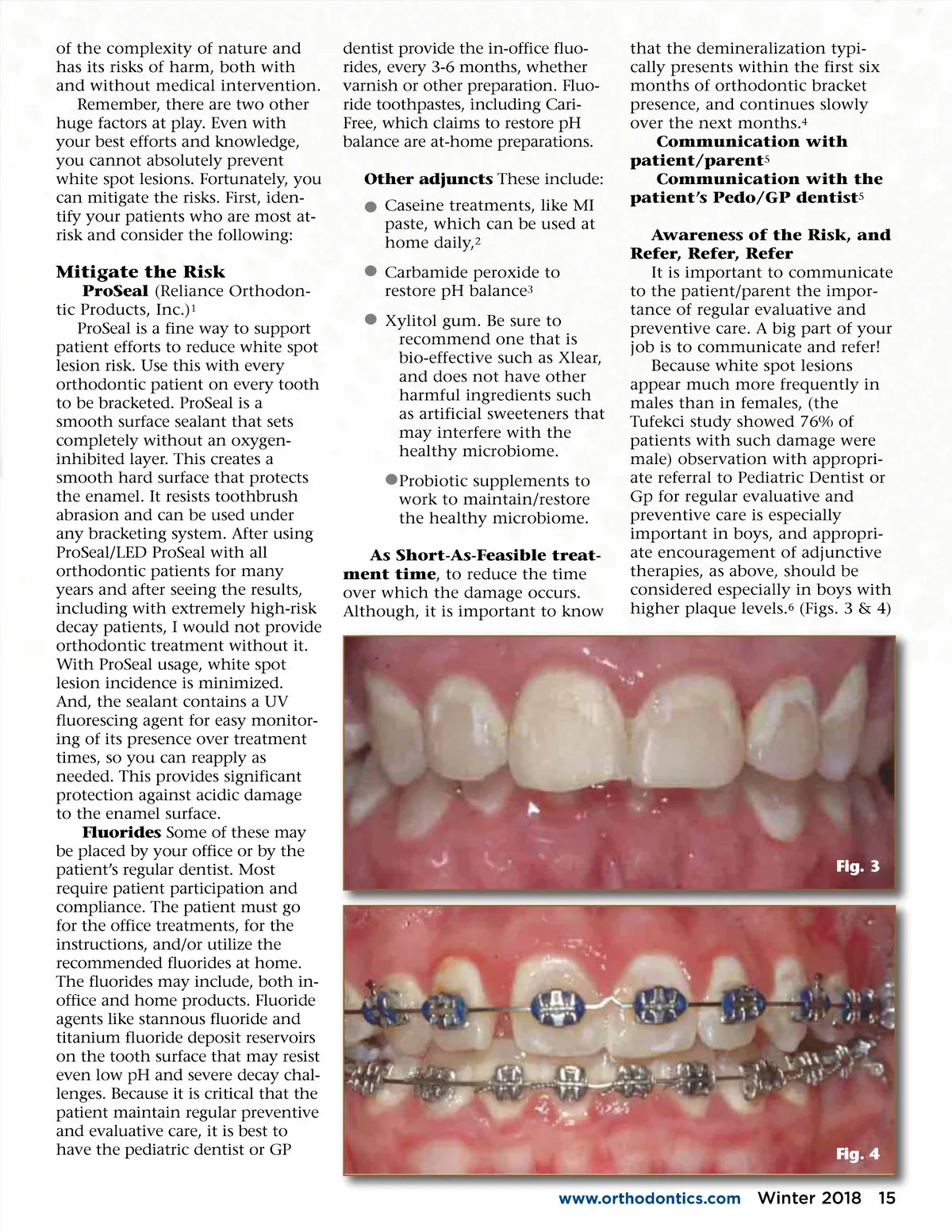
of the complexity of nature and has its risks of harm, both with and without medical intervention. Remember, there are two other huge factors at play. Even with your best efforts and knowledge, you cannot absolutely prevent white spot lesions. Fortunately, you can mitigate the risks. First, iden-tify your patients who are most at-risk and consider the following: dentist provide the in-office fluo-rides, every 3-6 months, whether varnish or other preparation. Fluo-ride toothpastes, including Cari-Free, which claims to restore pH balance are at-home preparations. Other adjuncts These include: b Caseine treatments, like MI paste, which can be used at home daily, 2 b Carbamide peroxide to restore pH balance 3 b Xylitol gum. Be sure to recommend one that is bio-effective such as Xlear, and does not have other harmful ingredients such as artificial sweeteners that may interfere with the healthy microbiome. b Probiotic supplements to work to maintain/restore the healthy microbiome. As Short-As-Feasible treat-ment time , to reduce the time over which the damage occurs. Although, it is important to know that the demineralization typi-cally presents within the first six months of orthodontic bracket presence, and continues slowly over the next months. 4 Communication with patient/parent 5 Communication with the patient’s Pedo/GP dentist 5 Awareness of the Risk, and Refer, Refer, Refer It is important to communicate to the patient/parent the impor-tance of regular evaluative and preventive care. A big part of your job is to communicate and refer! Because white spot lesions appear much more frequently in males than in females, (the Tufekci study showed 76% of patients with such damage were male) observation with appropri-ate referral to Pediatric Dentist or Gp for regular evaluative and preventive care is especially important in boys, and appropri-ate encouragement of adjunctive therapies, as above, should be considered especially in boys with higher plaque levels. 6 (Figs. 3 & 4) Mitigate the Risk ProSeal (Reliance Orthodon-tic Products, Inc.) 1 ProSeal is a fine way to support patient efforts to reduce white spot lesion risk. Use this with every orthodontic patient on every tooth to be bracketed. ProSeal is a smooth surface sealant that sets completely without an oxygen-inhibited layer. This creates a smooth hard surface that protects the enamel. It resists toothbrush abrasion and can be used under any bracketing system. After using ProSeal/LED ProSeal with all orthodontic patients for many years and after seeing the results, including with extremely high-risk decay patients, I would not provide orthodontic treatment without it. With ProSeal usage, white spot lesion incidence is minimized. And, the sealant contains a UV fluorescing agent for easy monitor-ing of its presence over treatment times, so you can reapply as needed. This provides significant protection against acidic damage to the enamel surface. Fluorides Some of these may be placed by your office or by the patient’s regular dentist. Most require patient participation and compliance. The patient must go for the office treatments, for the instructions, and/or utilize the recommended fluorides at home. The fluorides may include, both in-office and home products. Fluoride agents like stannous fluoride and titanium fluoride deposit reservoirs on the tooth surface that may resist even low pH and severe decay chal-lenges. Because it is critical that the patient maintain regular preventive and evaluative care, it is best to have the pediatric dentist or GP Fig. 3 Fig. 4 www.orthodontics.com Winter 2018 15
Journal of the American Orthodontic Society Winter 2018: Page 15