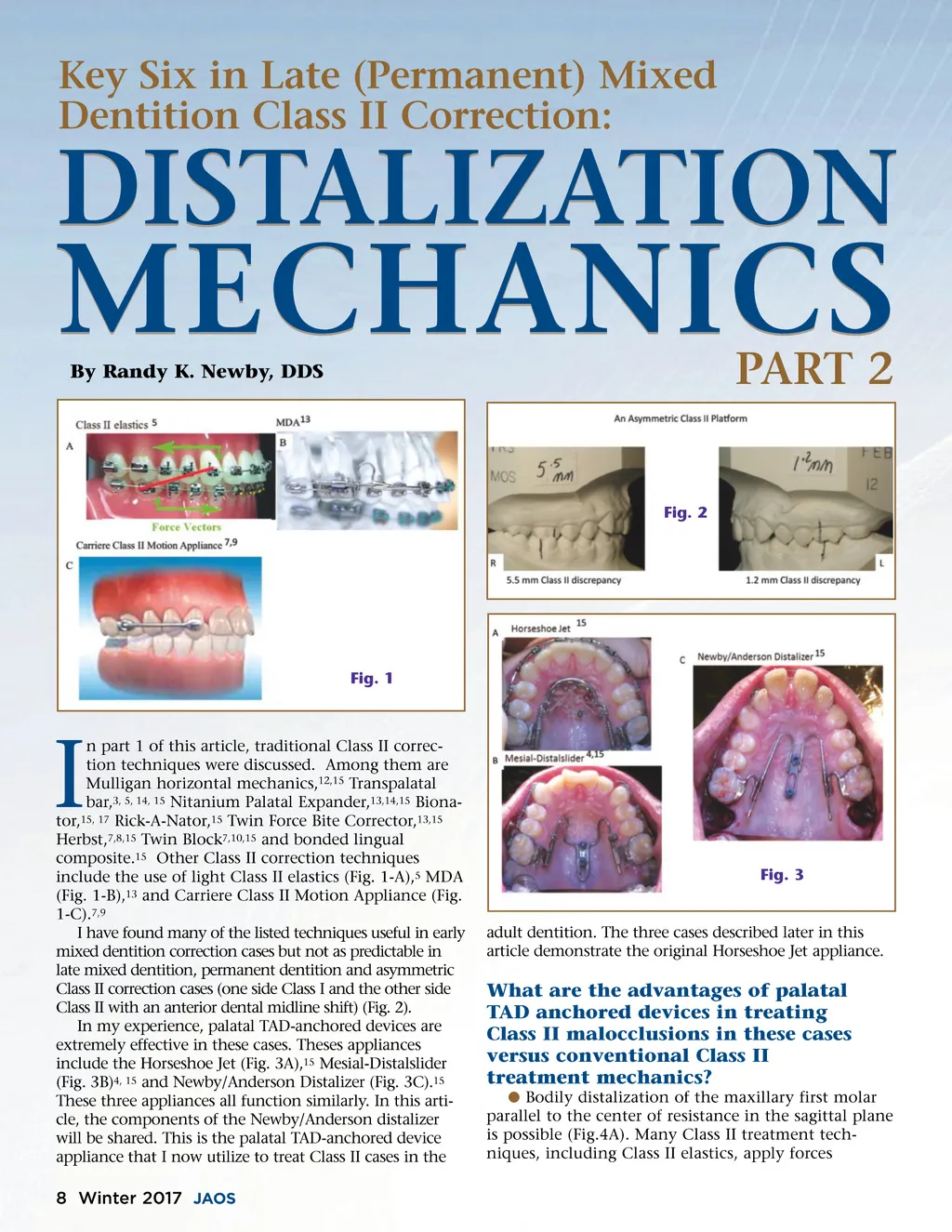
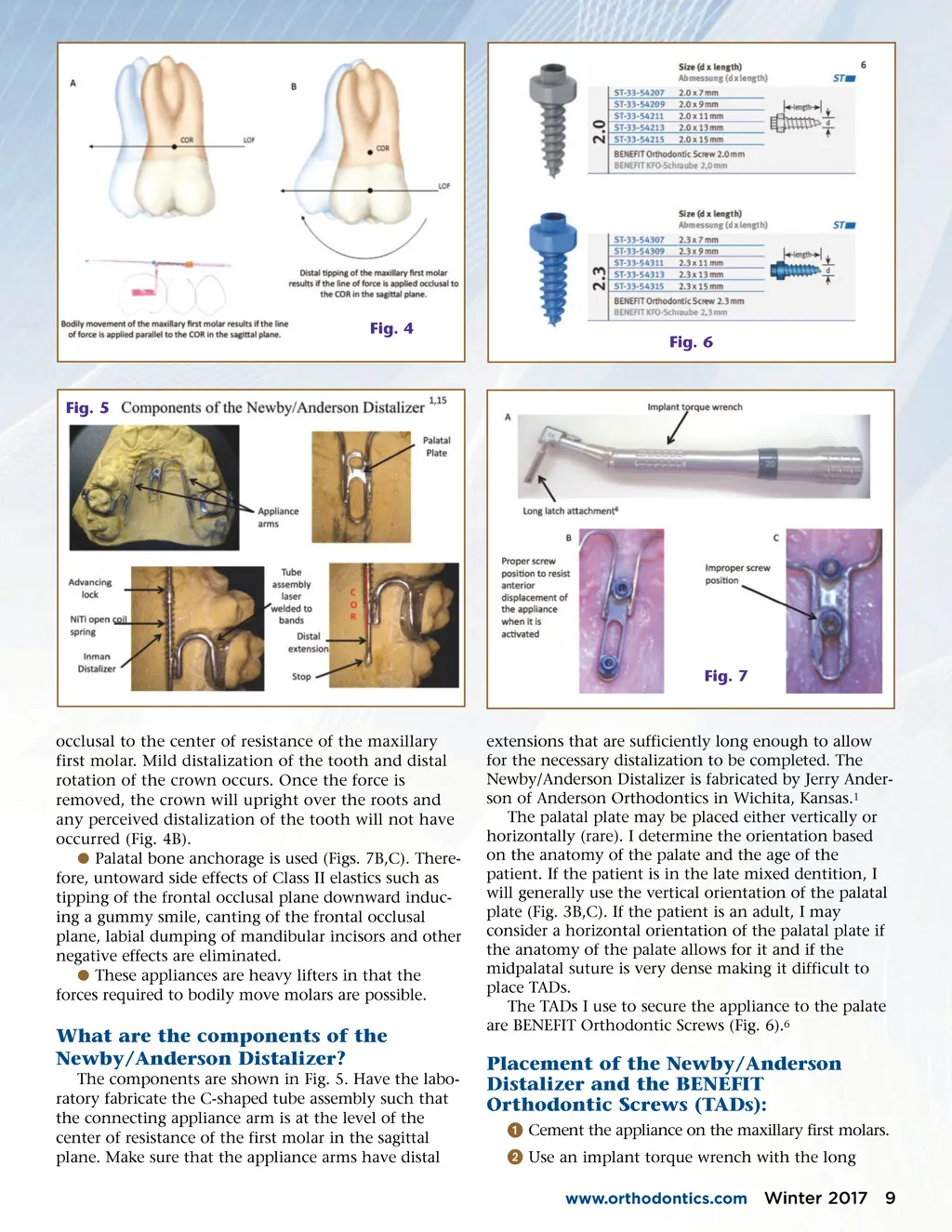
Key Six in Late (Permanent) Mixed Dentition Class II Correction: DISTALIZATION MECHANICS By Randy K. Newby, DDS PART 2 Fig. 2 Fig. 1 I n part 1 of this article, traditional Class II correc-tion techniques were discussed. Among them are Mulligan horizontal mechanics, 12,15 Transpalatal bar, 3, 5, 14, 15 Nitanium Palatal Expander, 13,14,15 Biona-tor, 15, 17 Rick-A-Nator, 15 Twin Force Bite Corrector, 13,15 Herbst, 7,8,15 Twin Block 7,10,15 and bonded lingual composite. 15 Other Class II correction techniques include the use of light Class II elastics (Fig. 1-A), 5 MDA (Fig. 1-B), 13 and Carriere Class II Motion Appliance (Fig. 1-C). 7,9 I have found many of the listed techniques useful in early mixed dentition correction cases but not as predictable in late mixed dentition, permanent dentition and asymmetric Class II correction cases (one side Class I and the other side Class II with an anterior dental midline shift) (Fig. 2). In my experience, palatal TAD-anchored devices are extremely effective in these cases. Theses appliances include the Horseshoe Jet (Fig. 3A), 15 Mesial-Distalslider (Fig. 3B) 4, 15 and Newby/Anderson Distalizer (Fig. 3C). 15 These three appliances all function similarly. In this arti-cle, the components of the Newby/Anderson distalizer will be shared. This is the palatal TAD-anchored device appliance that I now utilize to treat Class II cases in the Fig. 3 adult dentition. The three cases described later in this article demonstrate the original Horseshoe Jet appliance. b Bodily distalization of the maxillary first molar parallel to the center of resistance in the sagittal plane is possible (Fig.4A). Many Class II treatment tech-niques, including Class II elastics, apply forces What are the advantages of palatal TAD anchored devices in treating Class II malocclusions in these cases versus conventional Class II treatment mechanics? 8 Winter 2017 JAOS
Journal of the American Orthodontic Society Winter 2017: Page 8