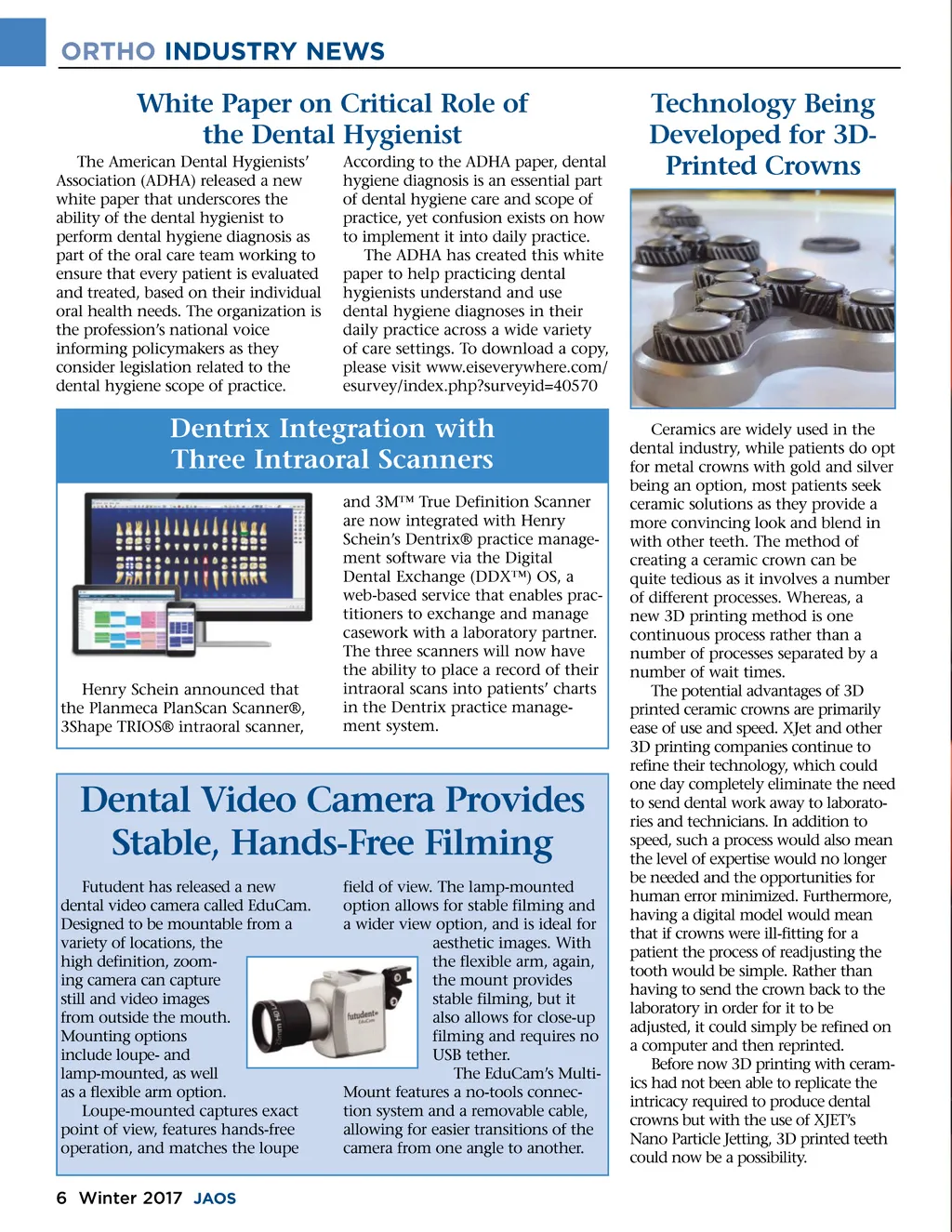
ORTHO INDUSTRY NEWS White Paper on Critical Role of the Dental Hygienist The American Dental Hygienists’ Association (ADHA) released a new white paper that underscores the ability of the dental hygienist to perform dental hygiene diagnosis as part of the oral care team working to ensure that every patient is evaluated and treated, based on their individual oral health needs. The organization is the profession’s national voice informing policymakers as they consider legislation related to the dental hygiene scope of practice. According to the ADHA paper, dental hygiene diagnosis is an essential part of dental hygiene care and scope of practice, yet confusion exists on how to implement it into daily practice. The ADHA has created this white paper to help practicing dental hygienists understand and use dental hygiene diagnoses in their daily practice across a wide variety of care settings. To download a copy, please visit www.eiseverywhere.com/ esurvey/index.php?surveyid=40570 Technology Being Developed for 3D-Printed Crowns Dentrix Integration with Three Intraoral Scanners and 3M™ True Definition Scanner are now integrated with Henry Schein’s Dentrix® practice manage-ment software via the Digital Dental Exchange (DDX™) OS, a web-based service that enables prac-titioners to exchange and manage casework with a laboratory partner. The three scanners will now have the ability to place a record of their intraoral scans into patients’ charts in the Dentrix practice manage-ment system. Henry Schein announced that the Planmeca PlanScan Scanner®, 3Shape TRIOS® intraoral scanner, Dental Video Camera Provides Stable, Hands-Free Filming Futudent has released a new dental video camera called EduCam. Designed to be mountable from a variety of locations, the high definition, zoom-ing camera can capture still and video images from outside the mouth. Mounting options include loupe-and lamp-mounted, as well as a flexible arm option. Loupe-mounted captures exact point of view, features hands-free operation, and matches the loupe field of view. The lamp-mounted option allows for stable filming and a wider view option, and is ideal for aesthetic images. With the flexible arm, again, the mount provides stable filming, but it also allows for close-up filming and requires no USB tether. The EduCam’s Multi-Mount features a no-tools connec-tion system and a removable cable, allowing for easier transitions of the camera from one angle to another. Ceramics are widely used in the dental industry, while patients do opt for metal crowns with gold and silver being an option, most patients seek ceramic solutions as they provide a more convincing look and blend in with other teeth. The method of creating a ceramic crown can be quite tedious as it involves a number of different processes. Whereas, a new 3D printing method is one continuous process rather than a number of processes separated by a number of wait times. The potential advantages of 3D printed ceramic crowns are primarily ease of use and speed. XJet and other 3D printing companies continue to refine their technology, which could one day completely eliminate the need to send dental work away to laborato-ries and technicians. In addition to speed, such a process would also mean the level of expertise would no longer be needed and the opportunities for human error minimized. Furthermore, having a digital model would mean that if crowns were ill-fitting for a patient the process of readjusting the tooth would be simple. Rather than having to send the crown back to the laboratory in order for it to be adjusted, it could simply be refined on a computer and then reprinted. Before now 3D printing with ceram-ics had not been able to replicate the intricacy required to produce dental crowns but with the use of XJET’s Nano Particle Jetting, 3D printed teeth could now be a possibility. 6 Winter 2017 JAOS
Journal of the American Orthodontic Society Winter 2017: Page 6