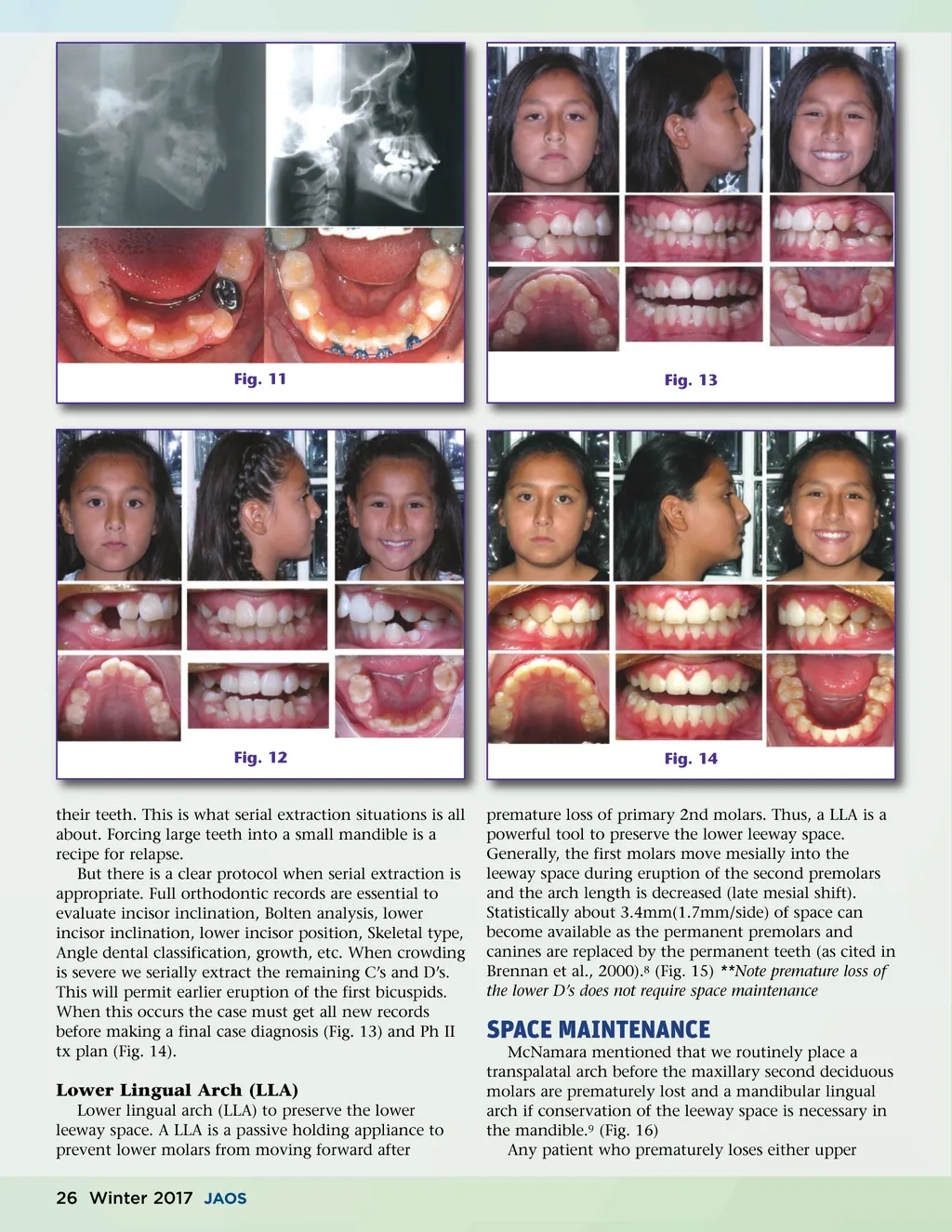
Fig. 11 Fig. 13 Fig. 12 Fig. 14 their teeth. This is what serial extraction situations is all about. Forcing large teeth into a small mandible is a recipe for relapse. But there is a clear protocol when serial extraction is appropriate. Full orthodontic records are essential to evaluate incisor inclination, Bolten analysis, lower incisor inclination, lower incisor position, Skeletal type, Angle dental classification, growth, etc. When crowding is severe we serially extract the remaining C’s and D’s. This will permit earlier eruption of the first bicuspids. When this occurs the case must get all new records before making a final case diagnosis (Fig. 13) and Ph II tx plan (Fig. 14). premature loss of primary 2nd molars. Thus, a LLA is a powerful tool to preserve the lower leeway space. Generally, the first molars move mesially into the leeway space during eruption of the second premolars and the arch length is decreased (late mesial shift). Statistically about 3.4mm(1.7mm/side) of space can become available as the permanent premolars and canines are replaced by the permanent teeth (as cited in Brennan et al., 2000). 8 (Fig. 15) **Note premature loss of the lower D’s does not require space maintenance SPACE MAINTENANCE McNamara mentioned that we routinely place a transpalatal arch before the maxillary second deciduous molars are prematurely lost and a mandibular lingual arch if conservation of the leeway space is necessary in the mandible. 9 (Fig. 16) Any patient who prematurely loses either upper Lower Lingual Arch (LLA) Lower lingual arch (LLA) to preserve the lower leeway space. A LLA is a passive holding appliance to prevent lower molars from moving forward after 26 Winter 2017 JAOS
Journal of the American Orthodontic Society Winter 2017: Page 26