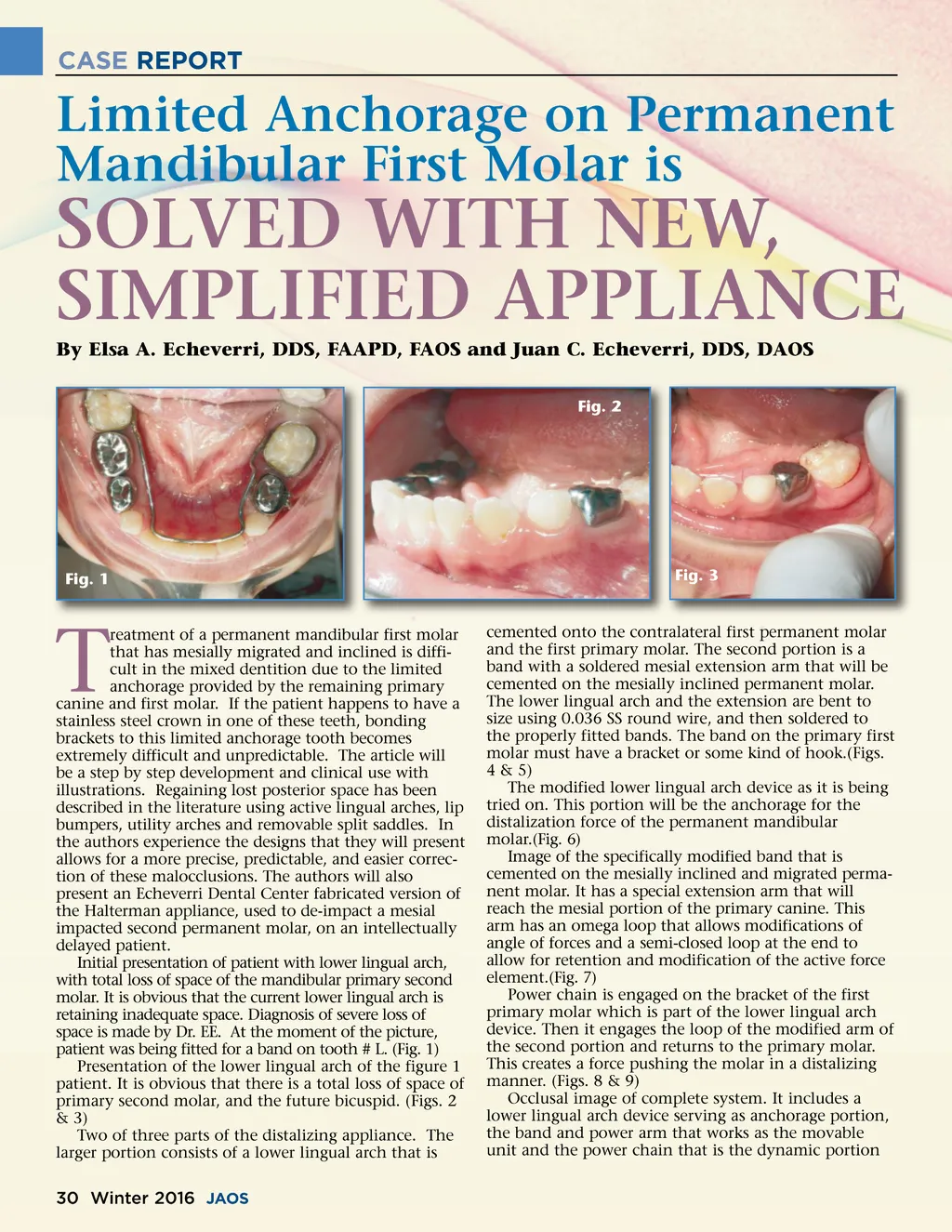
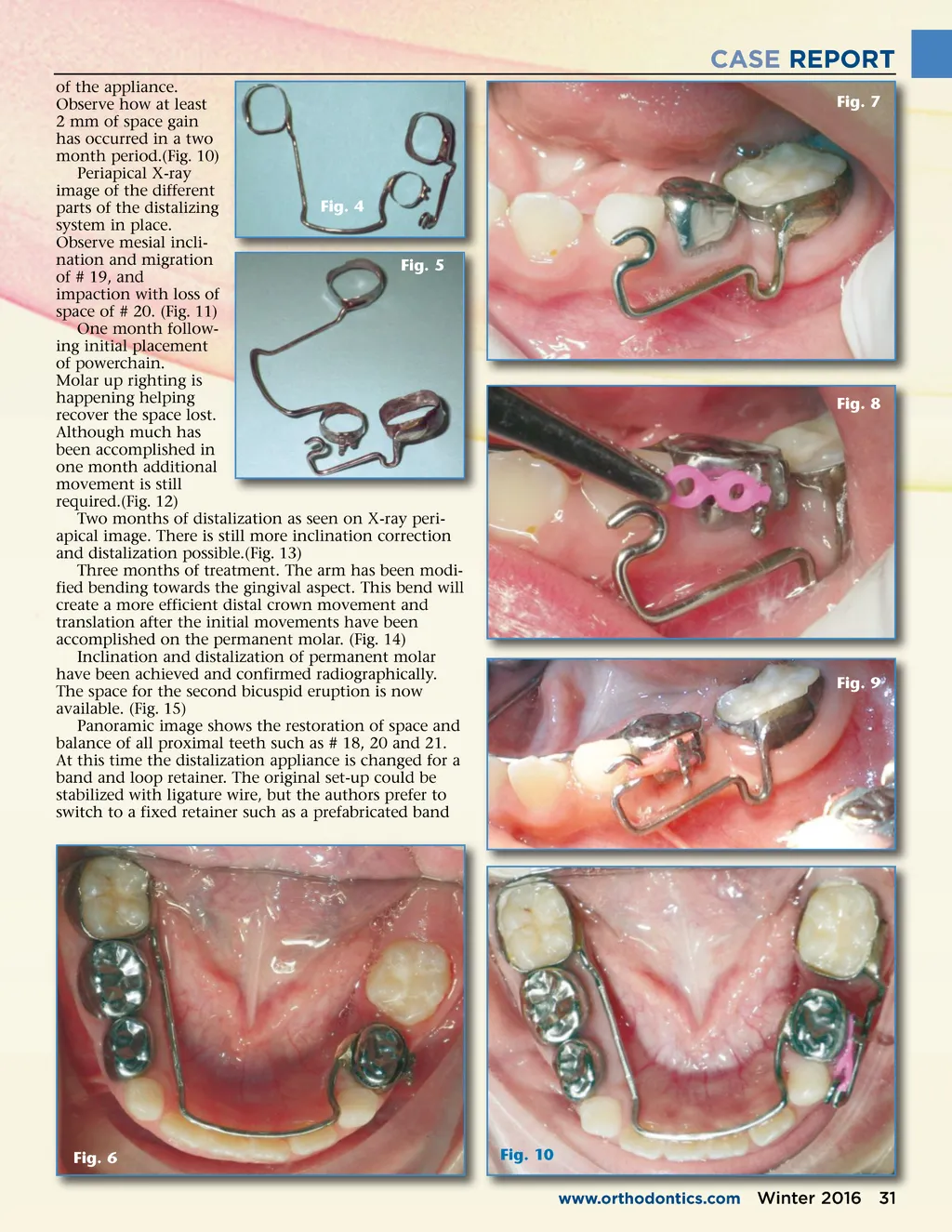
CASE REPORT Limited Anchorage on Permanent Mandibular First Molar is SOLVED WITH NEW, SIMPLIFIED APPLIANCE By Elsa A. Echeverri, DDS, FAAPD, FAOS and Juan C. Echeverri, DDS, DAOS Fig. 2 Fig. 1 Fig. 3 T reatment of a permanent mandibular first molar that has mesially migrated and inclined is diffi-cult in the mixed dentition due to the limited anchorage provided by the remaining primary canine and first molar. If the patient happens to have a stainless steel crown in one of these teeth, bonding brackets to this limited anchorage tooth becomes extremely difficult and unpredictable. The article will be a step by step development and clinical use with illustrations. Regaining lost posterior space has been described in the literature using active lingual arches, lip bumpers, utility arches and removable split saddles. In the authors experience the designs that they will present allows for a more precise, predictable, and easier correc-tion of these malocclusions. The authors will also present an Echeverri Dental Center fabricated version of the Halterman appliance, used to de-impact a mesial impacted second permanent molar, on an intellectually delayed patient. Initial presentation of patient with lower lingual arch, with total loss of space of the mandibular primary second molar. It is obvious that the current lower lingual arch is retaining inadequate space. Diagnosis of severe loss of space is made by Dr. EE. At the moment of the picture, patient was being fitted for a band on tooth # L. (Fig. 1) Presentation of the lower lingual arch of the figure 1 patient. It is obvious that there is a total loss of space of primary second molar, and the future bicuspid. (Figs. 2 & 3) Two of three parts of the distalizing appliance. The larger portion consists of a lower lingual arch that is cemented onto the contralateral first permanent molar and the first primary molar. The second portion is a band with a soldered mesial extension arm that will be cemented on the mesially inclined permanent molar. The lower lingual arch and the extension are bent to size using 0.036 SS round wire, and then soldered to the properly fitted bands. The band on the primary first molar must have a bracket or some kind of hook.(Figs. 4 & 5) The modified lower lingual arch device as it is being tried on. This portion will be the anchorage for the distalization force of the permanent mandibular molar.(Fig. 6) Image of the specifically modified band that is cemented on the mesially inclined and migrated perma-nent molar. It has a special extension arm that will reach the mesial portion of the primary canine. This arm has an omega loop that allows modifications of angle of forces and a semi-closed loop at the end to allow for retention and modification of the active force element.(Fig. 7) Power chain is engaged on the bracket of the first primary molar which is part of the lower lingual arch device. Then it engages the loop of the modified arm of the second portion and returns to the primary molar. This creates a force pushing the molar in a distalizing manner. (Figs. 8 & 9) Occlusal image of complete system. It includes a lower lingual arch device serving as anchorage portion, the band and power arm that works as the movable unit and the power chain that is the dynamic portion 30 Winter 2016 JAOS
Journal of the American Orthodontic Society Winter 2016: Page 30