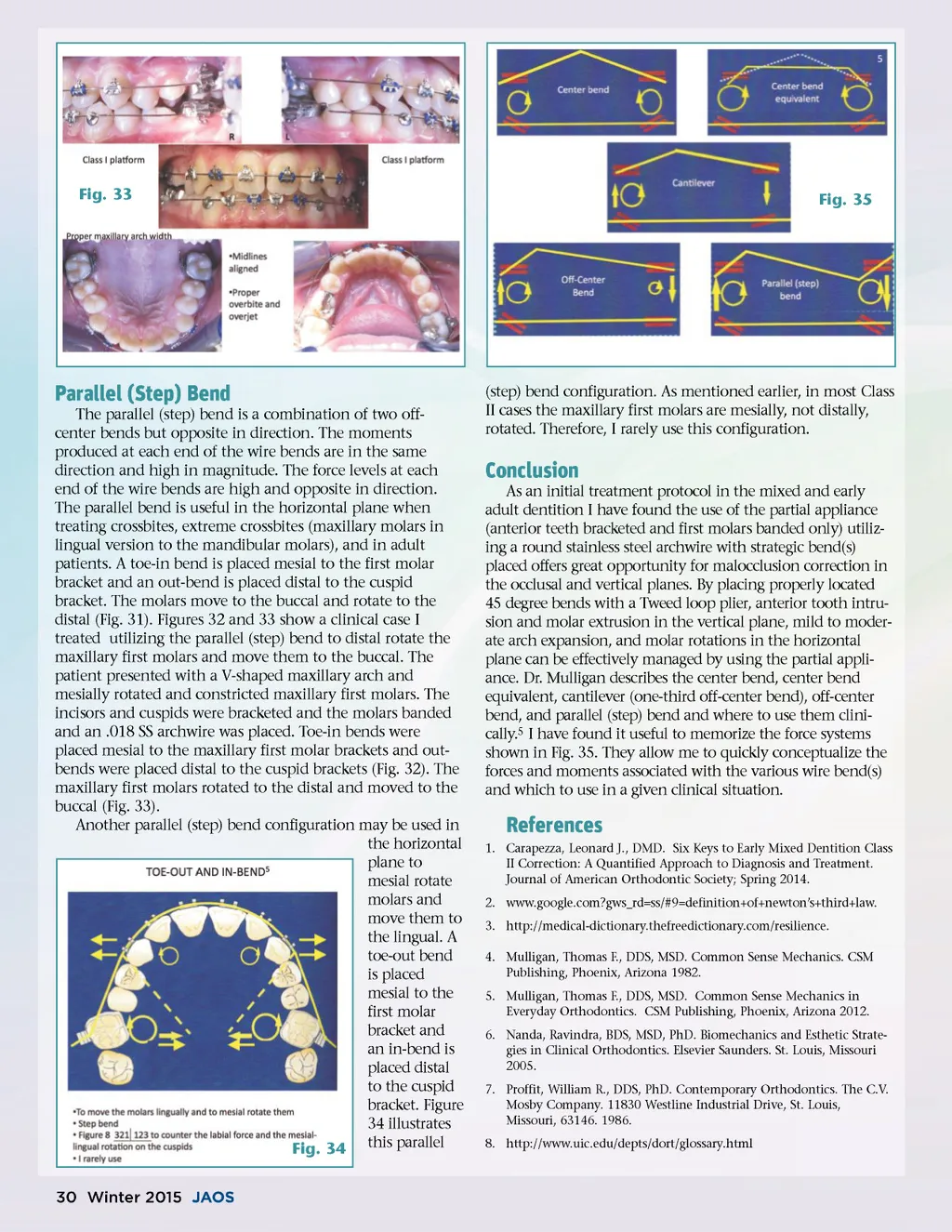
Fig. 33 Fig. 35 Parallel (Step) Bend The parallel (step) bend is a combination of two off-center bends but opposite in direction. The moments produced at each end of the wire bends are in the same direction and high in magnitude. The force levels at each end of the wire bends are high and opposite in direction. The parallel bend is useful in the horizontal plane when treating crossbites, extreme crossbites (maxillary molars in lingual version to the mandibular molars), and in adult patients. A toe-in bend is placed mesial to the first molar bracket and an out-bend is placed distal to the cuspid bracket. The molars move to the buccal and rotate to the distal (Fig. 31). Figures 32 and 33 show a clinical case I treated utilizing the parallel (step) bend to distal rotate the maxillary first molars and move them to the buccal. The patient presented with a V-shaped maxillary arch and mesially rotated and constricted maxillary first molars. The incisors and cuspids were bracketed and the molars banded and an .018 SS archwire was placed. Toe-in bends were placed mesial to the maxillary first molar brackets and out-bends were placed distal to the cuspid brackets (Fig. 32). The maxillary first molars rotated to the distal and moved to the buccal (Fig. 33). Another parallel (step) bend configuration may be used in the horizontal plane to mesial rotate molars and move them to the lingual. A toe-out bend is placed mesial to the first molar bracket and an in-bend is placed distal to the cuspid bracket. Figure 34 illustrates Fig. 34 this parallel 30 Winter 2015 JAOS (step) bend configuration. As mentioned earlier, in most Class II cases the maxillary first molars are mesially, not distally, rotated. Therefore, I rarely use this configuration. Conclusion As an initial treatment protocol in the mixed and early adult dentition I have found the use of the partial appliance (anterior teeth bracketed and first molars banded only) utiliz-ing a round stainless steel archwire with strategic bend(s) placed offers great opportunity for malocclusion correction in the occlusal and vertical planes. By placing properly located 45 degree bends with a Tweed loop plier, anterior tooth intru-sion and molar extrusion in the vertical plane, mild to moder-ate arch expansion, and molar rotations in the horizontal plane can be effectively managed by using the partial appli-ance. Dr. Mulligan describes the center bend, center bend equivalent, cantilever (one-third off-center bend), off-center bend, and parallel (step) bend and where to use them clini-cally. 5 I have found it useful to memorize the force systems shown in Fig. 35. They allow me to quickly conceptualize the forces and moments associated with the various wire bend(s) and which to use in a given clinical situation. References 1. Carapezza, Leonard J., DMD. Six Keys to Early Mixed Dentition Class II Correction: A Quantified Approach to Diagnosis and Treatment. Journal of American Orthodontic Society; Spring 2014. 2. www.google.com?gws_rd=ss/#9=definition+of+newton’s+third+law. 3. http://medical-dictionary.thefreedictionary.com/resilience. 4. Mulligan, Thomas F., DDS, MSD. Common Sense Mechanics. CSM Publishing, Phoenix, Arizona 1982. 5. Mulligan, Thomas F., DDS, MSD. Common Sense Mechanics in Everyday Orthodontics. CSM Publishing, Phoenix, Arizona 2012. 6. Nanda, Ravindra, BDS, MSD, PhD. Biomechanics and Esthetic Strate-gies in Clinical Orthodontics. Elsevier Saunders. St. Louis, Missouri 2005. 7. Proffit, William R., DDS, PhD. Contemporary Orthodontics. The C.V. Mosby Company. 11830 Westline Industrial Drive, St. Louis, Missouri, 63146. 1986. 8. http://www.uic.edu/depts/dort/glossary.html
Journal of the American Orthodontic Society Winter 2015: Page 30