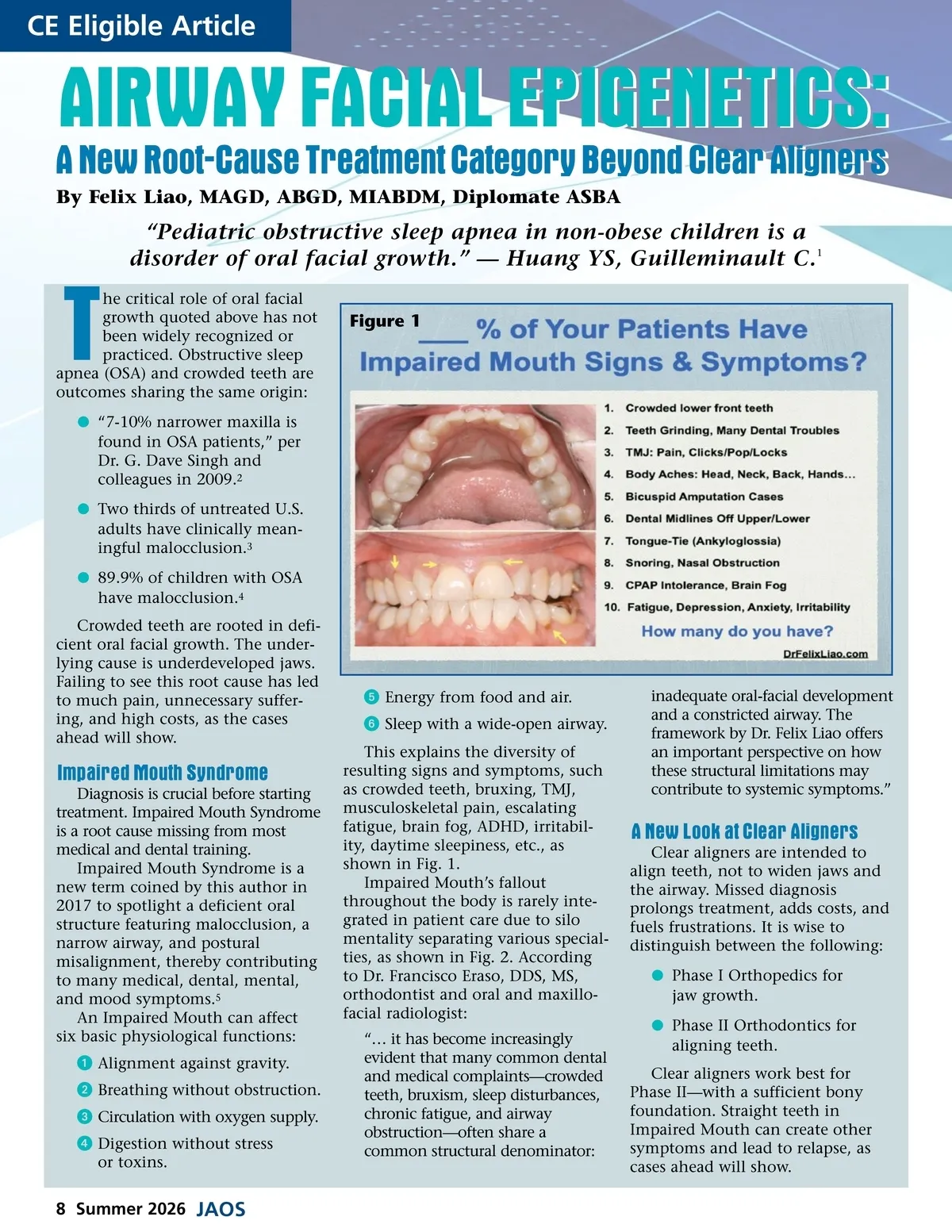
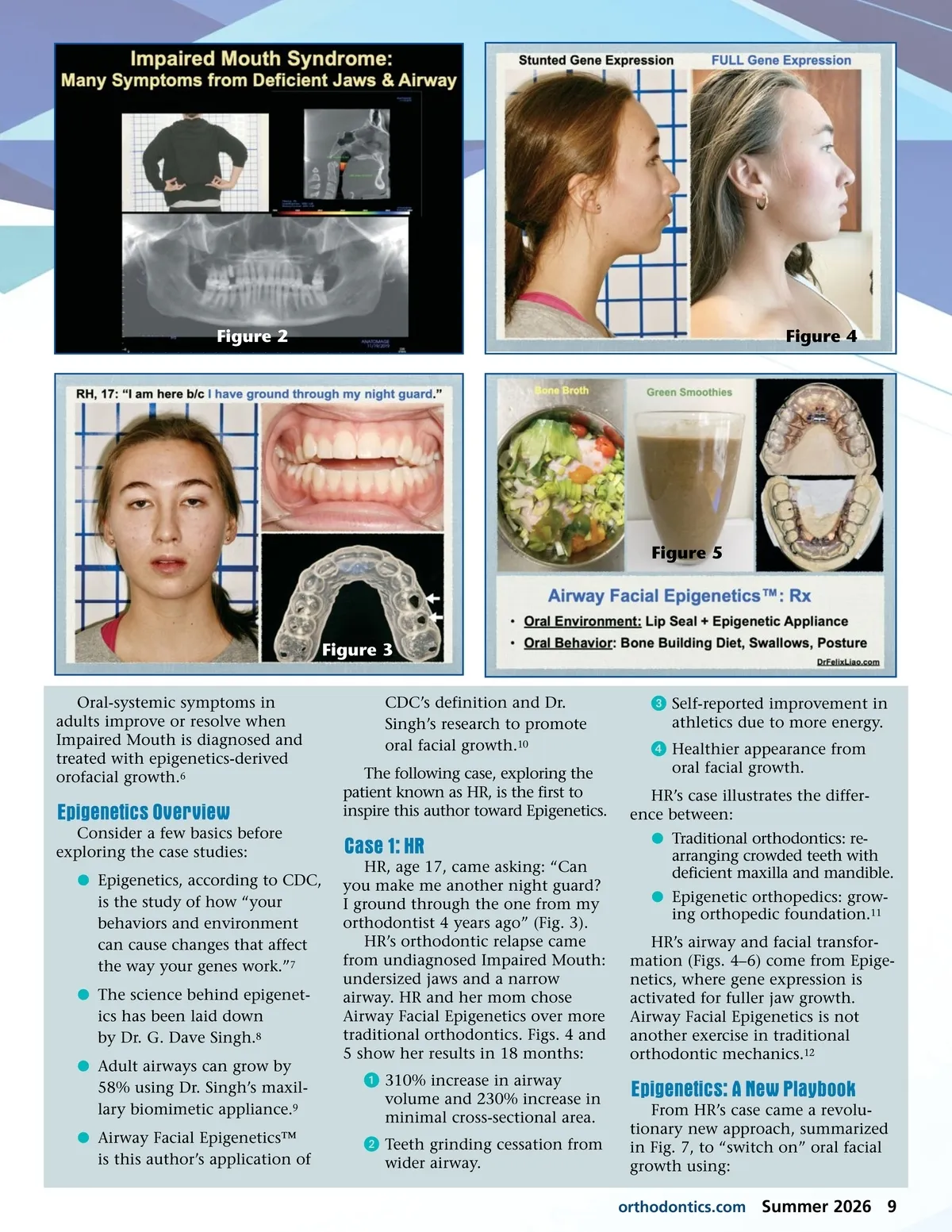
Figure 2 Figure 4 Figure 5 Figure 3 Oral-systemic symptoms in adults improve or resolve when Impaired Mouth is diagnosed and treated with epigenetics-derived orofacial growth. 6 CDC’s definition and Dr. Singh’s research to promote oral facial growth. 10 The following case, exploring the patient known as HR, is the first to inspire this author toward Epigenetics. ᕣ Self-reported improvement in athletics due to more energy. ᕤ Healthier appearance from oral facial growth. HR’s case illustrates the differ-ence between: b Traditional orthodontics: re-arranging crowded teeth with deficient maxilla and mandible. b Epigenetic orthopedics: grow-ing orthopedic foundation. 11 HR’s airway and facial transfor-mation (Figs. 4–6) come from Epige-netics, where gene expression is activated for fuller jaw growth. Airway Facial Epigenetics is not another exercise in traditional orthodontic mechanics. 12 Epigenetics Overview Consider a few basics before exploring the case studies: b Epigenetics, according to CDC, is the study of how “your behaviors and environment can cause changes that affect the way your genes work.” 7 b The science behind epigenet-ics has been laid down by Dr. G. Dave Singh. 8 b Adult airways can grow by 58% using Dr. Singh’s maxil-lary biomimetic appliance. 9 b Airway Facial Epigenetics™ is this author’s application of Case 1: HR HR, age 17, came asking: “Can you make me another night guard? I ground through the one from my orthodontist 4 years ago” (Fig. 3). HR’s orthodontic relapse came from undiagnosed Impaired Mouth: undersized jaws and a narrow airway. HR and her mom chose Airway Facial Epigenetics over more traditional orthodontics. Figs. 4 and 5 show her results in 18 months: ᕡ 310% increase in airway volume and 230% increase in minimal cross-sectional area. ᕢ Teeth grinding cessation from wider airway. Epigenetics: A New Playbook From HR’s case came a revolu-tionary new approach, summarized in Fig. 7, to “switch on” oral facial growth using: orthodontics.com Summer 2026 9
Journal of the American Orthodontic Society Summer 2026: Page 9