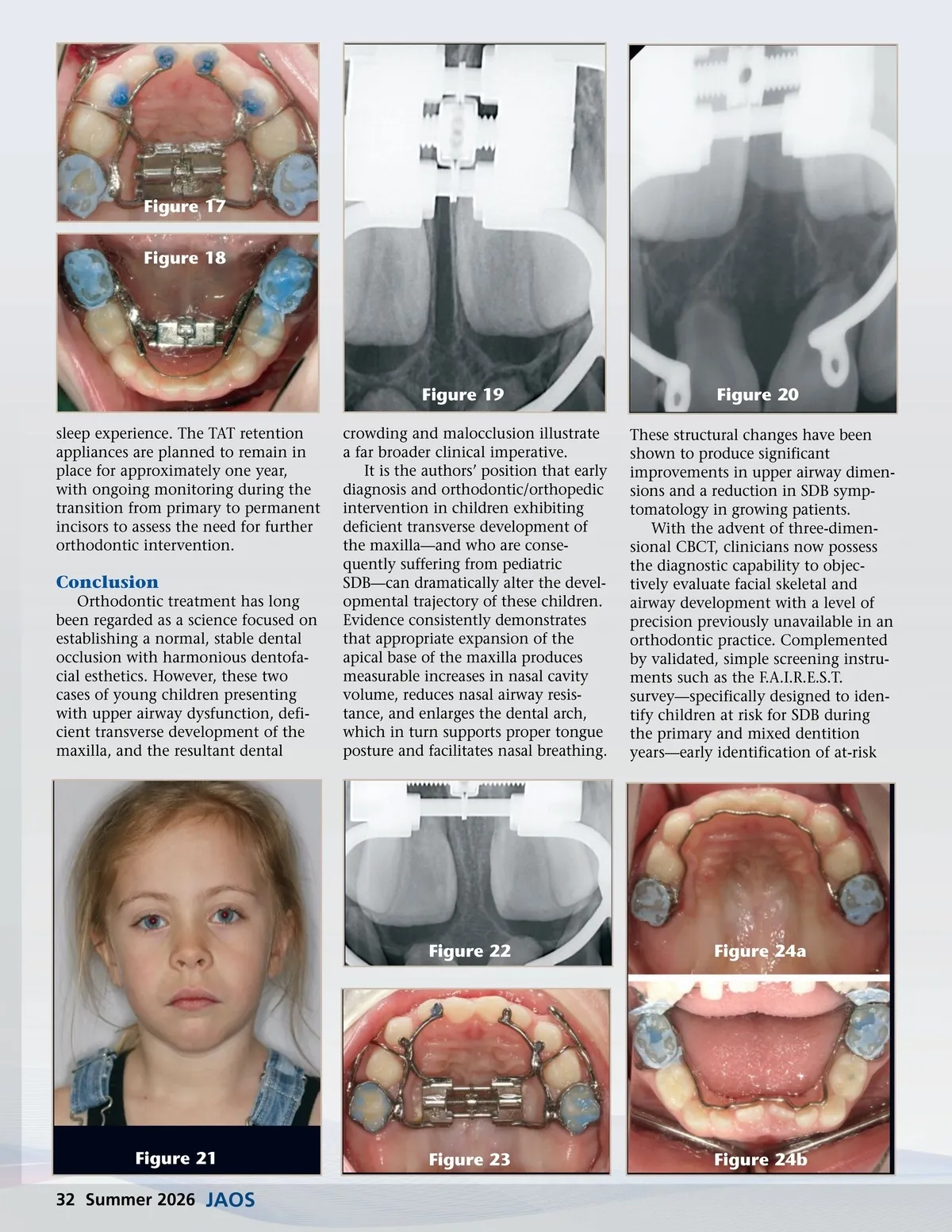
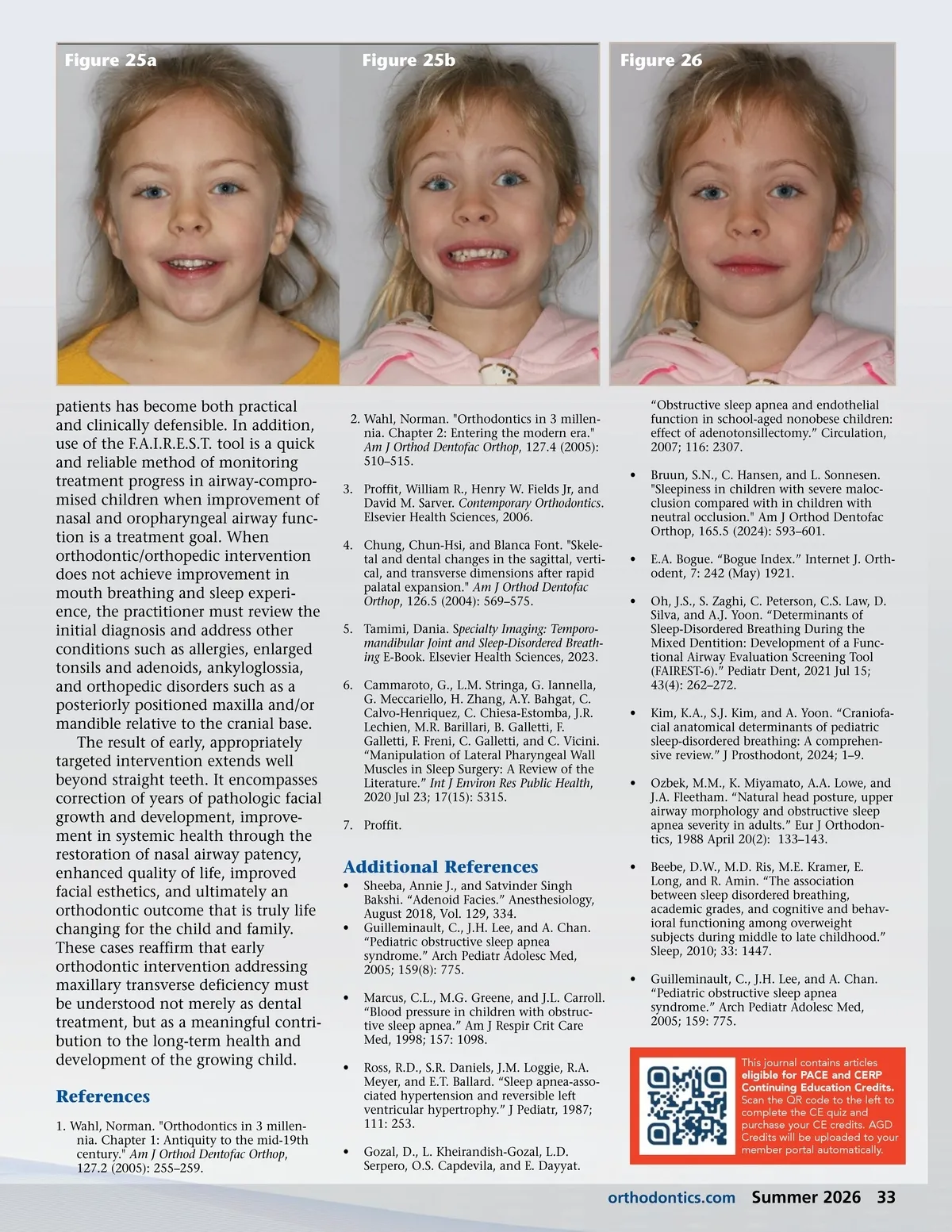
Figure 17 Figure 18 Figure 19 sleep experience. The TAT retention appliances are planned to remain in place for approximately one year, with ongoing monitoring during the transition from primary to permanent incisors to assess the need for further orthodontic intervention. crowding and malocclusion illustrate a far broader clinical imperative. It is the authors’ position that early diagnosis and orthodontic/orthopedic intervention in children exhibiting deficient transverse development of the maxilla—and who are conse-quently suffering from pediatric SDB—can dramatically alter the devel-opmental trajectory of these children. Evidence consistently demonstrates that appropriate expansion of the apical base of the maxilla produces measurable increases in nasal cavity volume, reduces nasal airway resis-tance, and enlarges the dental arch, which in turn supports proper tongue posture and facilitates nasal breathing. Figure 20 These structural changes have been shown to produce significant improvements in upper airway dimen-sions and a reduction in SDB symp-tomatology in growing patients. With the advent of three-dimen-sional CBCT, clinicians now possess the diagnostic capability to objec-tively evaluate facial skeletal and airway development with a level of precision previously unavailable in an orthodontic practice. Complemented by validated, simple screening instru-ments such as the F.A.I.R.E.S.T. survey—specifically designed to iden-tify children at risk for SDB during the primary and mixed dentition years—early identification of at-risk Conclusion Orthodontic treatment has long been regarded as a science focused on establishing a normal, stable dental occlusion with harmonious dentofa-cial esthetics. However, these two cases of young children presenting with upper airway dysfunction, defi-cient transverse development of the maxilla, and the resultant dental Figure 22 Figure 24a Figure 21 32 Summer 2026 JAOS Figure 23 Figure 24b
Journal of the American Orthodontic Society Summer 2026: Page 32