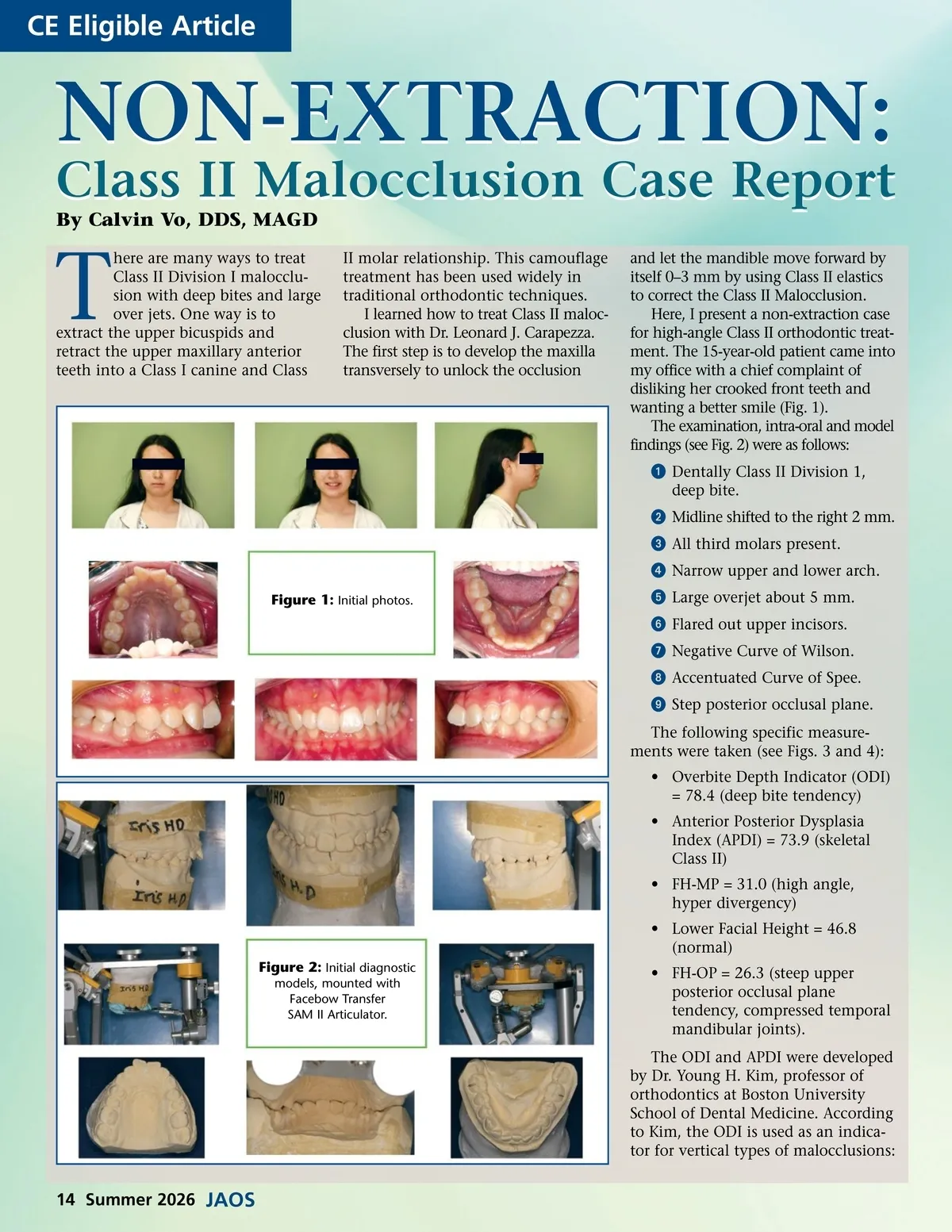
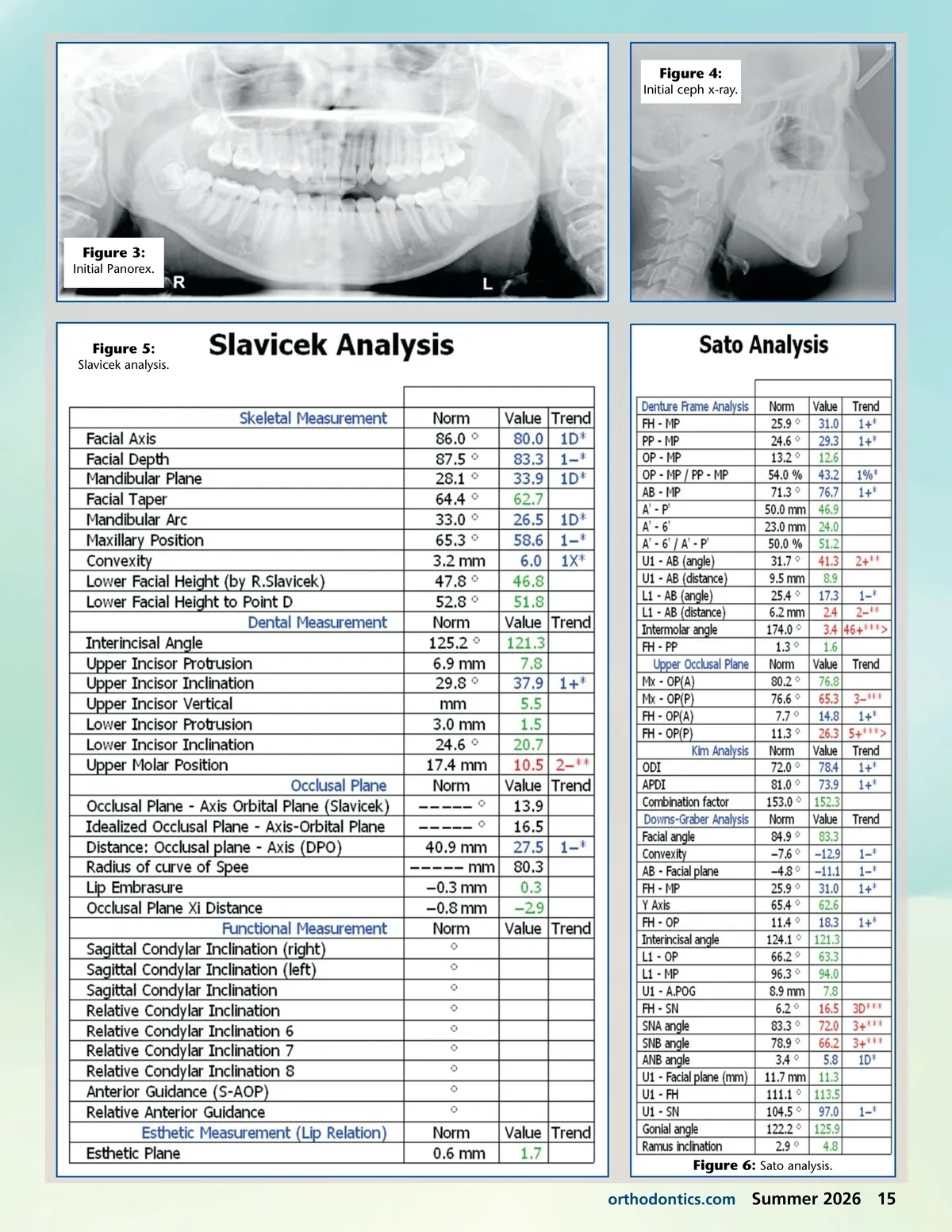
CE Eligible Article NON-EXTRACTION: By Calvin Vo, DDS, MAGD Class II Malocclusion Case Report T here are many ways to treat Class II Division I malocclu-sion with deep bites and large over jets. One way is to extract the upper bicuspids and retract the upper maxillary anterior teeth into a Class I canine and Class II molar relationship. This camouflage treatment has been used widely in traditional orthodontic techniques. I learned how to treat Class II maloc-clusion with Dr. Leonard J. Carapezza. The first step is to develop the maxilla transversely to unlock the occlusion and let the mandible move forward by itself 0–3 mm by using Class II elastics to correct the Class II Malocclusion. Here, I present a non-extraction case for high-angle Class II orthodontic treat-ment. The 15-year-old patient came into my office with a chief complaint of disliking her crooked front teeth and wanting a better smile (Fig. 1). The examination, intra-oral and model findings (see Fig. 2) were as follows: ᕡ Dentally Class II Division 1, deep bite. ᕢ Midline shifted to the right 2 mm. ᕣ All third molars present. ᕤ Narrow upper and lower arch. ᕥ Large overjet about 5 mm. ᕦ Flared out upper incisors. ᕧ Negative Curve of Wilson. ᕨ Accentuated Curve of Spee. ᕩ Step posterior occlusal plane. The following specific measure-ments were taken (see Figs. 3 and 4): • Overbite Depth Indicator (ODI) = 78.4 (deep bite tendency) • Anterior Posterior Dysplasia Index (APDI) = 73.9 (skeletal Class II) • FH-MP = 31.0 (high angle, hyper divergency) • Lower Facial Height = 46.8 (normal) Figure 1: Initial photos. Figure 2: Initial diagnostic models, mounted with Facebow Transfer SAM II Articulator. • FH-OP = 26.3 (steep upper posterior occlusal plane tendency, compressed temporal mandibular joints). The ODI and APDI were developed by Dr. Young H. Kim, professor of orthodontics at Boston University School of Dental Medicine. According to Kim, the ODI is used as an indica-tor for vertical types of malocclusions: 14 Summer 2026 JAOS
Journal of the American Orthodontic Society Summer 2026: Page 14