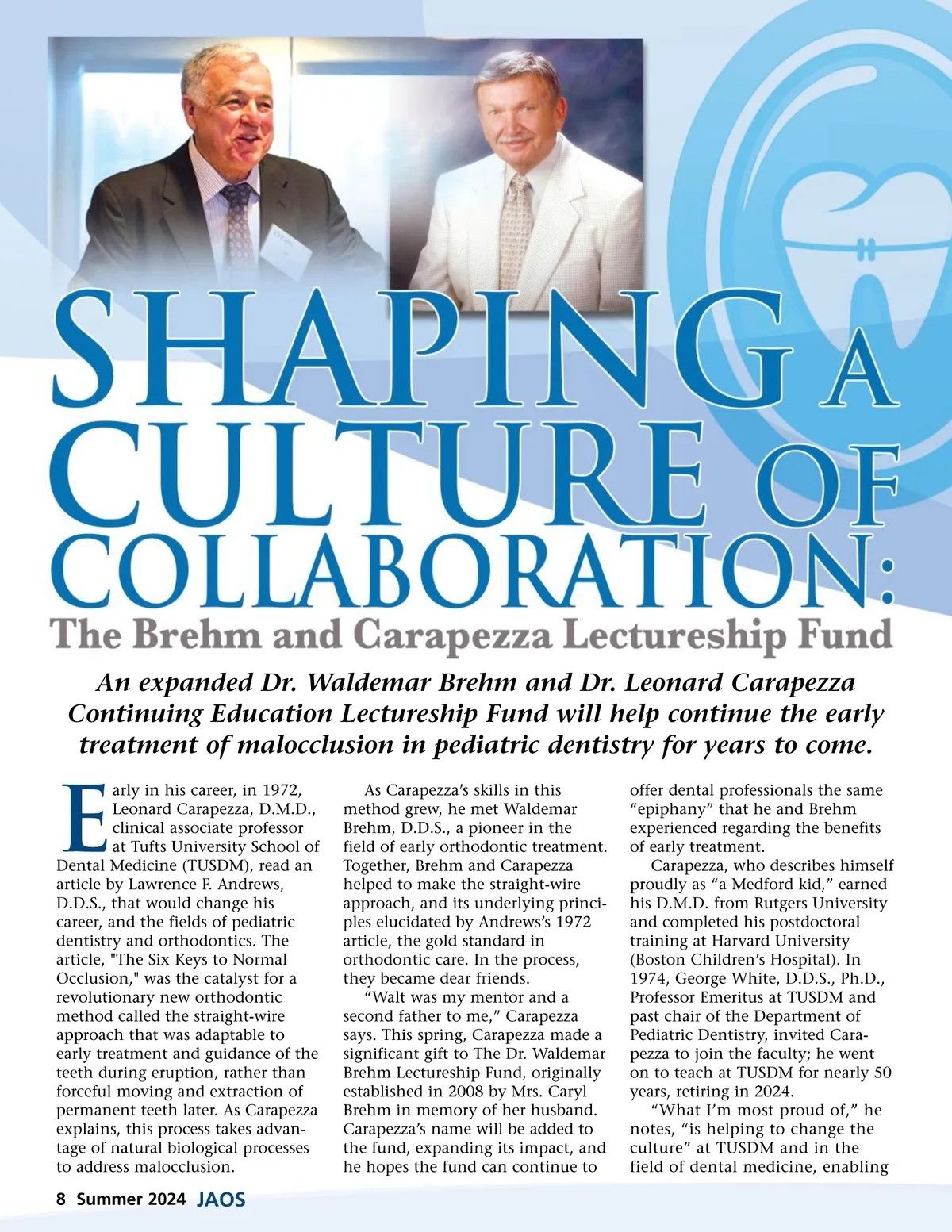
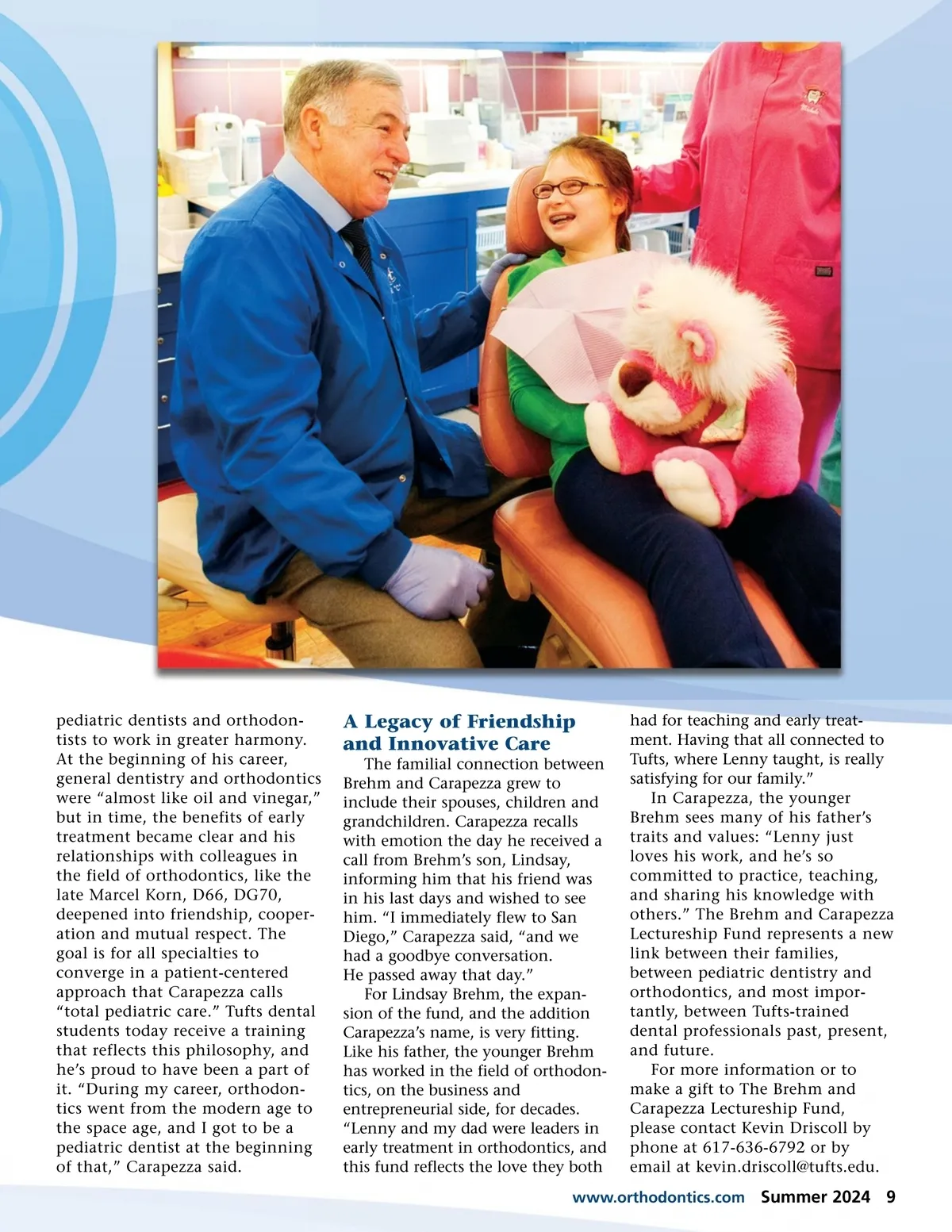
An expanded Dr. Waldemar Brehm and Dr. Leonard Carapezza Continuing Education Lectureship Fund will help continue the early treatment of malocclusion in pediatric dentistry for years to come. arly in his career, in 1972, Leonard Carapezza, D.M.D., clinical associate professor at Tufts University School of Dental Medicine (TUSDM), read an article by Lawrence F. Andrews, D.D.S., that would change his career, and the fields of pediatric dentistry and orthodontics. The article, "The Six Keys to Normal Occlusion," was the catalyst for a revolutionary new orthodontic method called the straight-wire approach that was adaptable to early treatment and guidance of the teeth during eruption, rather than forceful moving and extraction of permanent teeth later. As Carapezza explains, this process takes advan-tage of natural biological processes to address malocclusion. E As Carapezza’s skills in this method grew, he met Waldemar Brehm, D.D.S., a pioneer in the field of early orthodontic treatment. Together, Brehm and Carapezza helped to make the straight-wire approach, and its underlying princi-ples elucidated by Andrews’s 1972 article, the gold standard in orthodontic care. In the process, they became dear friends. “Walt was my mentor and a second father to me,” Carapezza says. This spring, Carapezza made a significant gift to The Dr. Waldemar Brehm Lectureship Fund, originally established in 2008 by Mrs. Caryl Brehm in memory of her husband. Carapezza’s name will be added to the fund, expanding its impact, and he hopes the fund can continue to offer dental professionals the same “epiphany” that he and Brehm experienced regarding the benefits of early treatment. Carapezza, who describes himself proudly as “a Medford kid,” earned his D.M.D. from Rutgers University and completed his postdoctoral training at Harvard University (Boston Children’s Hospital). In 1974, George White, D.D.S., Ph.D., Professor Emeritus at TUSDM and past chair of the Department of Pediatric Dentistry, invited Cara-pezza to join the faculty; he went on to teach at TUSDM for nearly 50 years, retiring in 2024. “What I’m most proud of,” he notes, “is helping to change the culture” at TUSDM and in the field of dental medicine, enabling 8 Summer 2024 JAOS
Journal of the American Orthodontic Society Summer 2024: Page 8