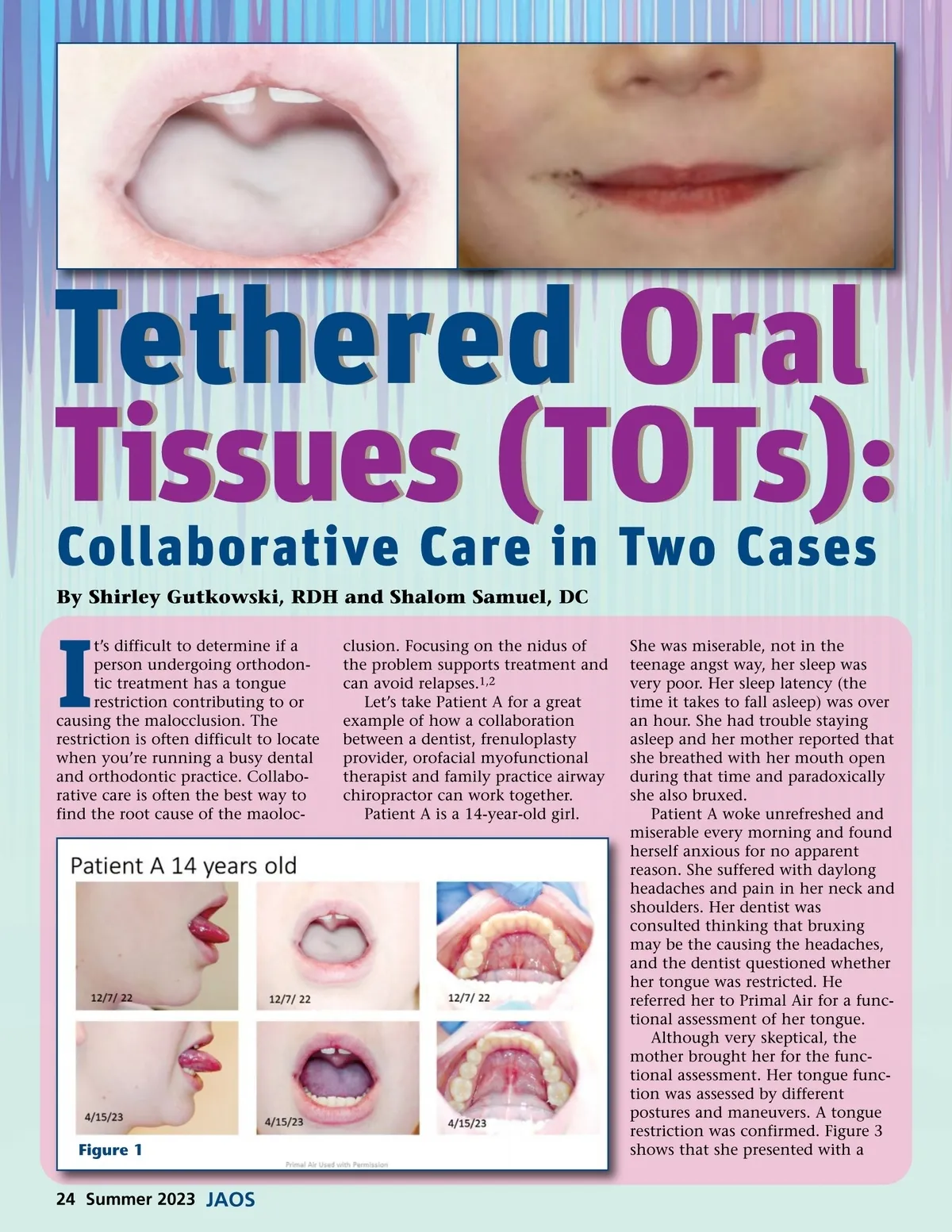
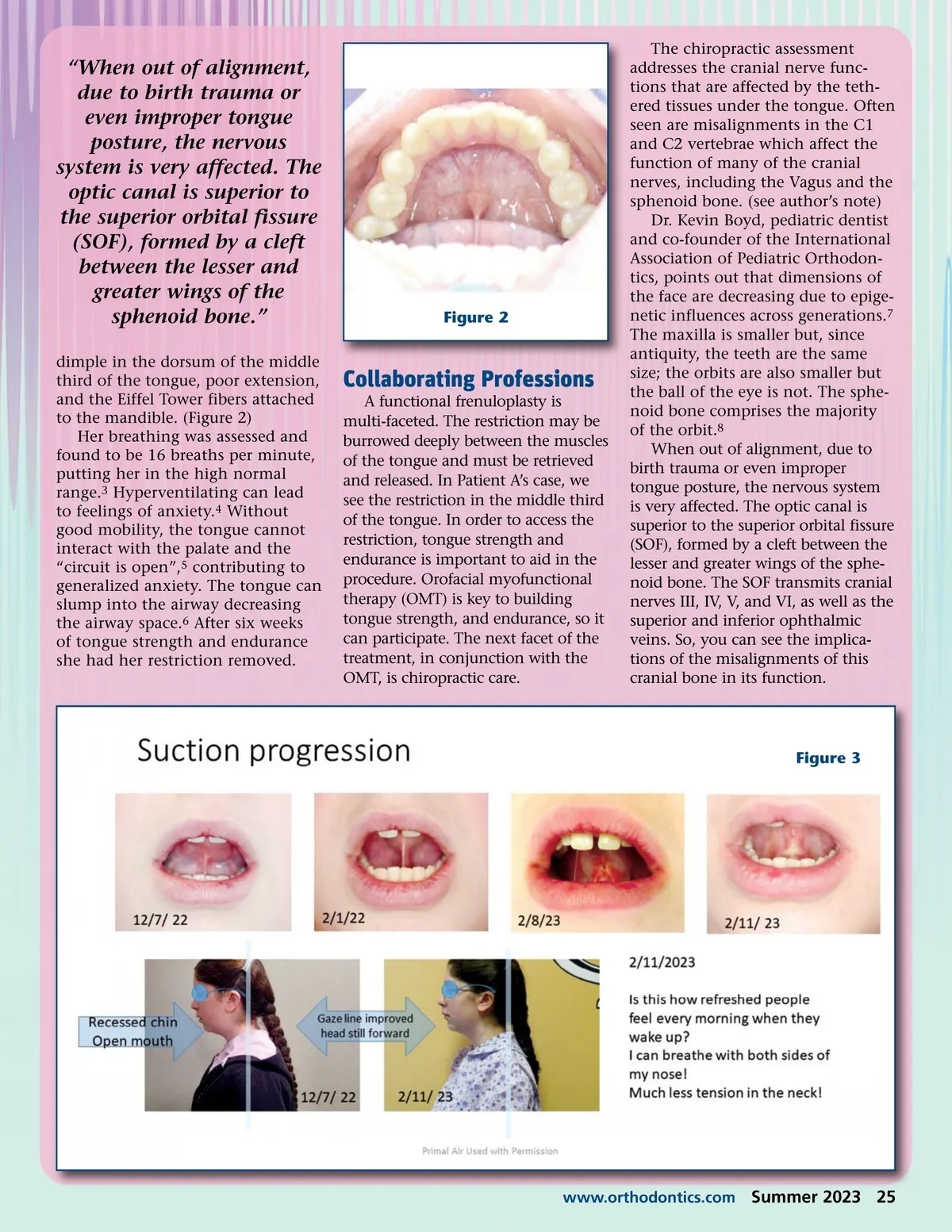
Tethered Oral Tissues (TOTs): Collaborative Care in Two Cases By Shirley Gutkowski, RDH and Shalom Samuel, DC I t’s difficult to determine if a person undergoing orthodon-tic treatment has a tongue restriction contributing to or causing the malocclusion. The restriction is often difficult to locate when you’re running a busy dental and orthodontic practice. Collabo-rative care is often the best way to find the root cause of the maoloc-clusion. Focusing on the nidus of the problem supports treatment and can avoid relapses. 1,2 Let’s take Patient A for a great example of how a collaboration between a dentist, frenuloplasty provider, orofacial myofunctional therapist and family practice airway chiropractor can work together. Patient A is a 14-year-old girl. Figure 1 She was miserable, not in the teenage angst way, her sleep was very poor. Her sleep latency (the time it takes to fall asleep) was over an hour. She had trouble staying asleep and her mother reported that she breathed with her mouth open during that time and paradoxically she also bruxed. Patient A woke unrefreshed and miserable every morning and found herself anxious for no apparent reason. She suffered with daylong headaches and pain in her neck and shoulders. Her dentist was consulted thinking that bruxing may be the causing the headaches, and the dentist questioned whether her tongue was restricted. He referred her to Primal Air for a func-tional assessment of her tongue. Although very skeptical, the mother brought her for the func-tional assessment. Her tongue func-tion was assessed by different postures and maneuvers. A tongue restriction was confirmed. Figure 3 shows that she presented with a 24 Summer 2023 JAOS
Journal of the American Orthodontic Society Summer 2023: Page 24