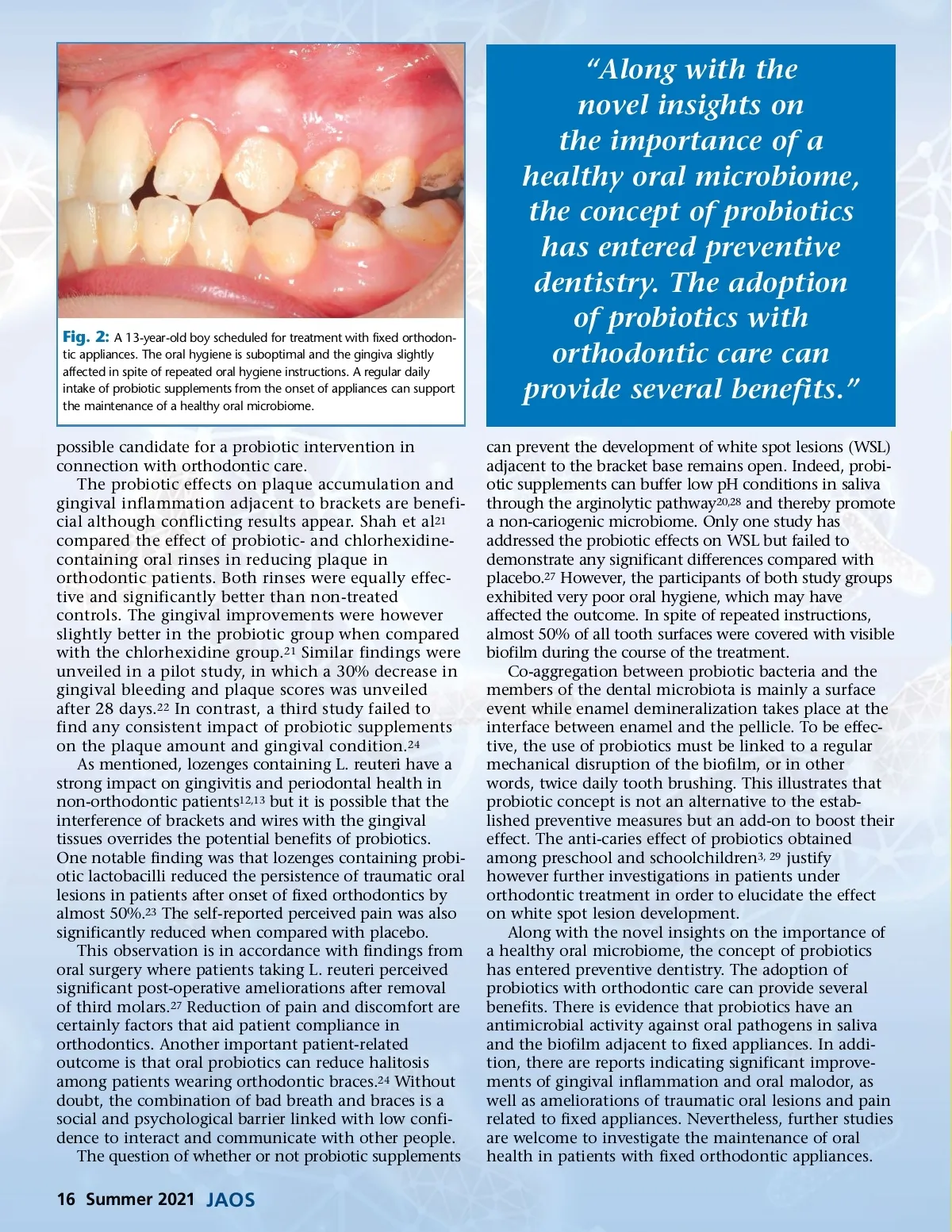
Fig. 2: A 13-year-old boy scheduled for treatment with fixed orthodon-tic appliances. The oral hygiene is suboptimal and the gingiva slightly affected in spite of repeated oral hygiene instructions. A regular daily intake of probiotic supplements from the onset of appliances can support the maintenance of a healthy oral microbiome. “Along with the novel insights on the importance of a healthy oral microbiome, the concept of probiotics has entered preventive dentistry. The adoption of probiotics with orthodontic care can provide several benefits.” can prevent the development of white spot lesions (WSL) adjacent to the bracket base remains open. Indeed, probi-otic supplements can buffer low pH conditions in saliva through the arginolytic pathway 20,28 and thereby promote a non-cariogenic microbiome. Only one study has addressed the probiotic effects on WSL but failed to demonstrate any significant differences compared with placebo. 27 However, the participants of both study groups exhibited very poor oral hygiene, which may have affected the outcome. In spite of repeated instructions, almost 50% of all tooth surfaces were covered with visible biofilm during the course of the treatment. Co-aggregation between probiotic bacteria and the members of the dental microbiota is mainly a surface event while enamel demineralization takes place at the interface between enamel and the pellicle. To be effec-tive, the use of probiotics must be linked to a regular mechanical disruption of the biofilm, or in other words, twice daily tooth brushing. This illustrates that probiotic concept is not an alternative to the estab-lished preventive measures but an add-on to boost their effect. The anti-caries effect of probiotics obtained among preschool and schoolchildren 3, 29 justify however further investigations in patients under orthodontic treatment in order to elucidate the effect on white spot lesion development. Along with the novel insights on the importance of a healthy oral microbiome, the concept of probiotics has entered preventive dentistry. The adoption of probiotics with orthodontic care can provide several benefits. There is evidence that probiotics have an antimicrobial activity against oral pathogens in saliva and the biofilm adjacent to fixed appliances. In addi-tion, there are reports indicating significant improve-ments of gingival inflammation and oral malodor, as well as ameliorations of traumatic oral lesions and pain related to fixed appliances. Nevertheless, further studies are welcome to investigate the maintenance of oral health in patients with fixed orthodontic appliances. possible candidate for a probiotic intervention in connection with orthodontic care. The probiotic effects on plaque accumulation and gingival inflammation adjacent to brackets are benefi-cial although conflicting results appear. Shah et al 21 compared the effect of probiotic-and chlorhexidine-containing oral rinses in reducing plaque in orthodontic patients. Both rinses were equally effec-tive and significantly better than non-treated controls. The gingival improvements were however slightly better in the probiotic group when compared with the chlorhexidine group. 21 Similar findings were unveiled in a pilot study, in which a 30% decrease in gingival bleeding and plaque scores was unveiled after 28 days. 22 In contrast, a third study failed to find any consistent impact of probiotic supplements on the plaque amount and gingival condition. 24 As mentioned, lozenges containing L. reuteri have a strong impact on gingivitis and periodontal health in non-orthodontic patients 12,13 but it is possible that the interference of brackets and wires with the gingival tissues overrides the potential benefits of probiotics. One notable finding was that lozenges containing probi-otic lactobacilli reduced the persistence of traumatic oral lesions in patients after onset of fixed orthodontics by almost 50%. 23 The self-reported perceived pain was also significantly reduced when compared with placebo. This observation is in accordance with findings from oral surgery where patients taking L. reuteri perceived significant post-operative ameliorations after removal of third molars. 27 Reduction of pain and discomfort are certainly factors that aid patient compliance in orthodontics. Another important patient-related outcome is that oral probiotics can reduce halitosis among patients wearing orthodontic braces. 24 Without doubt, the combination of bad breath and braces is a social and psychological barrier linked with low confi-dence to interact and communicate with other people. The question of whether or not probiotic supplements 16 Summer 2021 JAOS
Journal of the American Orthodontic Society Summer 2021: Page 16