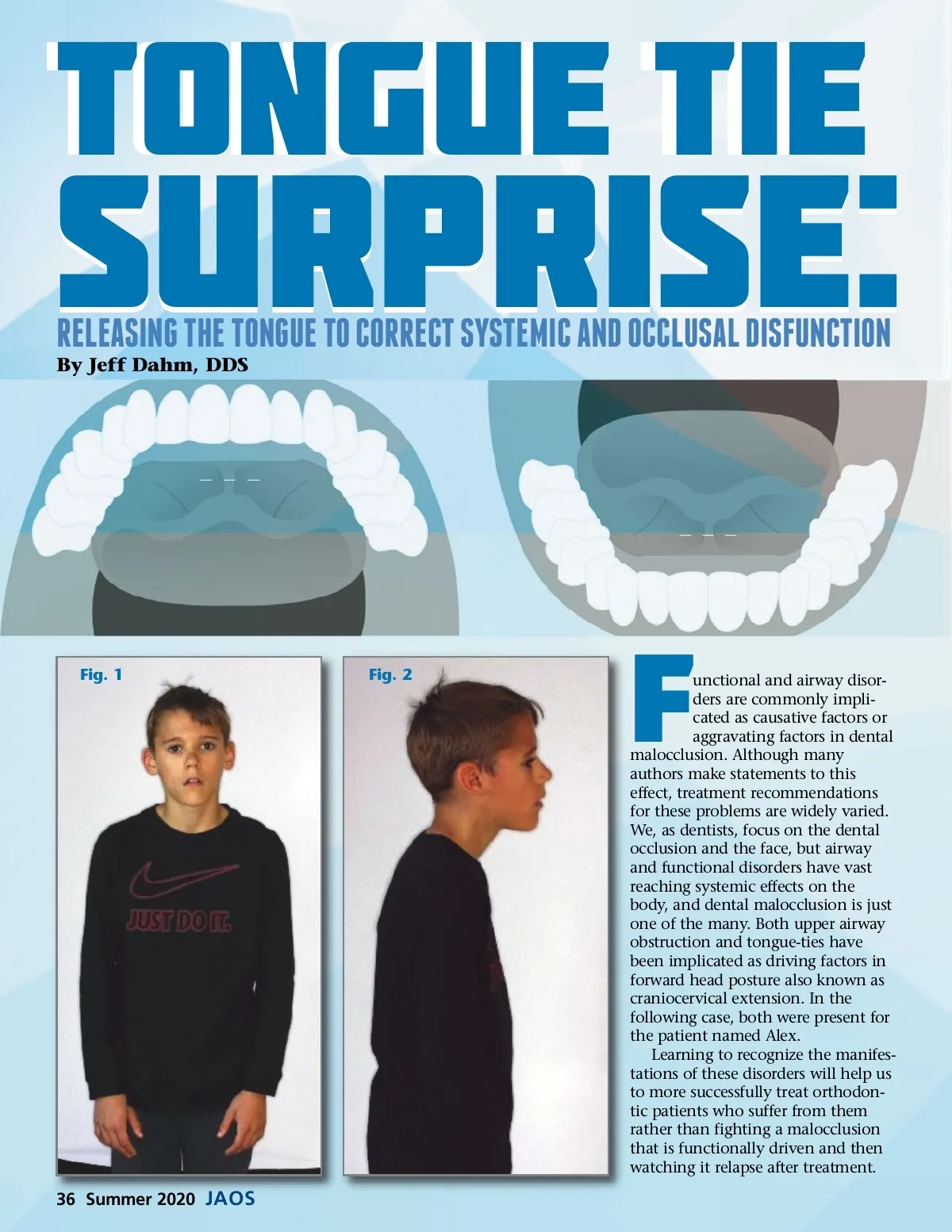
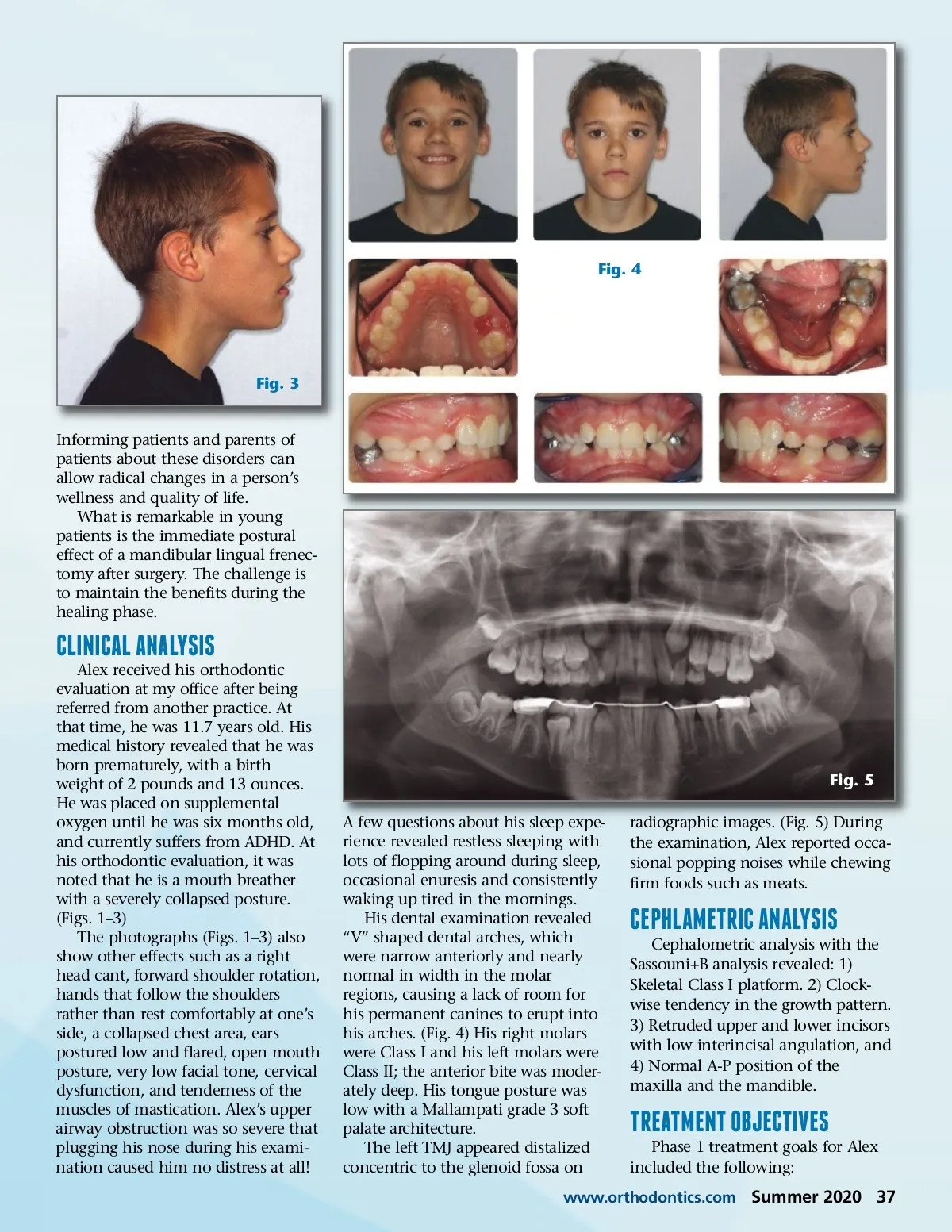
Fig. 4 Fig. 3 Informing patients and parents of patients about these disorders can allow radical changes in a person’s wellness and quality of life. What is remarkable in young patients is the immediate postural effect of a mandibular lingual frenec-tomy after surgery. The challenge is to maintain the benefits during the healing phase. CliniCal analysis Alex received his orthodontic evaluation at my office after being referred from another practice. At that time, he was 11.7 years old. His medical history revealed that he was born prematurely, with a birth weight of 2 pounds and 13 ounces. He was placed on supplemental oxygen until he was six months old, and currently suffers from ADHD. At his orthodontic evaluation, it was noted that he is a mouth breather with a severely collapsed posture. (Figs. 1–3) The photographs (Figs. 1–3) also show other effects such as a right head cant, forward shoulder rotation, hands that follow the shoulders rather than rest comfortably at one’s side, a collapsed chest area, ears postured low and flared, open mouth posture, very low facial tone, cervical dysfunction, and tenderness of the muscles of mastication. Alex’s upper airway obstruction was so severe that plugging his nose during his exami-nation caused him no distress at all! Fig. 5 A few questions about his sleep expe-rience revealed restless sleeping with lots of flopping around during sleep, occasional enuresis and consistently waking up tired in the mornings. His dental examination revealed “V” shaped dental arches, which were narrow anteriorly and nearly normal in width in the molar regions, causing a lack of room for his permanent canines to erupt into his arches. (Fig. 4) His right molars were Class I and his left molars were Class II; the anterior bite was moder-ately deep. His tongue posture was low with a Mallampati grade 3 soft palate architecture. The left TMJ appeared distalized concentric to the glenoid fossa on radiographic images. (Fig. 5) During the examination, Alex reported occa-sional popping noises while chewing firm foods such as meats. CePhlameTRiC analysis Cephalometric analysis with the Sassouni+B analysis revealed: 1) Skeletal Class I platform. 2) Clock-wise tendency in the growth pattern. 3) Retruded upper and lower incisors with low interincisal angulation, and 4) Normal A-P position of the maxilla and the mandible. TReaTmenT oBJeCTiVes Phase 1 treatment goals for Alex included the following: www.orthodontics.com Summer 2020 37
Journal of the American Orthodontic Society Summer 2020: Page 37