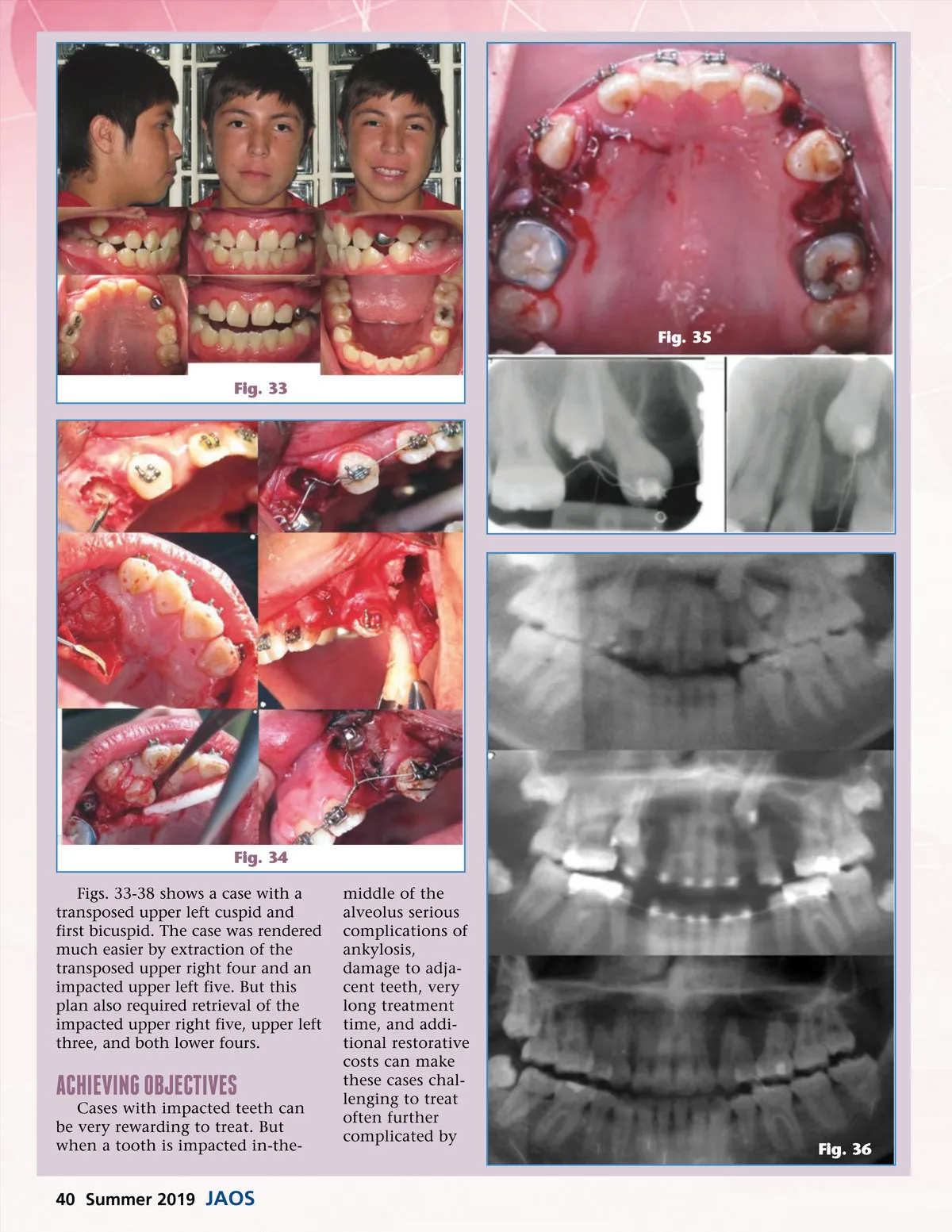
Fig. 38 6. Manne, R., et al. "Impacted canines: Etiology, diagnosis, and orthodontic management." Jour-nal of pharmacy & bioallied sciences 4.Suppl 2 (2012): S234. 7. Topouzelis, N., et al. "Dilaceration of maxillary central incisor: a literature review." Dental Traumatology 26.5 (2010): 427-433. 8. Shapira, Y., and Mladen M. K. "Tooth transpositions—a review of the literature and treatment considerations." The Angle Orthodontist 59.4 (1989): 271-276. Fig. 37 patient “burn-out” and disappoint-ing final results. If a case has these limitations yet absolutely require retrieval of the impacted tooth, it may be financially wise to refer these cases to an orthodontic specialist. After all, isn’t it their job to treat the tough cases? But often these difficult cases can be converted into relatively easy situa-tions if you are willing to extract the impacted teeth. The same is true for cases with transposed teeth. We support GPs that want to perform world-class orthodontic treat-ment. Hopefully these articles will make you a savvier clinician helping you and your patients get more joy from doing orthodontics. The essence of advanced thinking orthodontic training is to work smarter and not harder to achieve this objective. references 1. MCNEILL, R. W., and DONALD R. J. "Congenitally absent maxillary lateral incisors: treatment planning considera-tions." The Angle Orthodontist 43.1 (1973): 24-29. 2. Nicassio, R., and Zavala, M.: Considera-tions of extracting bicuspids: Part 1. Jour-nal of the American Orthodontic Society: 16-22. Spring 2018. 3. Nicassio, R., and Zavala, M.: Considera-tions of extracting bicuspids: Part 2. Jour-nal of the American Orthodontic Society: 24-30. Summer 2018. 4. Nicassio, R., and Zavala, M.: Considera-tions of extracting bicuspids: Part 3. Jour-nal of the American Orthodontic Society: 22-29. Fall 2018. 5. Yavuz, M. S., et al. "Impacted mandibular canines." J Contemp Dent Pract 8.7 (2007): 78-85. www.orthodontics.com Summer 2019 41
Journal of the American Orthodontic Society Summer 2019: Page 41