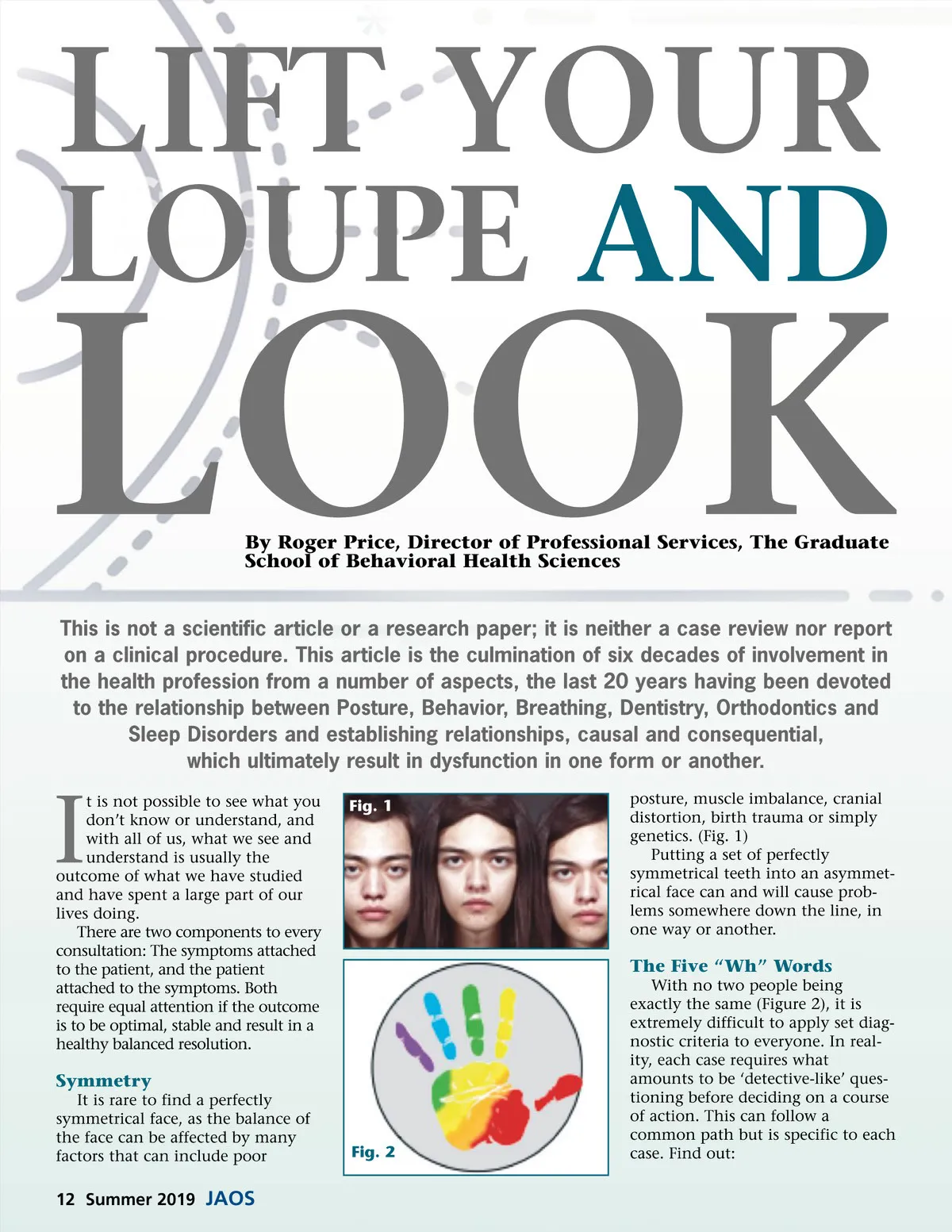
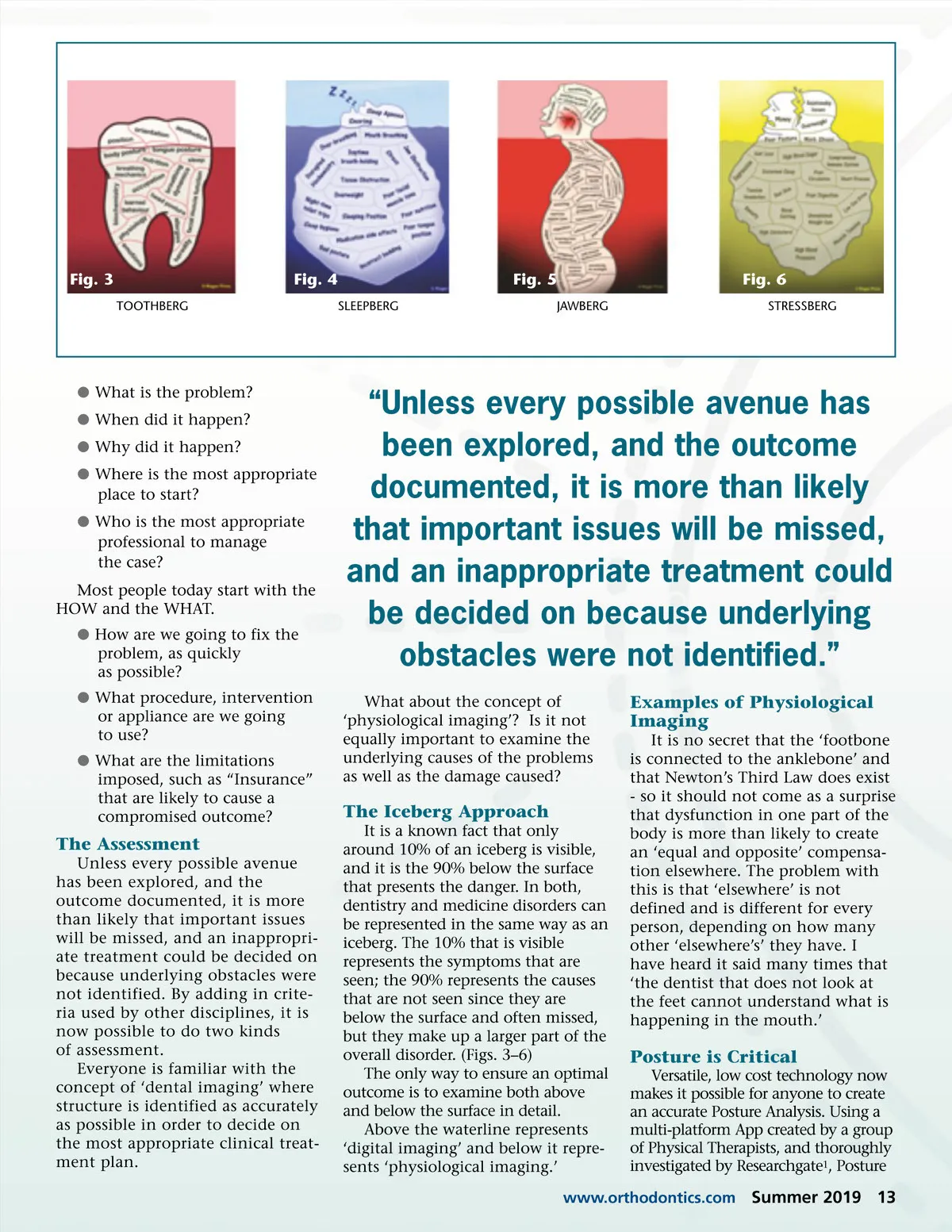
Fig. 3 TOOTHBERG Fig. 4 SLEEPBERG Fig. 5 JAWBERG Fig. 6 STRESSBERG b What is the problem? b When did it happen? b Why did it happen? b Where is the most appropriate place to start? b Who is the most appropriate professional to manage the case? Most people today start with the HOW and the WHAT. b How are we going to fix the problem, as quickly as possible? b What procedure, intervention or appliance are we going to use? b What are the limitations imposed, such as “Insurance” that are likely to cause a compromised outcome? “Unless every possible avenue has been explored, and the outcome documented, it is more than likely that important issues will be missed, and an inappropriate treatment could be decided on because underlying obstacles were not identified.” What about the concept of ‘physiological imaging’? Is it not equally important to examine the underlying causes of the problems as well as the damage caused? Examples of Physiological Imaging It is no secret that the ‘footbone is connected to the anklebone’ and that Newton’s Third Law does exist -so it should not come as a surprise that dysfunction in one part of the body is more than likely to create an ‘equal and opposite’ compensa-tion elsewhere. The problem with this is that ‘elsewhere’ is not defined and is different for every person, depending on how many other ‘elsewhere’s’ they have. I have heard it said many times that ‘the dentist that does not look at the feet cannot understand what is happening in the mouth.’ The Iceberg Approach It is a known fact that only around 10% of an iceberg is visible, and it is the 90% below the surface that presents the danger. In both, dentistry and medicine disorders can be represented in the same way as an iceberg. The 10% that is visible represents the symptoms that are seen; the 90% represents the causes that are not seen since they are below the surface and often missed, but they make up a larger part of the overall disorder. (Figs. 3–6) The only way to ensure an optimal outcome is to examine both above and below the surface in detail. Above the waterline represents ‘digital imaging’ and below it repre-sents ‘physiological imaging.’ The Assessment Unless every possible avenue has been explored, and the outcome documented, it is more than likely that important issues will be missed, and an inappropri-ate treatment could be decided on because underlying obstacles were not identified. By adding in crite-ria used by other disciplines, it is now possible to do two kinds of assessment. Everyone is familiar with the concept of ‘dental imaging’ where structure is identified as accurately as possible in order to decide on the most appropriate clinical treat-ment plan. Posture is Critical Versatile, low cost technology now makes it possible for anyone to create an accurate Posture Analysis. Using a multi-platform App created by a group of Physical Therapists, and thoroughly investigated by Researchgate 1 , Posture www.orthodontics.com Summer 2019 13
Journal of the American Orthodontic Society Summer 2019: Page 13