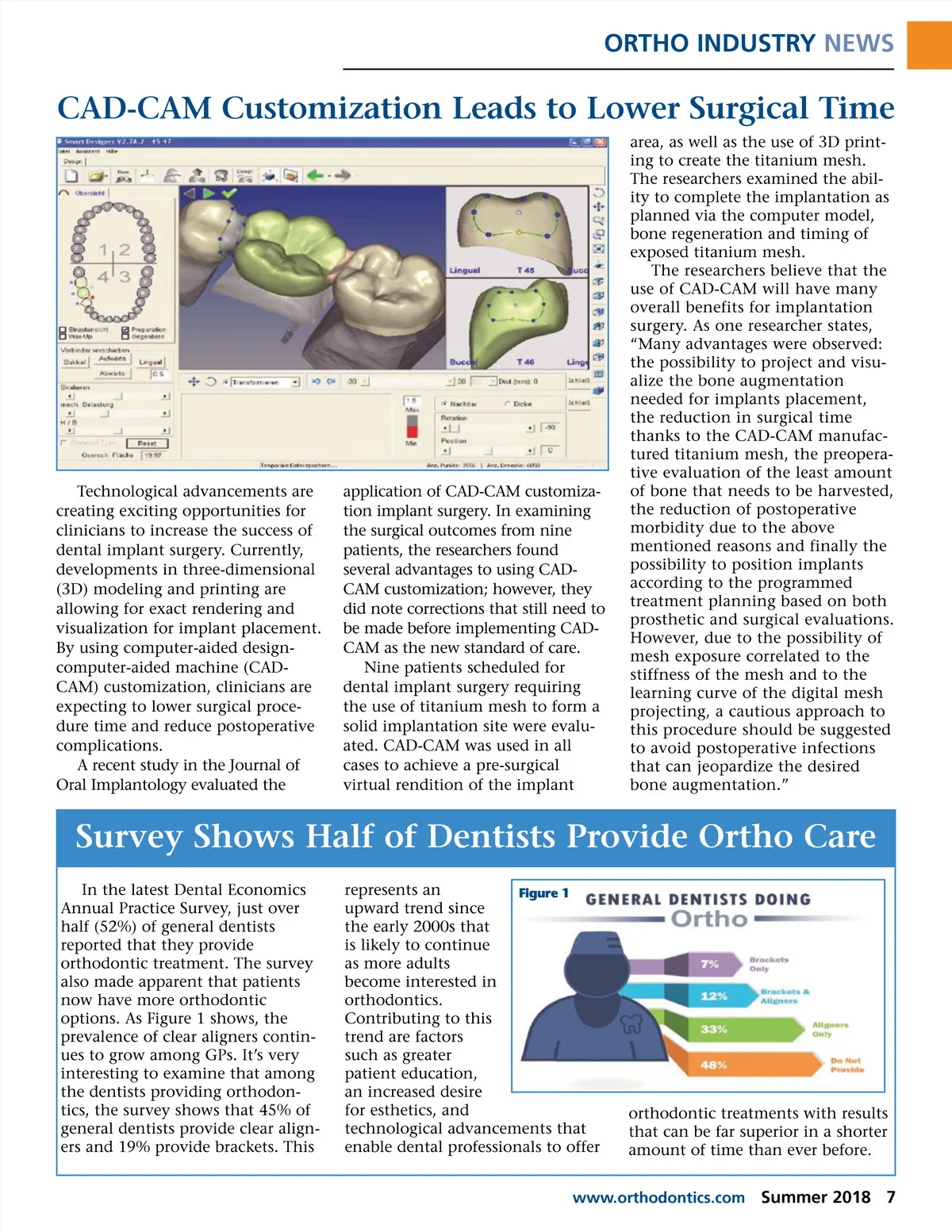
ORTHO INDUSTRY NEWS CAD-CAM Customization Leads to Lower Surgical Time area, as well as the use of 3D print-ing to create the titanium mesh. The researchers examined the abil-ity to complete the implantation as planned via the computer model, bone regeneration and timing of exposed titanium mesh. The researchers believe that the use of CAD-CAM will have many overall benefits for implantation surgery. As one researcher states, “Many advantages were observed: the possibility to project and visu-alize the bone augmentation needed for implants placement, the reduction in surgical time thanks to the CAD-CAM manufac-tured titanium mesh, the preopera-tive evaluation of the least amount of bone that needs to be harvested, the reduction of postoperative morbidity due to the above mentioned reasons and finally the possibility to position implants according to the programmed treatment planning based on both prosthetic and surgical evaluations. However, due to the possibility of mesh exposure correlated to the stiffness of the mesh and to the learning curve of the digital mesh projecting, a cautious approach to this procedure should be suggested to avoid postoperative infections that can jeopardize the desired bone augmentation.” Technological advancements are creating exciting opportunities for clinicians to increase the success of dental implant surgery. Currently, developments in three-dimensional (3D) modeling and printing are allowing for exact rendering and visualization for implant placement. By using computer-aided design-computer-aided machine (CAD-CAM) customization, clinicians are expecting to lower surgical proce-dure time and reduce postoperative complications. A recent study in the Journal of Oral Implantology evaluated the application of CAD-CAM customiza-tion implant surgery. In examining the surgical outcomes from nine patients, the researchers found several advantages to using CAD-CAM customization; however, they did note corrections that still need to be made before implementing CAD-CAM as the new standard of care. Nine patients scheduled for dental implant surgery requiring the use of titanium mesh to form a solid implantation site were evalu-ated. CAD-CAM was used in all cases to achieve a pre-surgical virtual rendition of the implant Survey Shows Half of Dentists Provide Ortho Care In the latest Dental Economics Annual Practice Survey, just over half (52%) of general dentists reported that they provide orthodontic treatment. The survey also made apparent that patients now have more orthodontic options. As Figure 1 shows, the prevalence of clear aligners contin-ues to grow among GPs. It’s very interesting to examine that among the dentists providing orthodon-tics, the survey shows that 45% of general dentists provide clear align-ers and 19% provide brackets. This represents an Figure 1 upward trend since the early 2000s that is likely to continue as more adults become interested in orthodontics. Contributing to this trend are factors such as greater patient education, an increased desire for esthetics, and technological advancements that enable dental professionals to offer orthodontic treatments with results that can be far superior in a shorter amount of time than ever before. www.orthodontics.com Summer 2018 7
Journal of the American Orthodontic Society Summer 2018/Buyer's Guide: Page 7