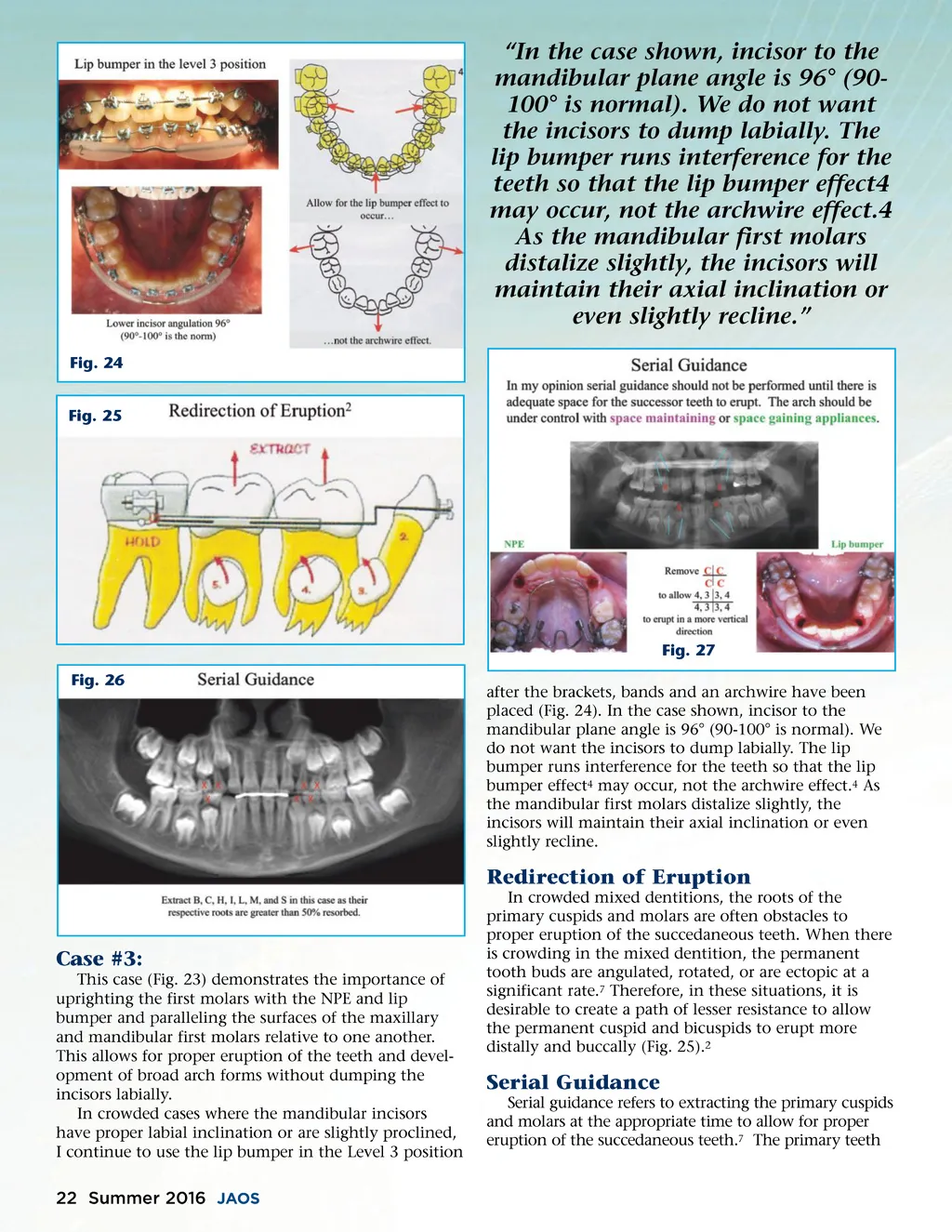
“In the case shown, incisor to the mandibular plane angle is 96° (90-100° is normal). We do not want the incisors to dump labially. The lip bumper runs interference for the teeth so that the lip bumper effect4 may occur, not the archwire effect.4 As the mandibular first molars distalize slightly, the incisors will maintain their axial inclination or even slightly recline.” Fig. 24 Fig. 25 Fig. 27 Fig. 26 after the brackets, bands and an archwire have been placed (Fig. 24). In the case shown, incisor to the mandibular plane angle is 96° (90-100° is normal). We do not want the incisors to dump labially. The lip bumper runs interference for the teeth so that the lip bumper effect 4 may occur, not the archwire effect. 4 As the mandibular first molars distalize slightly, the incisors will maintain their axial inclination or even slightly recline. Redirection of Eruption In crowded mixed dentitions, the roots of the primary cuspids and molars are often obstacles to proper eruption of the succedaneous teeth. When there is crowding in the mixed dentition, the permanent tooth buds are angulated, rotated, or are ectopic at a significant rate. 7 Therefore, in these situations, it is desirable to create a path of lesser resistance to allow the permanent cuspid and bicuspids to erupt more distally and buccally (Fig. 25). 2 Case #3: This case (Fig. 23) demonstrates the importance of uprighting the first molars with the NPE and lip bumper and paralleling the surfaces of the maxillary and mandibular first molars relative to one another. This allows for proper eruption of the teeth and devel-opment of broad arch forms without dumping the incisors labially. In crowded cases where the mandibular incisors have proper labial inclination or are slightly proclined, I continue to use the lip bumper in the Level 3 position Serial Guidance Serial guidance refers to extracting the primary cuspids and molars at the appropriate time to allow for proper eruption of the succedaneous teeth. 7 The primary teeth 22 Summer 2016 JAOS
Journal of the American Orthodontic Society Summer 2016 / Buyer's Guide: Page 22