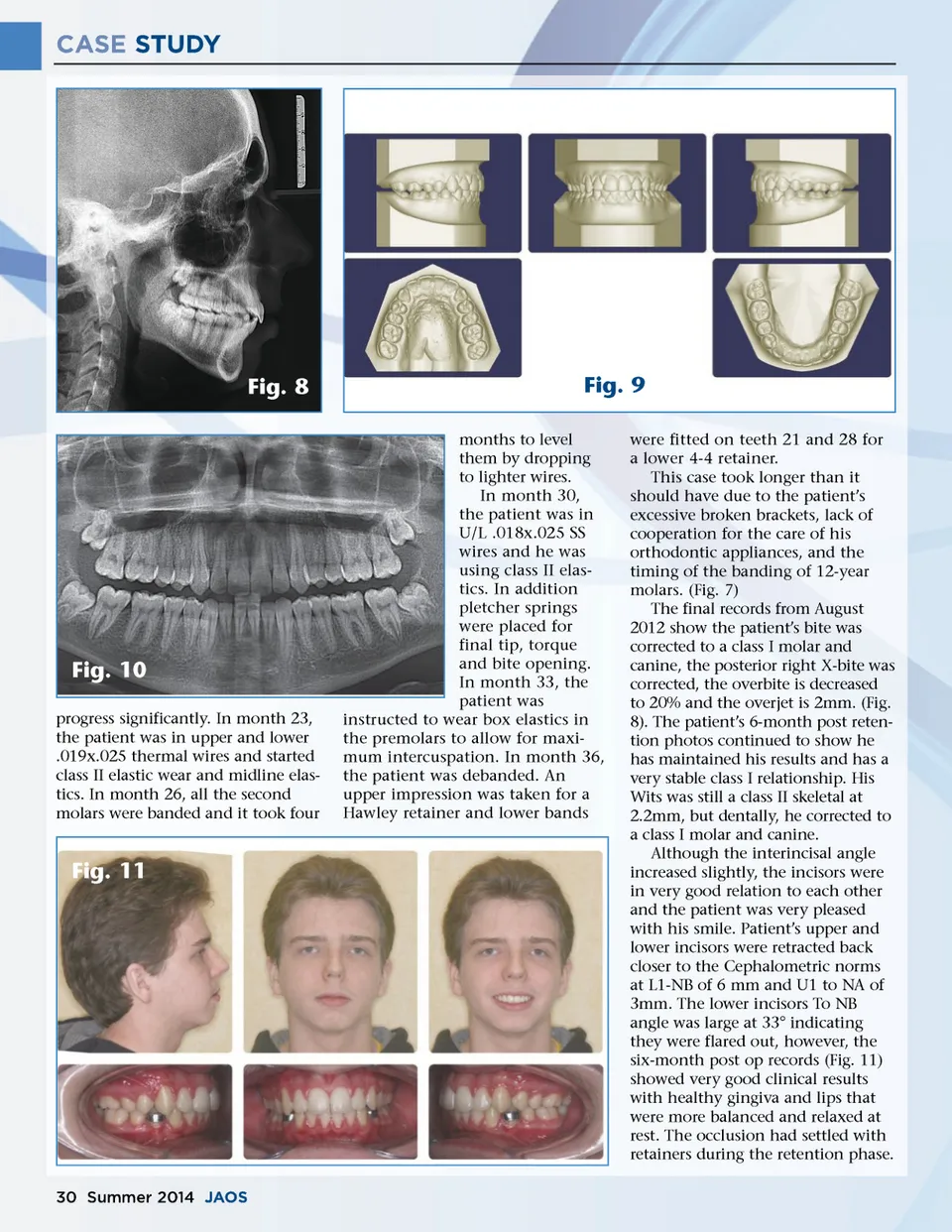
CASE STUDY Fig. 8 Fig. 9 months to level them by dropping to lighter wires. In month 30, the patient was in U/L .018x.025 SS wires and he was using class II elas-tics. In addition pletcher springs were placed for final tip, torque and bite opening. In month 33, the patient was instructed to wear box elastics in the premolars to allow for maxi-mum intercuspation. In month 36, the patient was debanded. An upper impression was taken for a Hawley retainer and lower bands were fitted on teeth 21 and 28 for a lower 4-4 retainer. This case took longer than it should have due to the patient’s excessive broken brackets, lack of cooperation for the care of his orthodontic appliances, and the timing of the banding of 12-year molars. (Fig. 7) The final records from August 2012 show the patient’s bite was corrected to a class I molar and canine, the posterior right X-bite was corrected, the overbite is decreased to 20% and the overjet is 2mm. (Fig. 8). The patient’s 6-month post reten-tion photos continued to show he has maintained his results and has a very stable class I relationship. His Wits was still a class II skeletal at 2.2mm, but dentally, he corrected to a class I molar and canine. Although the interincisal angle increased slightly, the incisors were in very good relation to each other and the patient was very pleased with his smile. Patient’s upper and lower incisors were retracted back closer to the Cephalometric norms at L1-NB of 6 mm and U1 to NA of 3mm. The lower incisors To NB angle was large at 33° indicating they were flared out, however, the six-month post op records (Fig. 11) showed very good clinical results with healthy gingiva and lips that were more balanced and relaxed at rest. The occlusion had settled with retainers during the retention phase. Fig. 10 progress significantly. In month 23, the patient was in upper and lower .019x.025 thermal wires and started class II elastic wear and midline elas-tics. In month 26, all the second molars were banded and it took four Fig. 11 30 Summer 2014 JAOS
Journal of the American Orthodontic Society Summer 2014 / Buyer's Guide: Page 30