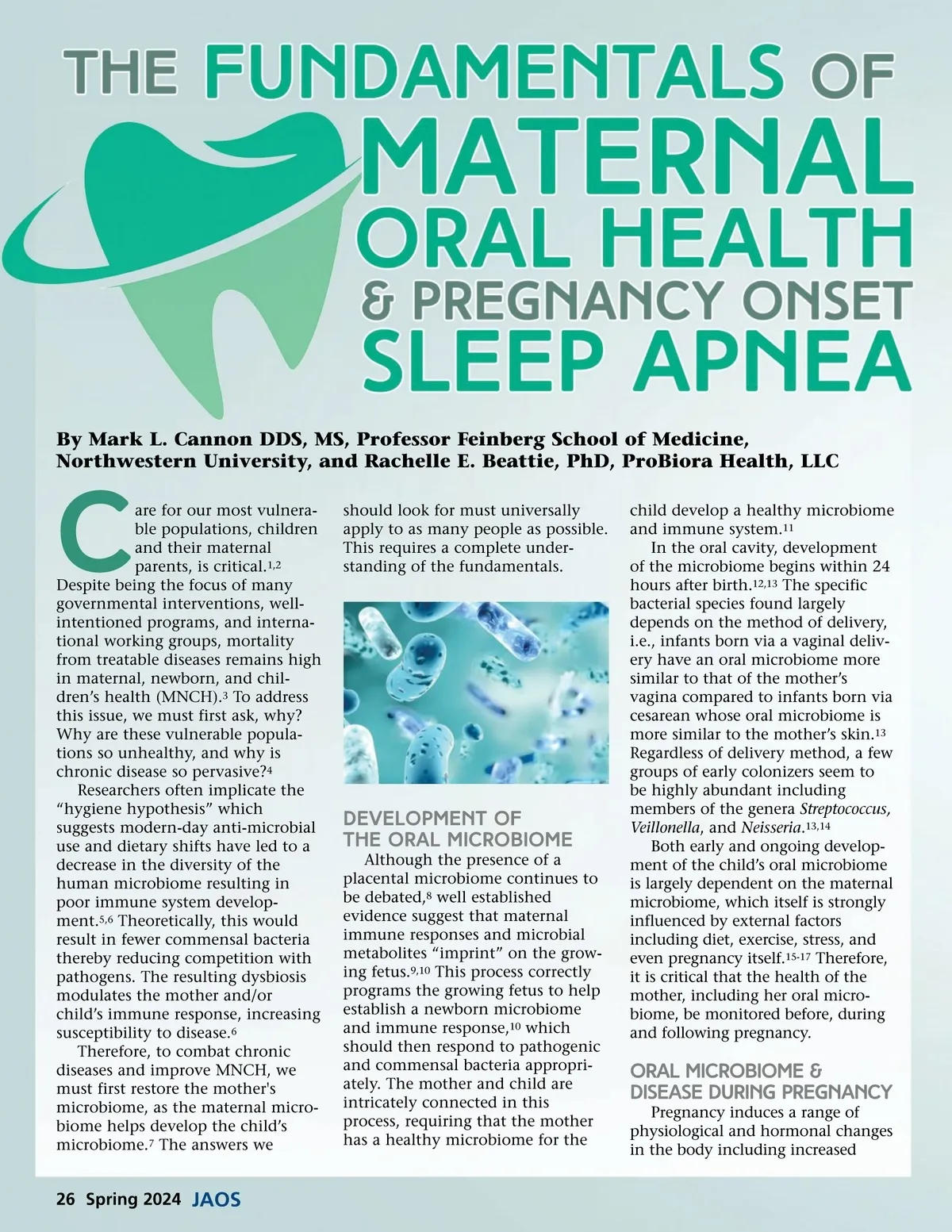
By Mark L. Cannon DDS, MS, Professor Feinberg School of Medicine, Northwestern University, and Rachelle E. Beattie, PhD, ProBiora Health, LLC C are for our most vulnera-ble populations, children and their maternal parents, is critical. 1,2 Despite being the focus of many governmental interventions, well-intentioned programs, and interna-tional working groups, mortality from treatable diseases remains high in maternal, newborn, and chil-dren’s health (MNCH). 3 To address this issue, we must first ask, why? Why are these vulnerable popula-tions so unhealthy, and why is chronic disease so pervasive? 4 Researchers often implicate the “hygiene hypothesis” which suggests modern-day anti-microbial use and dietary shifts have led to a decrease in the diversity of the human microbiome resulting in poor immune system develop-ment. 5,6 Theoretically, this would result in fewer commensal bacteria thereby reducing competition with pathogens. The resulting dysbiosis modulates the mother and/or child’s immune response, increasing susceptibility to disease. 6 Therefore, to combat chronic diseases and improve MNCH, we must first restore the mother's microbiome, as the maternal micro-biome helps develop the child’s microbiome. 7 The answers we should look for must universally apply to as many people as possible. This requires a complete under-standing of the fundamentals. Development of the Oral Microbiome Although the presence of a placental microbiome continues to be debated, 8 well established evidence suggest that maternal immune responses and microbial metabolites “imprint” on the grow-ing fetus. 9,10 This process correctly programs the growing fetus to help establish a newborn microbiome and immune response, 10 which should then respond to pathogenic and commensal bacteria appropri-ately. The mother and child are intricately connected in this process, requiring that the mother has a healthy microbiome for the child develop a healthy microbiome and immune system. 11 In the oral cavity, development of the microbiome begins within 24 hours after birth. 12,13 The specific bacterial species found largely depends on the method of delivery, i.e., infants born via a vaginal deliv-ery have an oral microbiome more similar to that of the mother’s vagina compared to infants born via cesarean whose oral microbiome is more similar to the mother’s skin. 13 Regardless of delivery method, a few groups of early colonizers seem to be highly abundant including members of the genera Streptococcus, Veillonella , and Neisseria . 13,14 Both early and ongoing develop-ment of the child’s oral microbiome is largely dependent on the maternal microbiome, which itself is strongly influenced by external factors including diet, exercise, stress, and even pregnancy itself. 15-17 Therefore, it is critical that the health of the mother, including her oral micro-biome, be monitored before, during and following pregnancy. Oral Microbiome & Disease During Pregnancy Pregnancy induces a range of physiological and hormonal changes in the body including increased 26 Spring 2024 JAOS
Journal of the American Orthodontic Society Spring 2024: Page 26