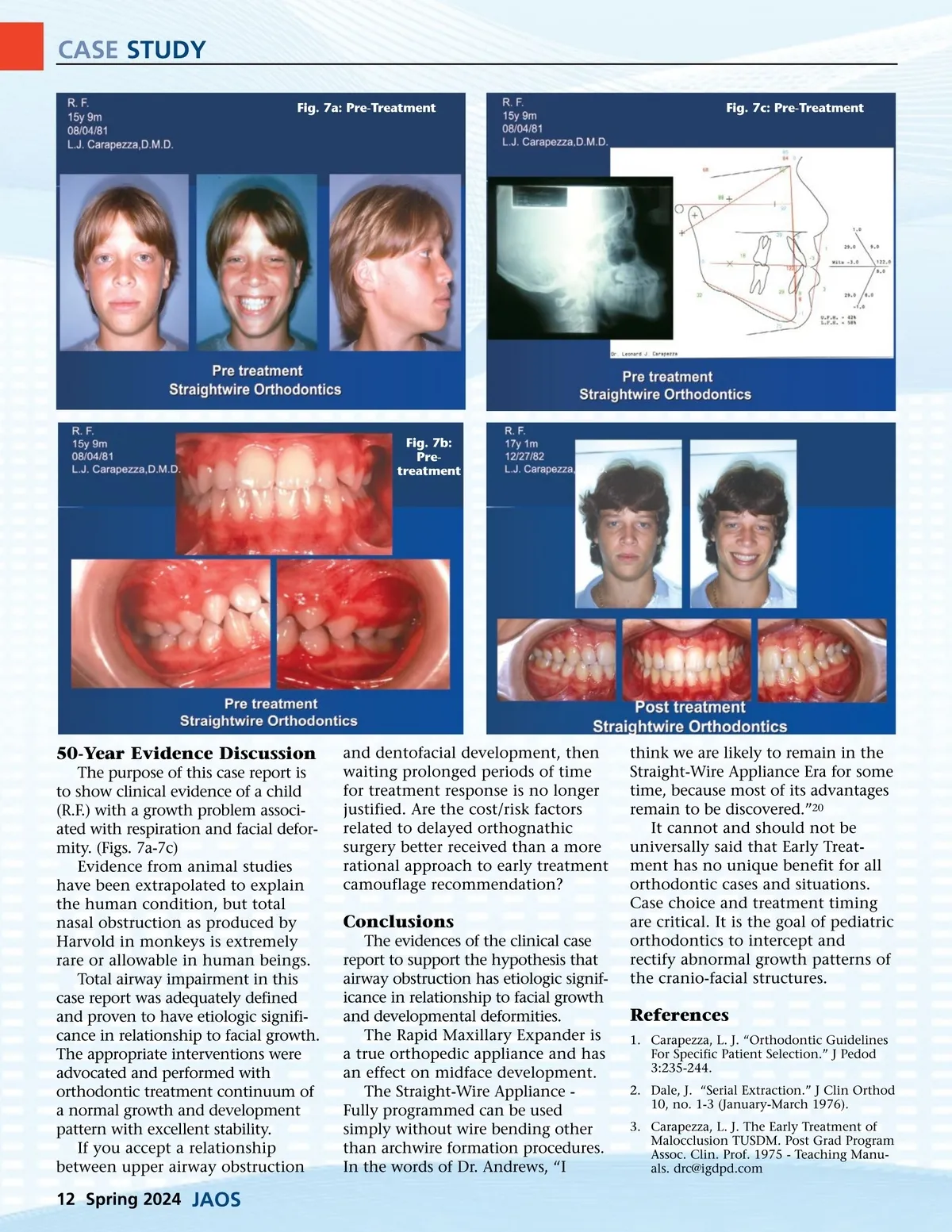
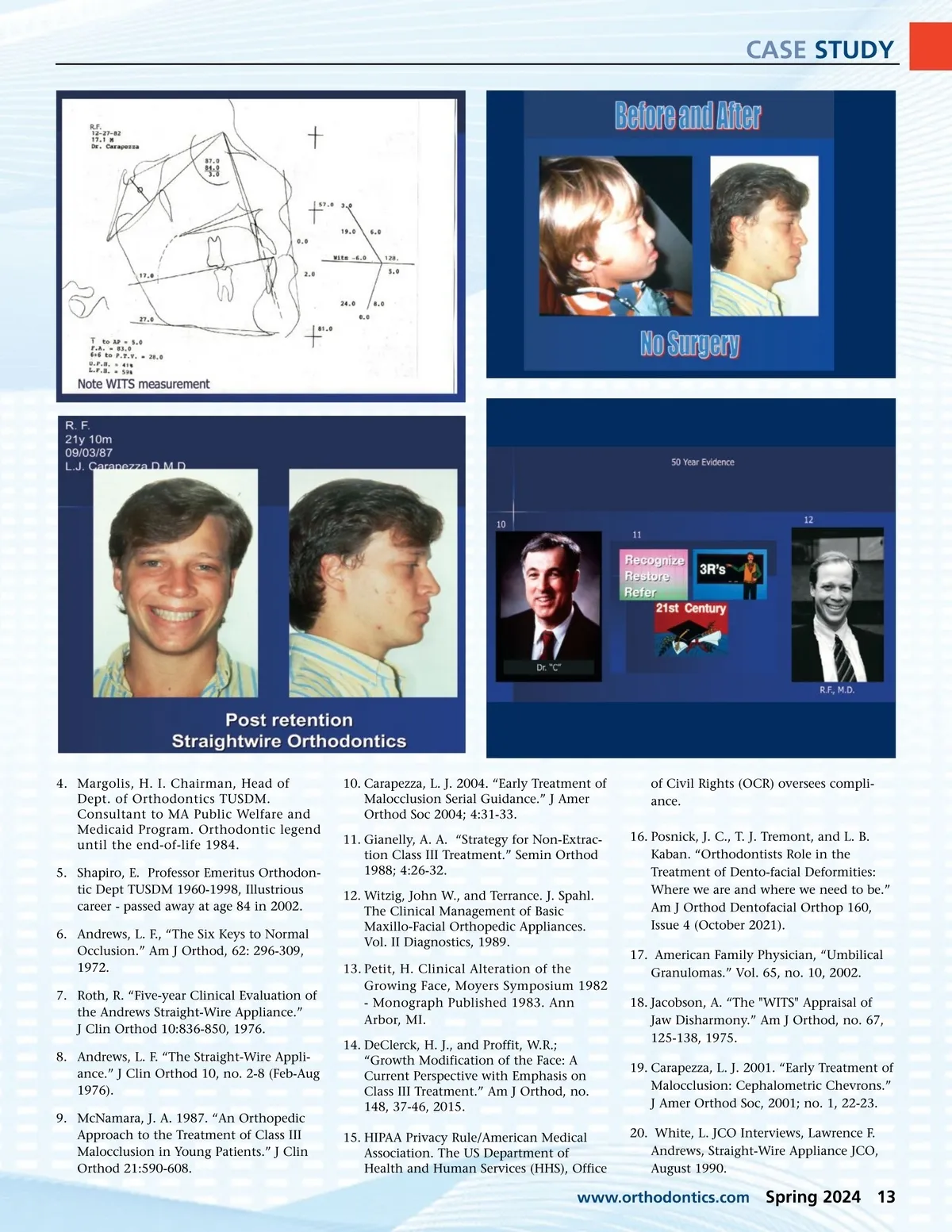
CASE STUDY Fig. 7a: Pre-Treatment Fig. 7c: Pre-Treatment Fig. 7b: Pre-treatment 50-Year Evidence Discussion The purpose of this case report is to show clinical evidence of a child (R.F.) with a growth problem associ-ated with respiration and facial defor-mity. (Figs. 7a-7c) Evidence from animal studies have been extrapolated to explain the human condition, but total nasal obstruction as produced by Harvold in monkeys is extremely rare or allowable in human beings. Total airway impairment in this case report was adequately defined and proven to have etiologic signifi-cance in relationship to facial growth. The appropriate interventions were advocated and performed with orthodontic treatment continuum of a normal growth and development pattern with excellent stability. If you accept a relationship between upper airway obstruction and dentofacial development, then waiting prolonged periods of time for treatment response is no longer justified. Are the cost/risk factors related to delayed orthognathic surgery better received than a more rational approach to early treatment camouflage recommendation? Conclusions The evidences of the clinical case report to support the hypothesis that airway obstruction has etiologic signif-icance in relationship to facial growth and developmental deformities. The Rapid Maxillary Expander is a true orthopedic appliance and has an effect on midface development. The Straight-Wire Appliance -Fully programmed can be used simply without wire bending other than archwire formation procedures. In the words of Dr. Andrews, “I think we are likely to remain in the Straight-Wire Appliance Era for some time, because most of its advantages remain to be discovered.” 20 It cannot and should not be universally said that Early Treat-ment has no unique benefit for all orthodontic cases and situations. Case choice and treatment timing are critical. It is the goal of pediatric orthodontics to intercept and rectify abnormal growth patterns of the cranio-facial structures. References 1. Carapezza, L. J. “Orthodontic Guidelines For Specific Patient Selection.” J Pedod 3:235-244. 2. Dale, J. “Serial Extraction.” J Clin Orthod 10, no. 1-3 (January-March 1976). 3. Carapezza, L. J. The Early Treatment of Malocclusion TUSDM. Post Grad Program Assoc. Clin. Prof. 1975 -Teaching Manu-als. drc@igdpd.com 12 Spring 2024 JAOS
Journal of the American Orthodontic Society Spring 2024: Page 12