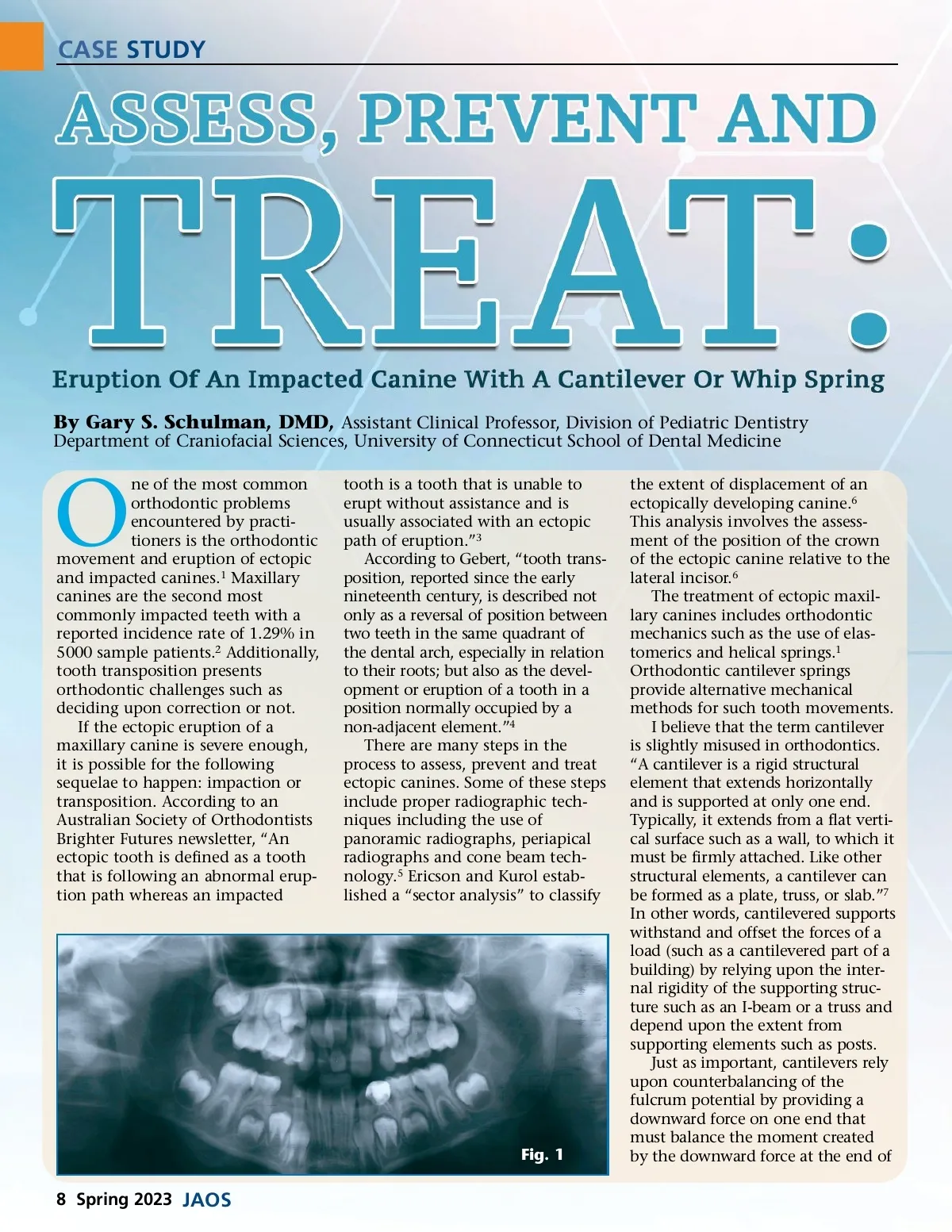
CASE STUDY By Gary S. Schulman, DMD, Assistant Clinical Professor, Division of Pediatric Dentistry Department of Craniofacial Sciences, University of Connecticut School of Dental Medicine O ne of the most common orthodontic problems encountered by practi-tioners is the orthodontic movement and eruption of ectopic and impacted canines. 1 Maxillary canines are the second most commonly impacted teeth with a reported incidence rate of 1.29% in 5000 sample patients. 2 Additionally, tooth transposition presents orthodontic challenges such as deciding upon correction or not. If the ectopic eruption of a maxillary canine is severe enough, it is possible for the following sequelae to happen: impaction or transposition. According to an Australian Society of Orthodontists Brighter Futures newsletter, “An ectopic tooth is defined as a tooth that is following an abnormal erup-tion path whereas an impacted tooth is a tooth that is unable to erupt without assistance and is usually associated with an ectopic path of eruption.” 3 According to Gebert, “tooth trans-position, reported since the early nineteenth century, is described not only as a reversal of position between two teeth in the same quadrant of the dental arch, especially in relation to their roots; but also as the devel-opment or eruption of a tooth in a position normally occupied by a non-adjacent element.” 4 There are many steps in the process to assess, prevent and treat ectopic canines. Some of these steps include proper radiographic tech-niques including the use of panoramic radiographs, periapical radiographs and cone beam tech-nology. 5 Ericson and Kurol estab-lished a “sector analysis” to classify Fig. 1 the extent of displacement of an ectopically developing canine. 6 This analysis involves the assess-ment of the position of the crown of the ectopic canine relative to the lateral incisor. 6 The treatment of ectopic maxil-lary canines includes orthodontic mechanics such as the use of elas-tomerics and helical springs. 1 Orthodontic cantilever springs provide alternative mechanical methods for such tooth movements. I believe that the term cantilever is slightly misused in orthodontics. “A cantilever is a rigid structural element that extends horizontally and is supported at only one end. Typically, it extends from a flat verti-cal surface such as a wall, to which it must be firmly attached. Like other structural elements, a cantilever can be formed as a plate, truss, or slab.” 7 In other words, cantilevered supports withstand and offset the forces of a load (such as a cantilevered part of a building) by relying upon the inter-nal rigidity of the supporting struc-ture such as an I-beam or a truss and depend upon the extent from supporting elements such as posts. Just as important, cantilevers rely upon counterbalancing of the fulcrum potential by providing a downward force on one end that must balance the moment created by the downward force at the end of 8 Spring 2023 JAOS
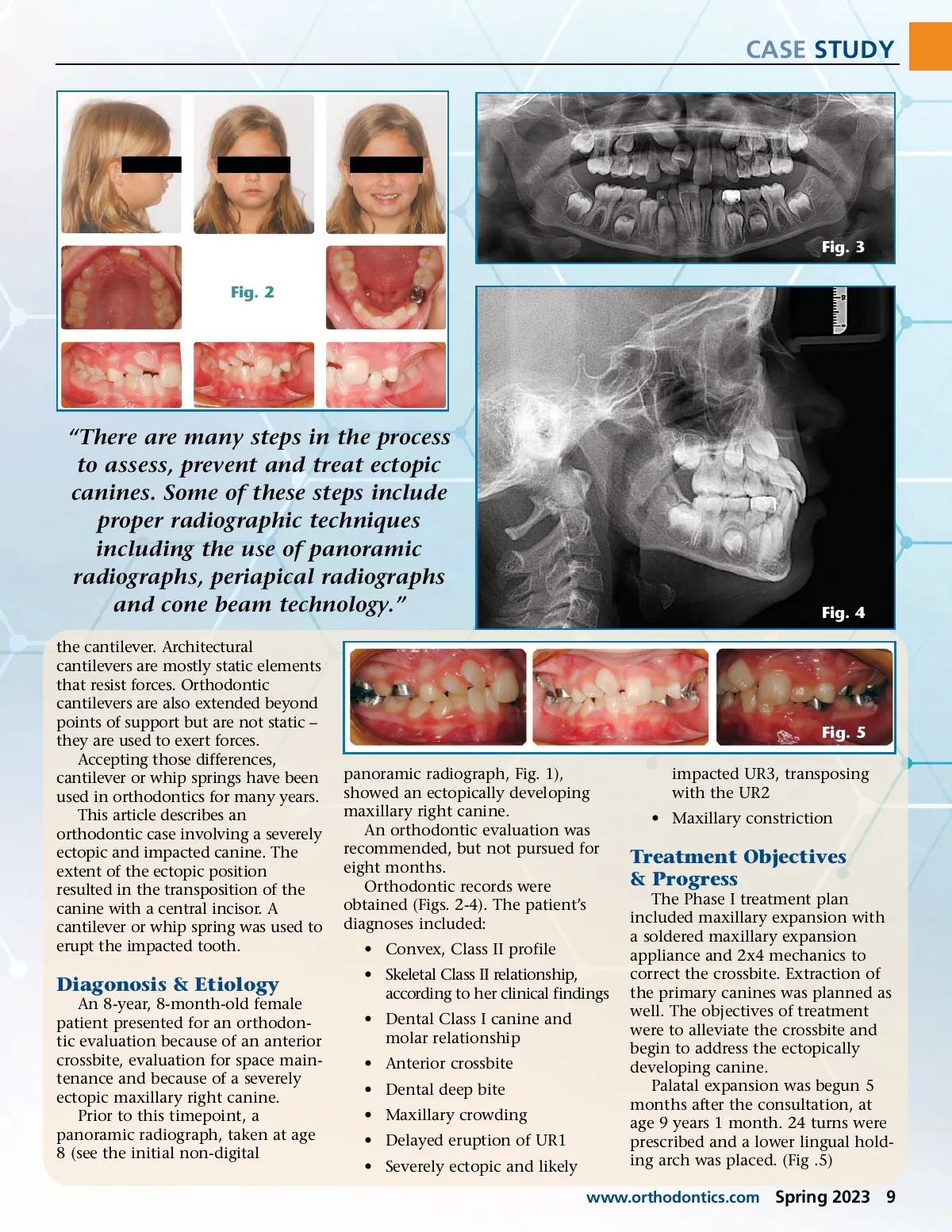
Journal of the American Orthodontic Society Spring 2023: Page 8