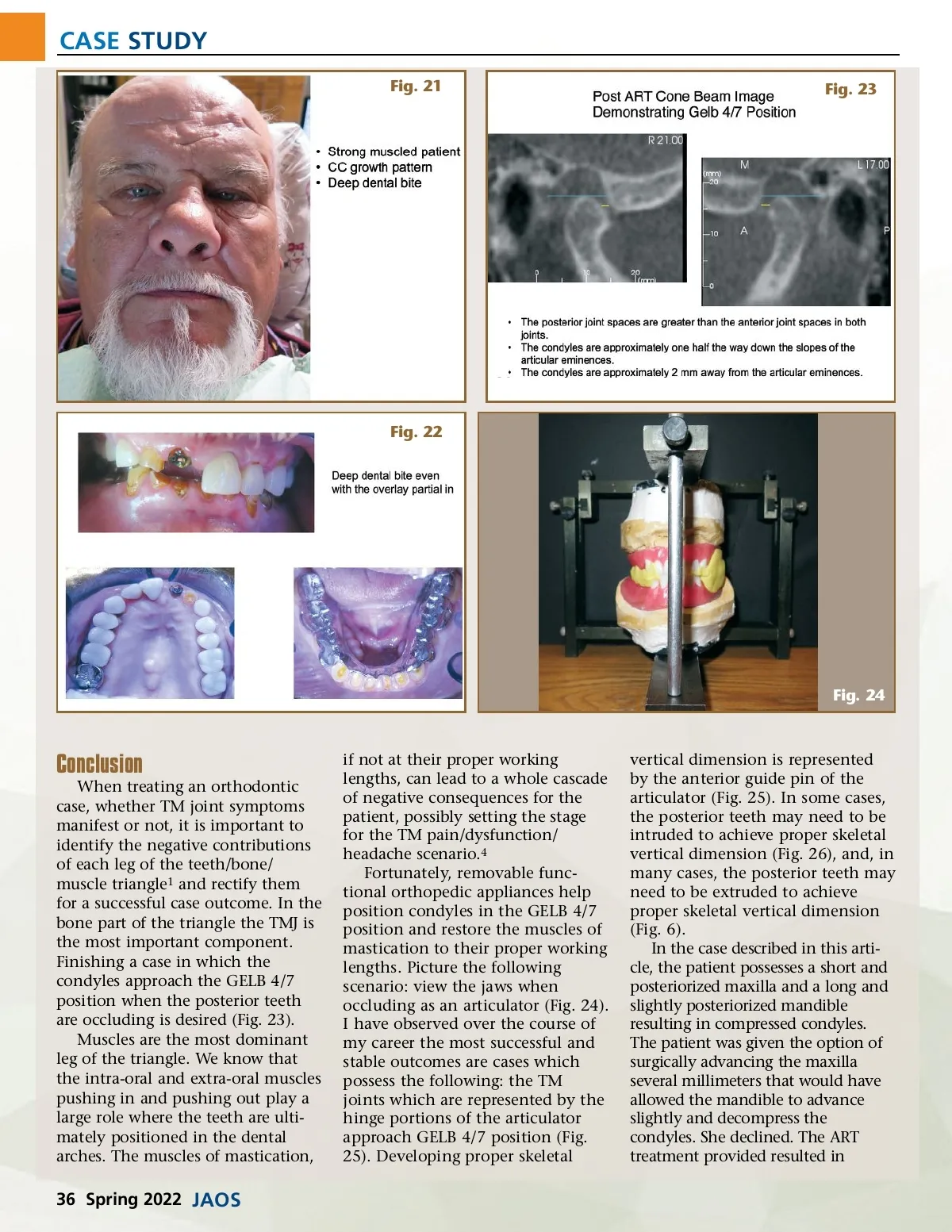
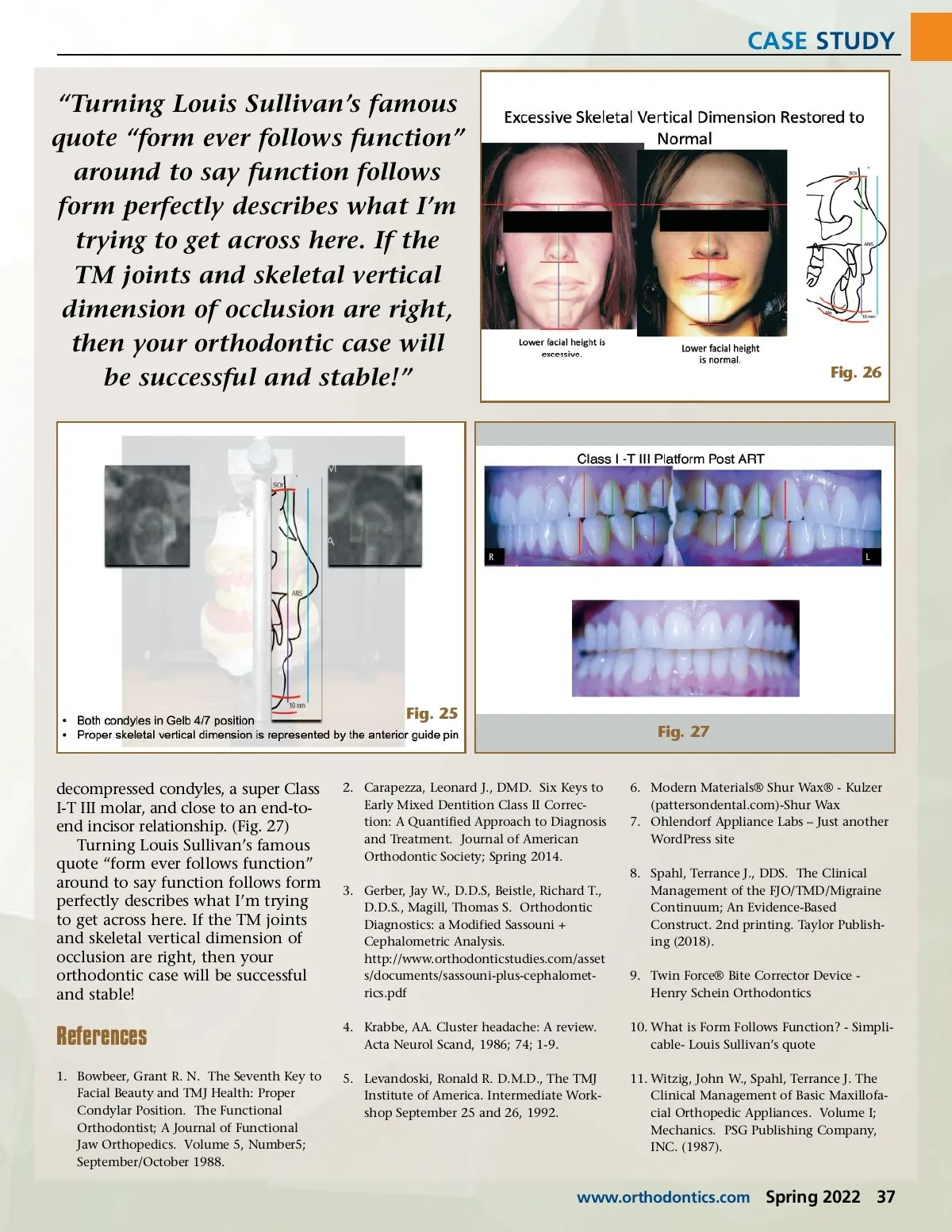
CASE STUDY Fig. 21 Fig. 23 Fig. 22 Fig. 24 Conclusion When treating an orthodontic case, whether TM joint symptoms manifest or not, it is important to identify the negative contributions of each leg of the teeth/bone/ muscle triangle 1 and rectify them for a successful case outcome. In the bone part of the triangle the TMJ is the most important component. Finishing a case in which the condyles approach the GELB 4/7 position when the posterior teeth are occluding is desired (Fig. 23). Muscles are the most dominant leg of the triangle. We know that the intra-oral and extra-oral muscles pushing in and pushing out play a large role where the teeth are ulti-mately positioned in the dental arches. The muscles of mastication, if not at their proper working lengths, can lead to a whole cascade of negative consequences for the patient, possibly setting the stage for the TM pain/dysfunction/ headache scenario. 4 Fortunately, removable func-tional orthopedic appliances help position condyles in the GELB 4/7 position and restore the muscles of mastication to their proper working lengths. Picture the following scenario: view the jaws when occluding as an articulator (Fig. 24). I have observed over the course of my career the most successful and stable outcomes are cases which possess the following: the TM joints which are represented by the hinge portions of the articulator approach GELB 4/7 position (Fig. 25). Developing proper skeletal vertical dimension is represented by the anterior guide pin of the articulator (Fig. 25). In some cases, the posterior teeth may need to be intruded to achieve proper skeletal vertical dimension (Fig. 26), and, in many cases, the posterior teeth may need to be extruded to achieve proper skeletal vertical dimension (Fig. 6). In the case described in this arti-cle, the patient possesses a short and posteriorized maxilla and a long and slightly posteriorized mandible resulting in compressed condyles. The patient was given the option of surgically advancing the maxilla several millimeters that would have allowed the mandible to advance slightly and decompress the condyles. She declined. The ART treatment provided resulted in 36 Spring 2022 JAOS
Journal of the American Orthodontic Society Spring 2022: Page 36