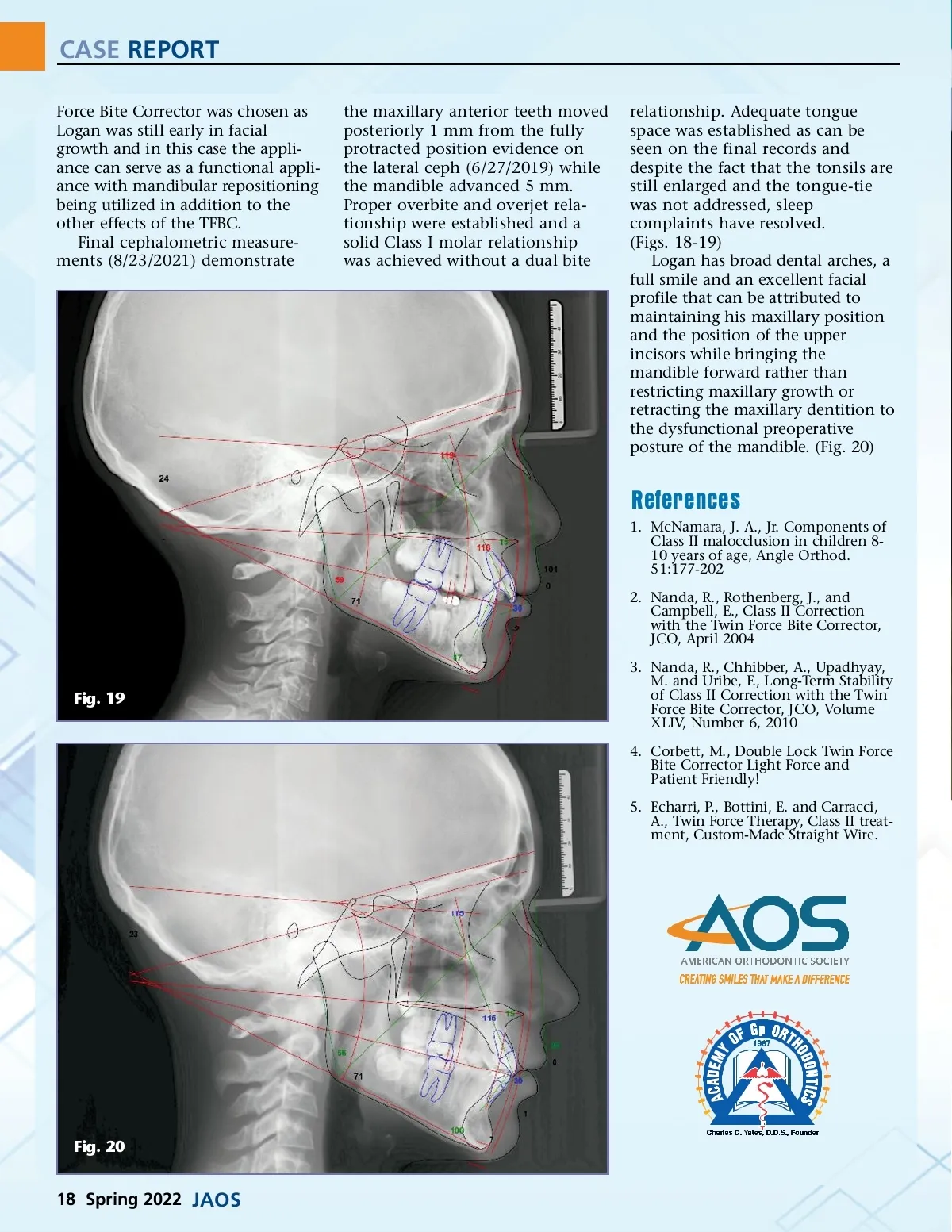
CASE REPORT Force Bite Corrector was chosen as Logan was still early in facial growth and in this case the appli-ance can serve as a functional appli-ance with mandibular repositioning being utilized in addition to the other effects of the TFBC. Final cephalometric measure-ments (8/23/2021) demonstrate the maxillary anterior teeth moved posteriorly 1 mm from the fully protracted position evidence on the lateral ceph (6/27/2019) while the mandible advanced 5 mm. Proper overbite and overjet rela-tionship were established and a solid Class I molar relationship was achieved without a dual bite relationship. Adequate tongue space was established as can be seen on the final records and despite the fact that the tonsils are still enlarged and the tongue-tie was not addressed, sleep complaints have resolved. (Figs. 18-19) Logan has broad dental arches, a full smile and an excellent facial profile that can be attributed to maintaining his maxillary position and the position of the upper incisors while bringing the mandible forward rather than restricting maxillary growth or retracting the maxillary dentition to the dysfunctional preoperative posture of the mandible. (Fig. 20) References 1. McNamara, J. A., Jr. Components of Class II malocclusion in children 8-10 years of age, Angle Orthod. 51:177-202 2. Nanda, R., Rothenberg, J., and Campbell, E., Class II Correction with the Twin Force Bite Corrector, JCO, April 2004 3. Nanda, R., Chhibber, A., Upadhyay, M. and Uribe, F., Long-Term Stability of Class II Correction with the Twin Force Bite Corrector, JCO, Volume XLIV, Number 6, 2010 4. Corbett, M., Double Lock Twin Force Bite Corrector Light Force and Patient Friendly! 5. Echarri, P., Bottini, E. and Carracci, A., Twin Force Therapy, Class II treat-ment, Custom-Made Straight Wire. Fig. 19 Fig. 20 18 Spring 2022 JAOS
Journal of the American Orthodontic Society Spring 2022: Page 18