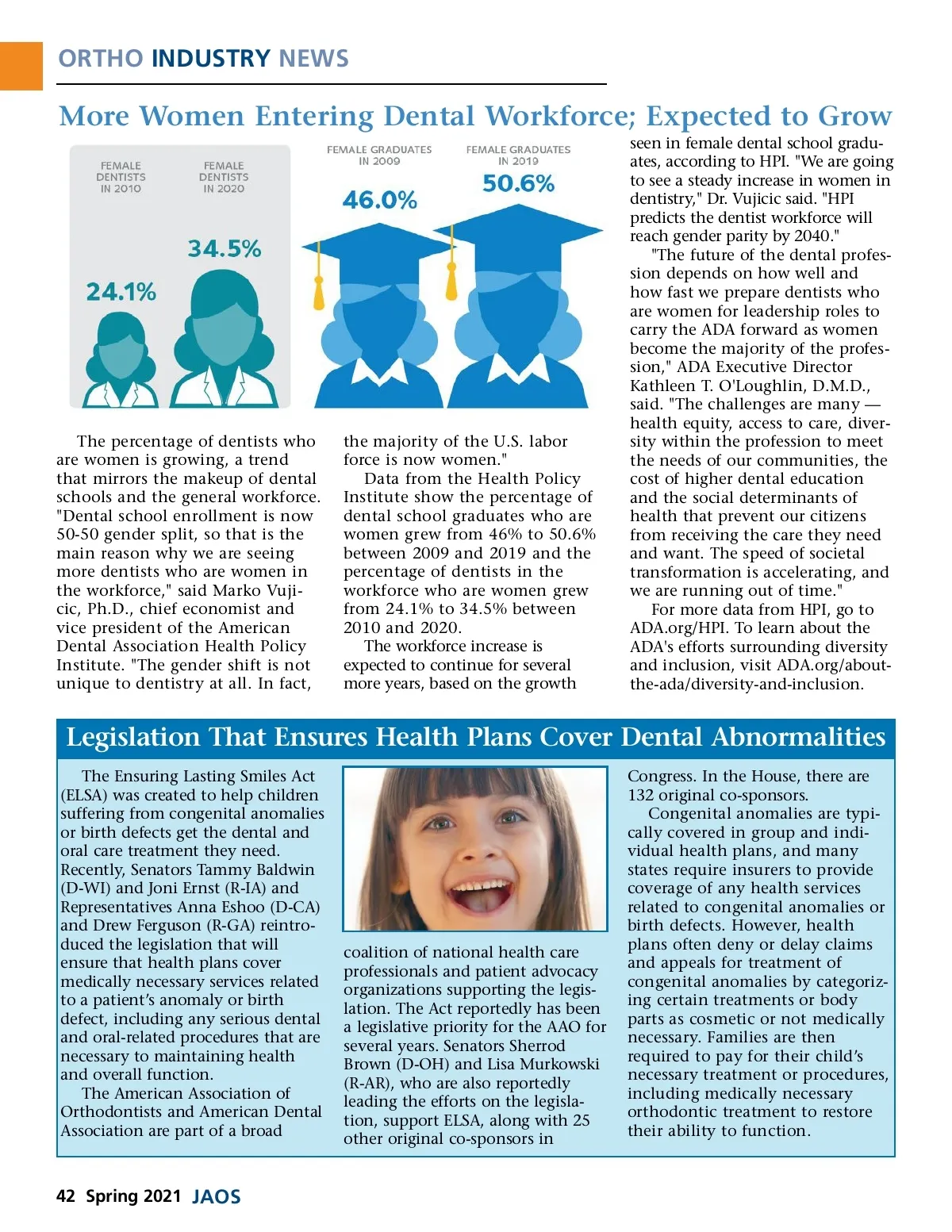
ORTHO INDUSTRY NEWS More Women Entering Dental Workforce; Expected to Grow seen in female dental school gradu-ates, according to HPI. "We are going to see a steady increase in women in dentistry," Dr. Vujicic said. "HPI predicts the dentist workforce will reach gender parity by 2040." "The future of the dental profes-sion depends on how well and how fast we prepare dentists who are women for leadership roles to carry the ADA forward as women become the majority of the profes-sion," ADA Executive Director Kathleen T. O'Loughlin, D.M.D., said. "The challenges are many — health equity, access to care, diver-sity within the profession to meet the needs of our communities, the cost of higher dental education and the social determinants of health that prevent our citizens from receiving the care they need and want. The speed of societal transformation is accelerating, and we are running out of time." For more data from HPI, go to ADA.org/HPI. To learn about the ADA's efforts surrounding diversity and inclusion, visit ADA.org/about-the-ada/diversity-and-inclusion. The percentage of dentists who are women is growing, a trend that mirrors the makeup of dental schools and the general workforce. "Dental school enrollment is now 50-50 gender split, so that is the main reason why we are seeing more dentists who are women in the workforce," said Marko Vuji-cic, Ph.D., chief economist and vice president of the American Dental Association Health Policy Institute. "The gender shift is not unique to dentistry at all. In fact, the majority of the U.S. labor force is now women." Data from the Health Policy Institute show the percentage of dental school graduates who are women grew from 46% to 50.6% between 2009 and 2019 and the percentage of dentists in the workforce who are women grew from 24.1% to 34.5% between 2010 and 2020. The workforce increase is expected to continue for several more years, based on the growth Legislation That Ensures Health Plans Cover Dental Abnormalities The Ensuring Lasting Smiles Act (ELSA) was created to help children suffering from congenital anomalies or birth defects get the dental and oral care treatment they need. Recently, Senators Tammy Baldwin (D-WI) and Joni Ernst (R-IA) and Representatives Anna Eshoo (D-CA) and Drew Ferguson (R-GA) reintro-duced the legislation that will ensure that health plans cover medically necessary services related to a patient’s anomaly or birth defect, including any serious dental and oral-related procedures that are necessary to maintaining health and overall function. The American Association of Orthodontists and American Dental Association are part of a broad Congress. In the House, there are 132 original co-sponsors. Congenital anomalies are typi-cally covered in group and indi-vidual health plans, and many states require insurers to provide coverage of any health services related to congenital anomalies or birth defects. However, health plans often deny or delay claims and appeals for treatment of congenital anomalies by categoriz-ing certain treatments or body parts as cosmetic or not medically necessary. Families are then required to pay for their child’s necessary treatment or procedures, including medically necessary orthodontic treatment to restore their ability to function. coalition of national health care professionals and patient advocacy organizations supporting the legis-lation. The Act reportedly has been a legislative priority for the AAO for several years. Senators Sherrod Brown (D-OH) and Lisa Murkowski (R-AR), who are also reportedly leading the efforts on the legisla-tion, support ELSA, along with 25 other original co-sponsors in 42 Spring 2021 JAOS
Journal of the American Orthodontic Society Spring 2021: Page 42