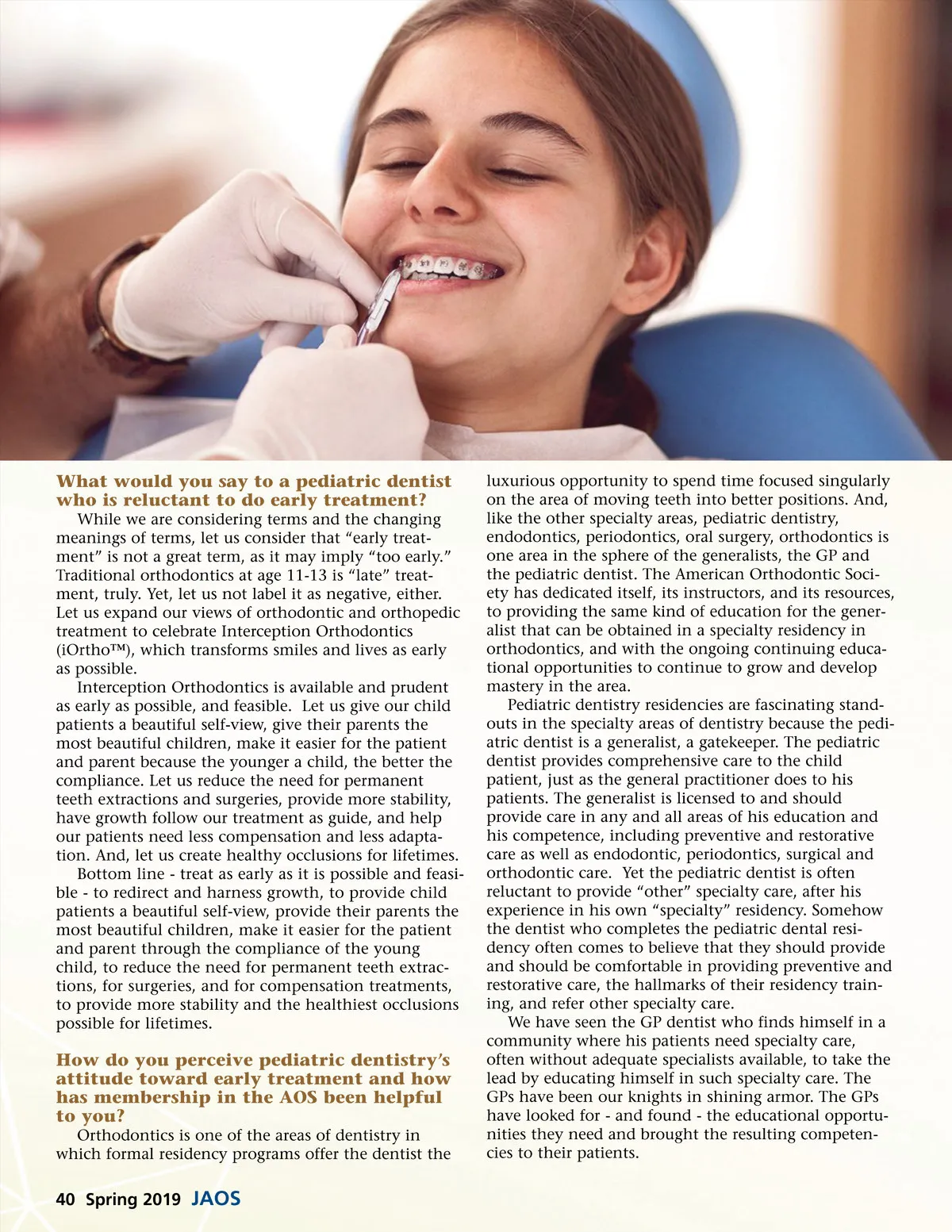
What would you say to a pediatric dentist who is reluctant to do early treatment? While we are considering terms and the changing meanings of terms, let us consider that “early treat-ment” is not a great term, as it may imply “too early.” Traditional orthodontics at age 11-13 is “late” treat-ment, truly. Yet, let us not label it as negative, either. Let us expand our views of orthodontic and orthopedic treatment to celebrate Interception Orthodontics (iOrtho™), which transforms smiles and lives as early as possible. Interception Orthodontics is available and prudent as early as possible, and feasible. Let us give our child patients a beautiful self-view, give their parents the most beautiful children, make it easier for the patient and parent because the younger a child, the better the compliance. Let us reduce the need for permanent teeth extractions and surgeries, provide more stability, have growth follow our treatment as guide, and help our patients need less compensation and less adapta-tion. And, let us create healthy occlusions for lifetimes. Bottom line -treat as early as it is possible and feasi-ble -to redirect and harness growth, to provide child patients a beautiful self-view, provide their parents the most beautiful children, make it easier for the patient and parent through the compliance of the young child, to reduce the need for permanent teeth extrac-tions, for surgeries, and for compensation treatments, to provide more stability and the healthiest occlusions possible for lifetimes. How do you perceive pediatric dentistry’s attitude toward early treatment and how has membership in the AOS been helpful to you? Orthodontics is one of the areas of dentistry in which formal residency programs offer the dentist the luxurious opportunity to spend time focused singularly on the area of moving teeth into better positions. And, like the other specialty areas, pediatric dentistry, endodontics, periodontics, oral surgery, orthodontics is one area in the sphere of the generalists, the GP and the pediatric dentist. The American Orthodontic Soci-ety has dedicated itself, its instructors, and its resources, to providing the same kind of education for the gener-alist that can be obtained in a specialty residency in orthodontics, and with the ongoing continuing educa-tional opportunities to continue to grow and develop mastery in the area. Pediatric dentistry residencies are fascinating stand-outs in the specialty areas of dentistry because the pedi-atric dentist is a generalist, a gatekeeper. The pediatric dentist provides comprehensive care to the child patient, just as the general practitioner does to his patients. The generalist is licensed to and should provide care in any and all areas of his education and his competence, including preventive and restorative care as well as endodontic, periodontics, surgical and orthodontic care. Yet the pediatric dentist is often reluctant to provide “other” specialty care, after his experience in his own “specialty” residency. Somehow the dentist who completes the pediatric dental resi-dency often comes to believe that they should provide and should be comfortable in providing preventive and restorative care, the hallmarks of their residency train-ing, and refer other specialty care. We have seen the GP dentist who finds himself in a community where his patients need specialty care, often without adequate specialists available, to take the lead by educating himself in such specialty care. The GPs have been our knights in shining armor. The GPs have looked for -and found -the educational opportu-nities they need and brought the resulting competen-cies to their patients. 40 Spring 2019 JAOS
Journal of the American Orthodontic Society Spring 2019: Page 40