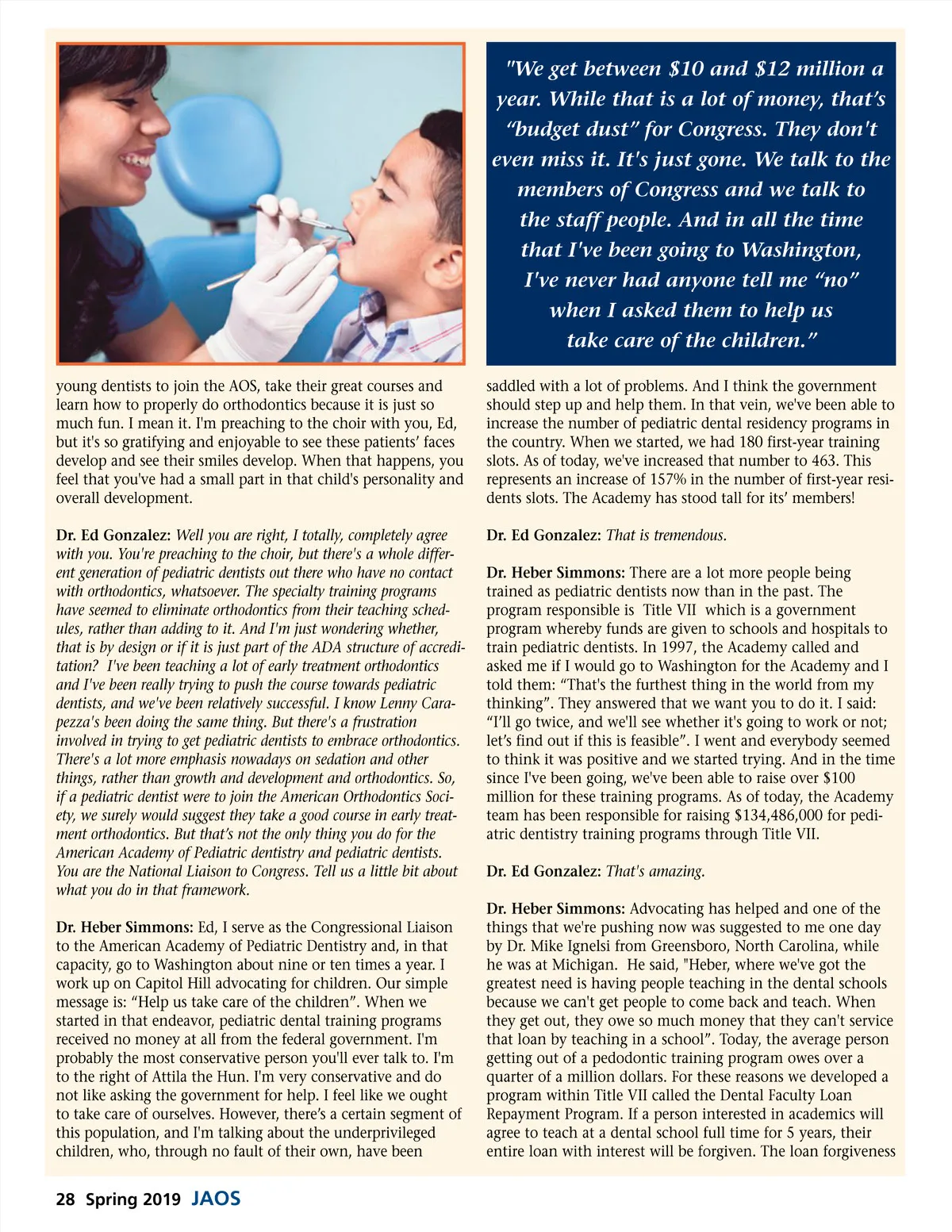
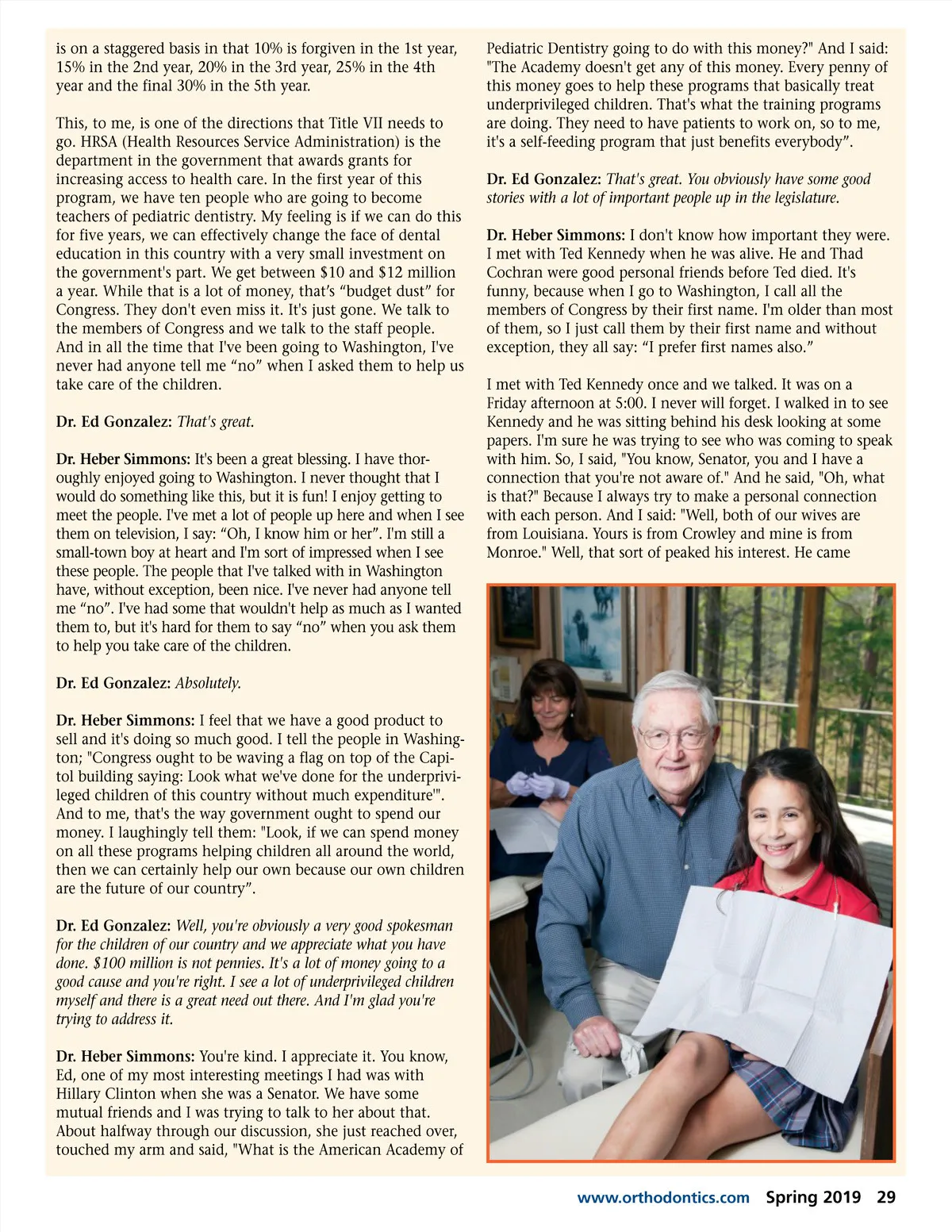
"We get between $10 and $12 million a year. While that is a lot of money, that’s “budget dust” for Congress. They don't even miss it. It's just gone. We talk to the members of Congress and we talk to the staff people. And in all the time that I've been going to Washington, I've never had anyone tell me “no” when I asked them to help us take care of the children.” young dentists to join the AOS, take their great courses and learn how to properly do orthodontics because it is just so much fun. I mean it. I'm preaching to the choir with you, Ed, but it's so gratifying and enjoyable to see these patients’ faces develop and see their smiles develop. When that happens, you feel that you've had a small part in that child's personality and overall development. Dr. Ed Gonzalez: Well you are right, I totally, completely agree with you. You're preaching to the choir, but there's a whole differ-ent generation of pediatric dentists out there who have no contact with orthodontics, whatsoever. The specialty training programs have seemed to eliminate orthodontics from their teaching sched-ules, rather than adding to it. And I'm just wondering whether, that is by design or if it is just part of the ADA structure of accredi-tation? I've been teaching a lot of early treatment orthodontics and I've been really trying to push the course towards pediatric dentists, and we've been relatively successful. I know Lenny Cara-pezza's been doing the same thing. But there's a frustration involved in trying to get pediatric dentists to embrace orthodontics. There's a lot more emphasis nowadays on sedation and other things, rather than growth and development and orthodontics. So, if a pediatric dentist were to join the American Orthodontics Soci-ety, we surely would suggest they take a good course in early treat-ment orthodontics. But that’s not the only thing you do for the American Academy of Pediatric dentistry and pediatric dentists. You are the National Liaison to Congress. Tell us a little bit about what you do in that framework. Dr. Heber Simmons: Ed, I serve as the Congressional Liaison to the American Academy of Pediatric Dentistry and, in that capacity, go to Washington about nine or ten times a year. I work up on Capitol Hill advocating for children. Our simple message is: “Help us take care of the children”. When we started in that endeavor, pediatric dental training programs received no money at all from the federal government. I'm probably the most conservative person you'll ever talk to. I'm to the right of Attila the Hun. I'm very conservative and do not like asking the government for help. I feel like we ought to take care of ourselves. However, there’s a certain segment of this population, and I'm talking about the underprivileged children, who, through no fault of their own, have been saddled with a lot of problems. And I think the government should step up and help them. In that vein, we've been able to increase the number of pediatric dental residency programs in the country. When we started, we had 180 first-year training slots. As of today, we've increased that number to 463. This represents an increase of 157% in the number of first-year resi-dents slots. The Academy has stood tall for its’ members! Dr. Ed Gonzalez: That is tremendous. Dr. Heber Simmons: There are a lot more people being trained as pediatric dentists now than in the past. The program responsible is Title VII which is a government program whereby funds are given to schools and hospitals to train pediatric dentists. In 1997, the Academy called and asked me if I would go to Washington for the Academy and I told them: “That's the furthest thing in the world from my thinking”. They answered that we want you to do it. I said: “I’ll go twice, and we'll see whether it's going to work or not; let’s find out if this is feasible”. I went and everybody seemed to think it was positive and we started trying. And in the time since I've been going, we've been able to raise over $100 million for these training programs. As of today, the Academy team has been responsible for raising $134,486,000 for pedi-atric dentistry training programs through Title VII. Dr. Ed Gonzalez: That's amazing. Dr. Heber Simmons: Advocating has helped and one of the things that we're pushing now was suggested to me one day by Dr. Mike Ignelsi from Greensboro, North Carolina, while he was at Michigan. He said, "Heber, where we've got the greatest need is having people teaching in the dental schools because we can't get people to come back and teach. When they get out, they owe so much money that they can't service that loan by teaching in a school”. Today, the average person getting out of a pedodontic training program owes over a quarter of a million dollars. For these reasons we developed a program within Title VII called the Dental Faculty Loan Repayment Program. If a person interested in academics will agree to teach at a dental school full time for 5 years, their entire loan with interest will be forgiven. The loan forgiveness 28 Spring 2019 JAOS
Journal of the American Orthodontic Society Spring 2019: Page 28