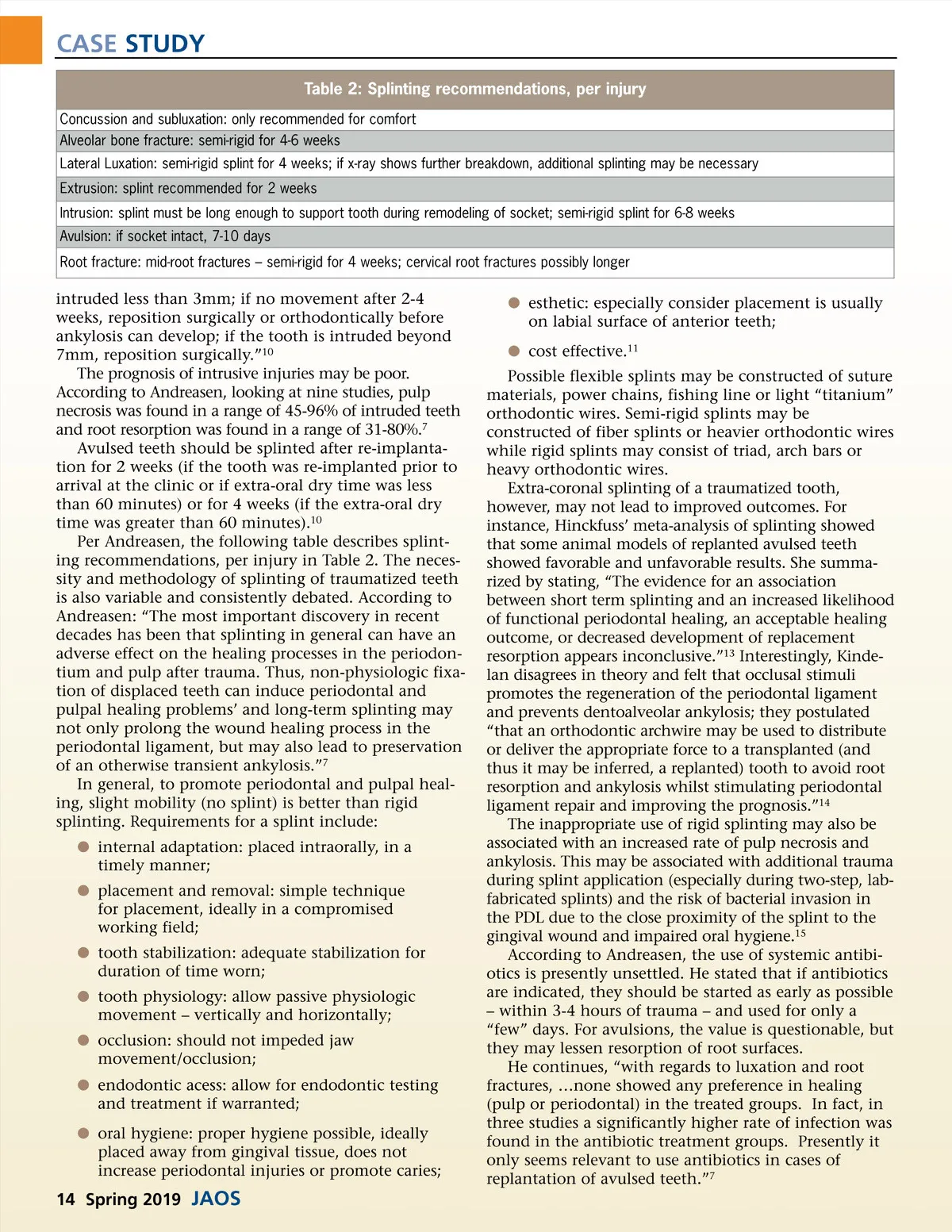
CASE STUDY Post Trauma Orthodontic Treatment The following outline, per Andreasen and Kindelan, summarizes their recommendations for observation periods to be followed after traumatic injuries and possible steps to take prior to orthodontic treatment: 7,14 Crown and crown-root fractures b Without pulpal involvement, “3 months is suffi-cient” prior to initiation b With pulpal involvement, “after partial pulpec-tomy, once hard tissue barrier established, often 3 months post treatment” b Wait until root development continues b If extrusion is indicated – relapse is likely and a fiberotomy may be beneficial Root fracture b 1-2 years b Do not treat teeth with fractures in middle or cervical third b After coronal pulpotomy and radiographic signs of establishment of a hard tissue barrier, wait approximately 3 months Minor damage to the periodontium (e.g. concussion and subluxation) b 3 months Moderate to severe injury to periodontium (e.g. lateral luxation (moderate/severe displacement), intrusion, avulsion and replantation) b Pulp obliteration may indicate repair of tooth b Avoid heavy forces b Orthodontic tooth movement is not recom-mended before complete periodontal healing has occurred (6 months) b If teeth are orthodontically moved between 6 and 12 months, ankylosis probable if tooth movement is not as expected b If resorption prior to ortho, may re-occur b In general, not clear – conflicting studies Immature traumatized teeth b Await radiographic evidence of continued root development b Clinical and radiographic controls should be carried out after 6 months, 1 year and 2 years Endodontically treated teeth b Due to caries – immediate orthodontic movement indicated provided no periapical pathology b Due to inflammatory resorption – await radio-graphic evidence of healing and allow at least 1 year to relapse before commencement of orthodontic treatment; more liable to further resorption during orthodontic movement b Due to trauma – in a mature closed apex tooth, following an initial dressing of calcium hydrox-ide, a definitive gutta-percha root filling should be placed; observation period depends on nature of original trauma b Conflicting data b Andreassen feels can move normally after treat-ment complete Root surface resorption b Surface – self limiting; treat normally b Inflammatory – infectious nature so must be treated endodontically; await radiographic heal-ing and at least one year; ortho forces will worsen Replacement resorption/ankylosis – fusion of tooth to bone; will not respond to orthodontic treatment It is widely accepted that certain treatment principles should also be followed for the orthodontic plan of trau-matized teeth. For example, light forces should be used and prolonged tipping may cause resorption. Pipette roots are also more likely to experience root resorption. Root resorption, secondary to trauma or orthodontic treatment, is a significant concern. Despite Kindelan’s impression that the evidence is inconclusive, 14 root resorp-tion during orthodontic treatment may be a greater concern during treatment of traumatized teeth. For instance, Andreasen compared three studies by Malmgren examining root resorption following orthodontic treatment. The first study determined that 52% of 55 traumatized teeth that had orthodontic treatment experienced minor, severe or extreme root resorption. The second and third studies showed that only 43% and 48%, respectively of non-traumatized incisors had some kind of resorption. 7 This demonstrates the increased risk of root resorption during the orthodontic treatment of traumatized teeth. Levander and Malmgren also determined that if there are signs of resorption early in a case, it is likely that resorption will be present at the end of treatment. They found that “if resorption is found after half a year of treatment with a fixed appliance, there is a high risk of extreme resorption at the end of treatment, minor resorption at that time indicates a moderate risk of severe resorption, irregular root contour indicates a limited risk of severe resorption at the end of treat-ment.” 16 Thus, regular radiographs are necessary to evaluate root resorption. They recommended a pause in treatment for those with resorption and found, “there was significantly less root resorption in patients treated with a pause than in those without.” 17 In cases of orthodontic extrusion of traumatized incisors, Bauss et al compared the pulpal vitality of trau-matized teeth to non-traumatized teeth after undergo-ing orthodontic forces. They found a significantly higher rate of pulp necrosis in the “orthodontics/ trauma” group and stated that, “the results of the present investigation indicated that orthodontic extru-sion of teeth with severe periodontal tissue injuries www.orthodontics.com Spring 2019 15
Journal of the American Orthodontic Society Spring 2019: Page 15